

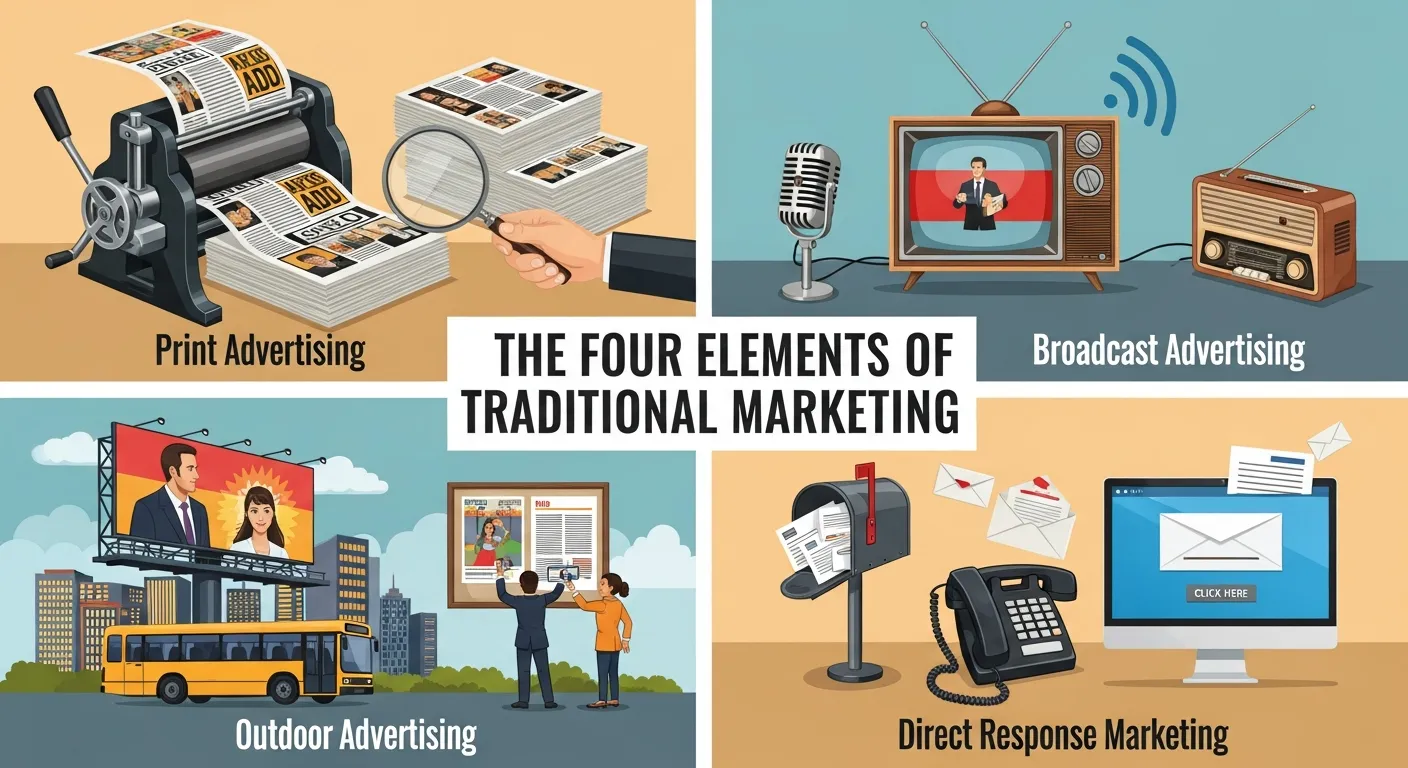
While digital channels dominate modern business strategies, understanding the foundational principles of traditional marketing remains essential. The four elements of traditional marketing provide a time-tested framework for building brands and reaching customers. This guide will explain these core components and show how they continue to create powerful, comprehensive campaigns that build awareness and drive sales.
This article offers a deep dive into the four elements of traditional marketing: print advertising, broadcast advertising, outdoor advertising, and direct response marketing. We will explore each element in detail, providing examples and strategies for implementation. You will learn how these classic methods work together, their advantages and challenges, and how they integrate into modern, holistic marketing plans to achieve business success.
What is Traditional Marketing?
Traditional marketing refers to any promotional strategy that uses conventional, non-digital channels to reach an audience. These methods predate the internet and rely on established media like print publications, broadcast television and radio, and physical displays. Unlike digital marketing, which facilitates two-way conversations and real-time data tracking, traditional marketing typically involves one-way communication aimed at a broad audience.
Its enduring power lies in its ability to build significant brand awareness and establish credibility. The four elements of traditional marketing are designed to interrupt daily life in a memorable way—a compelling TV commercial during a favorite show, a striking billboard on a daily commute, or a glossy magazine ad that catches the eye. This approach is highly effective for reaching consumers who are not actively searching for a product online, creating a broad foundation of brand recognition that can support other marketing efforts.
The Four Elements of Traditional Marketing: An In-depth Look
The traditional marketing mix is built upon four key pillars. Understanding how each of the four elements of traditional marketing functions is crucial for developing a well-rounded promotional strategy. These elements are not mutually exclusive; in fact, they are most powerful when used in concert.
- Print Advertising: Messages delivered through physical publications.
- Broadcast Advertising: Promotions aired on television and radio.
- Outdoor Advertising: Visual marketing in public spaces.
- Direct Response Marketing: Tactics designed to elicit an immediate action.
Let’s explore each of these components in greater detail.
Element 1: Print Advertising
Print advertising is one of the oldest and most respected of the four elements of traditional marketing. It involves placing promotional content in newspapers, magazines, brochures, flyers, and direct mail. The tangible nature of print creates a lasting impression and lends a sense of credibility to the advertised brand.
Newspapers
Newspaper advertising offers broad reach within a specific geographic area, making it ideal for local businesses. Ads placed in established newspapers benefit from the publication’s credibility and the trust it has built with its readership.
- Strengths: High local penetration, reader trust, and the ability to target specific cities or neighborhoods.
- Best For: Local retailers, event promotions (holiday promotions, seasonal sales), and announcements targeting an older demographic that still relies on daily papers.
Magazines
Magazines allow for highly targeted advertising based on reader interests, hobbies, or professions. A tech company can advertise in a trade journal, while a luxury fashion brand can showcase its products in a high-end lifestyle magazine. The high-quality paper and longer shelf life make magazines perfect for visually rich ads.
- Strengths: Niche audience targeting, high-quality visual presentation, and longer lifespan than newspapers.
- Best For: Luxury brand marketing, B2B digital marketing strategies (in trade publications), and brands targeting specific lifestyle segments.
Direct Mail
Direct mail delivers a personalized marketing message directly to a potential customer’s mailbox. This can take the form of postcards, letters, catalogs, or flyers. With sophisticated data, businesses can target households based on demographics, purchase history, and location. Despite the digital noise, a well-designed piece of direct mail can stand out. This is a classic component within the four elements of traditional marketing.
- Strengths: High level of targeting, personalization, tangible and memorable format, and measurable response rates.
- Best For: Local service providers, financial institutions, and e-commerce brands looking to supplement their digital efforts.
Brochures and Flyers
These materials are portable marketing tools that provide detailed information about a company, product, or event. They are effective at trade shows, in retail stores, or as leave-behinds during sales meetings.
- Strengths: Cost-effective, informative, and versatile for various distribution methods.
- Best For: Event marketing, trade shows, and providing detailed product information at the point of sale.
Print advertising, as one of the four elements of traditional marketing, offers a unique tactile experience that digital media cannot replicate.
Element 2: Broadcast Advertising
Broadcast advertising utilizes television and radio to reach a massive audience. This element of the marketing mix excels at storytelling and creating strong emotional connections through a combination of audio and visual stimuli. It remains a dominant force among the four elements of traditional marketing for building mass brand awareness.
Television Advertising
TV commercials remain one of the most powerful and persuasive advertising formats. They combine sight, sound, and motion to create compelling narratives that can demonstrate product benefits and evoke strong emotions. The reach of a television ad during a popular event like the Super Bowl is unparalleled.
- Strengths: Massive reach, high impact through visual storytelling, and the ability to build strong emotional connections.
- Best For: CPG brand marketing, automotive brands, and large-scale brand awareness campaigns.
- Strategy: Advertisers can target specific demographics by selecting programs and time slots that align with their audience’s viewing habits (e.g., morning talk shows for stay-at-home parents, primetime dramas for a broad adult audience).
Radio Advertising
Radio offers a cost-effective way to reach a large, local audience. Radio ads can be produced and updated quickly, making them ideal for promoting time-sensitive events or sales. The intimate nature of radio, often listened to alone in the car, can create a personal connection between the listener and the brand.
- Strengths: Cost-effective, high frequency, strong local reach, and quick production turnaround.
- Best For: Local businesses, event promoters, car dealerships, and promotions requiring a quick launch.
- Strategy: Repetition is key in radio advertising. The “theater of the mind” created by audio-only ads can be highly memorable if the creative is strong. A catchy jingle or a compelling voice can make a lasting impression. Sonic branding plays a huge role here.
Broadcast advertising is a cornerstone of the four elements of traditional marketing, offering unparalleled reach and brand-building potential.
Element 3: Outdoor Advertising
Also known as out-of-home (OOH) advertising, this element places promotional messages in public spaces. Outdoor ads capture attention during people’s daily routines, making them one of the most visible of the four elements of traditional marketing.
Billboards
Billboards are the most iconic form of outdoor advertising. Located along highways and in busy urban areas, their large format ensures high visibility.
- Traditional Billboards: Static images that deliver a simple, bold message.
- Digital Billboards: Allow for rotating ads, video content, and real-time updates, offering more flexibility than their static counterparts.
- Strengths: High frequency of exposure, massive reach, and geographic targeting. A great billboard design can become a local landmark.
Transit Advertising
This involves placing ads on and inside public transportation, such as buses, subways, taxis, and at airports. It targets commuters and travelers, who are often a captive audience with extended exposure time.
- Strengths: High reach in urban areas, long exposure times, and the ability to target a diverse, mobile audience.
Street Furniture
This integrates advertising into the urban landscape through bus shelters, benches, kiosks, and phone booths. It’s a subtle yet effective way to reach pedestrians in high-traffic areas.
- Strengths: Cost-effective, excellent for reaching pedestrians, and can be placed in close proximity to retail locations.
The primary advantage of outdoor advertising is that it cannot be skipped or turned off. It is an “always-on” medium that makes it a powerful and unavoidable part of the four elements of traditional marketing.
Element 4: Direct Response Marketing

The final of the four elements of traditional marketing is direct response. Unlike the other elements that primarily focus on brand awareness, direct response marketing is designed to trigger an immediate action from the consumer. Its success is measured by the number of responses (or leads) generated.
Direct Mail Campaigns
As mentioned under print, direct mail is also a key direct response tool. A campaign with a clear call-to-action (CTA), such as “Call now for a free quote” or “Mail this card back for 20% off,” is a classic direct response tactic.
Telemarketing
This involves contacting potential customers directly via telephone. While it has challenges related to public perception, professional and ethical telemarketing can be effective for complex B2B products or high-value consumer services that benefit from a personal conversation.
Print Ads with Response Mechanisms
A magazine or newspaper ad that includes a coupon, a QR code, a dedicated phone number, or a mail-in form is a form of direct response advertising. It bridges the gap between brand building and lead generation by giving the reader a clear next step.
Event Marketing
Hosting or participating in trade shows, conferences, and promotional events allows for face-to-face interaction. This is a powerful direct response channel, as you can demonstrate products, build relationships, and even make sales on the spot. Creative webinar ideas can be seen as a digital evolution of this concept.
Direct response is the most performance-oriented of the four elements of traditional marketing, focusing on measurable actions and ROI.
How the Four Elements of Traditional Marketing Work Together
The true power of the four elements of traditional marketing is realized when they are integrated into a cohesive strategy. They create a synergistic effect where the whole is greater than the sum of its parts.
|
Element |
Role in an Integrated Campaign |
Example |
|---|---|---|
|
Outdoor & Broadcast |
Builds Broad Awareness: Creates initial recognition and familiarity with the brand on a mass scale. |
A new beverage company runs TV commercials during primetime and places billboards on major highways. |
|
Print (Magazines) |
Targets and Educates: Reaches a niche audience with detailed information and visually appealing content, building desire. |
The beverage company places a full-page ad in a health and wellness magazine, highlighting its natural ingredients. |
|
Print (Newspapers/Flyers) |
Drives Local Action: Informs local consumers about availability and specific promotions. |
The company runs ads in local newspapers announcing that the beverage is now available at the local New Seasons Market. |
|
Direct Response |
Prompts Immediate Purchase: A targeted action designed to convert awareness and interest into a sale. |
A direct mail piece is sent to homes in the area with a coupon for “Buy One, Get One Free” at their local store. |
This integrated marketing approach ensures that consumers encounter the brand message at multiple touchpoints, each reinforcing the others. This consistency across the four elements of traditional marketing builds credibility and moves the consumer through the customer journey mapping process, from awareness to purchase.
Advantages and Challenges of Traditional Marketing
While powerful, the four elements of traditional marketing come with their own set of pros and cons.
Advantages
- High Impact and Trust: Traditional channels like television and print are often perceived as more credible than online ads.
- Broad Reach: These methods are unmatched for reaching a large, general audience quickly.
- Tangibility: A printed ad or a direct mail piece provides a physical object that a consumer can keep, which enhances memory and brand recall.
- Less Cluttered Environment: While the world is saturated with ads, a prime-time TV spot or a full-page magazine ad can feel less cluttered than a typical social media feed.
Challenges
- High Cost: Production and media buying for TV, print, and billboards can be very expensive.
- Difficult to Measure ROI: Unlike digital marketing, where every click can be tracked, measuring the direct impact of a billboard or a radio ad on sales can be difficult.
- Lack of Interaction: Most traditional marketing is a one-way street, with no easy way for consumers to engage with the brand directly.
- Long Lead Times: Campaigns often require weeks or months of planning, making it difficult to be nimble or react to market changes quickly.
Integrating the Four Elements of Traditional Marketing with Digital Strategies
The most successful modern campaigns do not choose between traditional and digital; they blend them. The four elements of traditional marketing can be powerfully enhanced with digital components.
- QR Codes in Print: Add a QR code to a magazine ad or flyer that links directly to a product page, a video tutorial, or a special landing page.
- Hashtags in Broadcast: Include a unique seasonal hashtag in a TV or radio ad to encourage social media conversation and user-generated content.
- Geofencing around Billboards: Use digital mobile ads to target people in the immediate vicinity of your outdoor advertisements, reinforcing the message.
- Driving to Web from Direct Mail: Use a direct mail piece to offer an exclusive online discount code, driving traffic to your website and allowing for precise tracking.
By combining the broad reach of the four elements of traditional marketing with the precise targeting and measurement of digital, marketers can create a truly comprehensive and effective brand marketing strategy.
Conclusion
The four elements of traditional marketing—print, broadcast, outdoor, and direct response—remain powerful tools for building brands and driving growth. While digital marketing offers unparalleled data and interactivity, the classic methods provide a foundation of reach, credibility, and real-world impact that is hard to replicate. The most successful businesses understand that the key is not to choose one over the other but to strategically integrate both to create a seamless customer experience across all touchpoints.
Frequently Asked Questions (FAQs)
1. Are the four elements of traditional marketing still relevant today?
Yes, they are highly relevant. While digital marketing is essential, traditional channels offer broad reach, high impact, and a level of credibility that can be very effective, especially when integrated with digital strategies. They are crucial for building mass brand awareness.
2. Which of the four elements of traditional marketing is the most expensive?
Generally, television advertising is the most expensive due to high production costs and the cost of buying airtime during popular shows. Large-scale billboard campaigns can also be very costly.
3. How can a small business use the four elements of traditional marketing?
A small business can focus on more affordable, local options. This includes advertising in local newspapers, running ads on local radio stations, using direct mail to target specific neighborhoods, and placing flyers in community centers.
4. What is the best way to measure the ROI of a traditional marketing campaign?
While challenging, you can use methods like creating unique phone numbers or website URLs for each campaign, using specific coupon codes, or simply asking customers “How did you hear about us?”. Tracking spikes in website traffic or sales during the campaign period can also provide insight.
5. How do the four Ps of marketing relate to the four elements of traditional marketing?
The four Ps (Product, Price, Place, Promotion) are a strategic framework for the entire marketing mix. The four elements of traditional marketing fall under the “Promotion” P. They are the tactical channels used to communicate the product, price, and place to the target audience.
6. Can B2B companies use traditional marketing effectively?
Yes. B2B companies can leverage traditional marketing by advertising in industry-specific trade magazines (print), sponsoring segments on business-focused radio shows (broadcast), placing billboards near industrial parks (outdoor), and using highly targeted direct mail (direct response).
7. Is influencer marketing a form of traditional or digital marketing?
Influencer marketing is a form of digital marketing. While it shares the principle of using a trusted voice (like a celebrity endorsement in traditional marketing), it operates on digital platforms like social media and blogs.
8. What is the biggest mistake companies make with traditional marketing?
The biggest mistake is failing to integrate it with their digital efforts. Running a traditional campaign in a silo misses huge opportunities for engagement and tracking. For example, a print ad without a digital call-to-action (like a website or QR code) is a missed opportunity.
9. How has technology changed the four elements of traditional marketing?
Technology has evolved them. Digital billboards allow for dynamic content. Addressable TV advertising allows for more targeted commercials. Programmatic direct mail uses digital data to trigger physical mailings. Technology is blurring the lines between traditional and digital.
10. Which of the four elements is best for building brand trust?
Print and television advertising are often considered the best for building trust. Appearing in a reputable magazine or running a high-quality TV commercial signals that a brand is established and credible. This is a key aspect of reputation management.







Leave a Reply