


Social media has transformed communication, creating a landscape where trends ignite and vanish in moments. This guide breaks down the science behind social media viral trends.
Discover what makes content go viral, from the psychology of sharing to platform algorithms. We’ll explore the lifecycle of social media viral trends, common formats, and provide a strategic framework for brands to harness their power for brand awareness and marketing success. This deep dive will unpack the mechanisms behind these powerful cultural phenomena.
What Are Social Media Viral Trends?
Social media viral trends are pieces of content—or distinct patterns of content—that achieve rapid and widespread circulation across multiple online platforms, reaching an audience far beyond their point of origin. Sparked by a single post, a viral phenomenon is defined not just by its reach, but by its velocity and user participation. It’s a digital wildfire, spreading from person to person through shares, remixes, and reactions. Understanding these powerful cultural moments is more than just a matter of curiosity; it’s a critical component of modern digital literacy and marketing acumen.
Understanding these trends is fundamental for anyone involved in brand marketing. They represent a powerful convergence of culture, technology, and psychology. What begins as a simple video or meme can evolve into a global conversation, influencing everything from consumer behavior and brand perception in marketing to language and social norms. The study of social media viral trends is essentially the study of modern digital culture in motion. These trends serve as a real-time barometer of public sentiment, humor, and interest, making them an invaluable source of insight. For a business, grasping the dynamics of social media viral trends can mean the difference between blending in and standing out spectacularly.
Key Characteristics of Viral Content
Not all popular content becomes a viral trend. True social media viral trends possess a specific set of characteristics that facilitate their explosive growth. Identifying these traits is the first step toward understanding and potentially creating viral content.
- Massive Shareability: The content is inherently easy and desirable to share. It strikes a chord that makes users want to pass it along to their network, acting as a catalyst for its spread. The content simplifies the act of sharing, making it a natural, almost reflexive action for the user.
- High Emotional Resonance: Viral content almost always evokes a strong emotional response. Whether it’s humor, awe, surprise, joy, or even anger, this emotional charge is a primary driver of engagement and sharing. Emotional marketing principles are at the core of virality. These strong feelings compel action, turning passive viewers into active participants in the trend’s journey.
- Effortless Replicability: The trend is simple for others to copy, remix, or participate in. This low barrier to entry is crucial for user-generated content (UGC) campaigns, challenges, and memes, allowing the trend to scale exponentially. The easier it is to join in, the more fuel the fire of social media viral trends has.
- Platform Optimization: The content is natively designed for the formats and features of platforms like TikTok, Instagram Reels, or X. It leverages short-form video, trending audio, or interactive elements to maximize visibility. Content that works with the platform’s native tools is rewarded by the algorithm.
- Cultural Relevance: The trend taps into current events, shared experiences, or ongoing cultural conversations. Its timeliness makes it feel immediate and important, compelling users to engage to feel part of a moment. This connection to the “now” is a defining feature of many social media viral trends.
Common Forms of Social Media Viral Trends
Social media viral trends manifest in a variety of formats, each with its own mechanics for spreading across the digital landscape. Recognizing these formats helps in strategizing how to engage with them.
- Memes: Image, video, or text-based jokes that are remixed and re-contextualized. They are a cornerstone of internet humor and a powerful vehicle for cultural commentary. The adaptability of memes makes them a persistent form of social media viral trends.
- Viral Videos: Short, engaging video clips that capture attention quickly. These can range from dance challenges and comedy skits to heartwarming moments and shocking events. Video SEO and platform-specific optimization are key to their success.
- Hashtag Challenges: User-driven campaigns centered around a specific hashtag, inviting people to create and share content related to a prompt. This format is a staple of consumer brand marketing campaigns and a classic example of participatory social media viral trends.
- Dance Trends: Choreographed routines that spread as users learn and perform them. These are especially prevalent on video-first platforms like TikTok and are a highly visible category of social media viral trends.
- Audio Clips and Sound Bites: Catchy song snippets, dialogue from movies, or original soundbites become the soundtrack for thousands of user-created videos. Sonic branding can even emerge from these trends.
- Viral News Stories: Breaking news that is emotionally charged or controversial can spread rapidly as users share opinions and commentary. This often fuels intense, though short-lived, social media viral trends.
- UGC Formats: Templates or prompts that encourage users to share their own experiences, such as “Tell me without telling me…” or “Put a finger down if…”. These formats are designed for mass participation.
- Filters and AR Effects: Interactive augmented reality filters that alter a user’s appearance or surroundings can become trends in their own right, generating millions of posts.
A trend can originate anywhere, from a TikTok video to a Reddit comment. The critical factor is its ability to resonate deeply enough to trigger a chain reaction of sharing and participation. Once this cycle begins, algorithms amplify its reach, and the content evolves into one of the many social media viral trends that define the digital ecosystem. The journey from a single post to a global phenomenon is a fascinating study in modern communication and culture.
The Psychology and Science Behind Virality: What Makes a Trend?
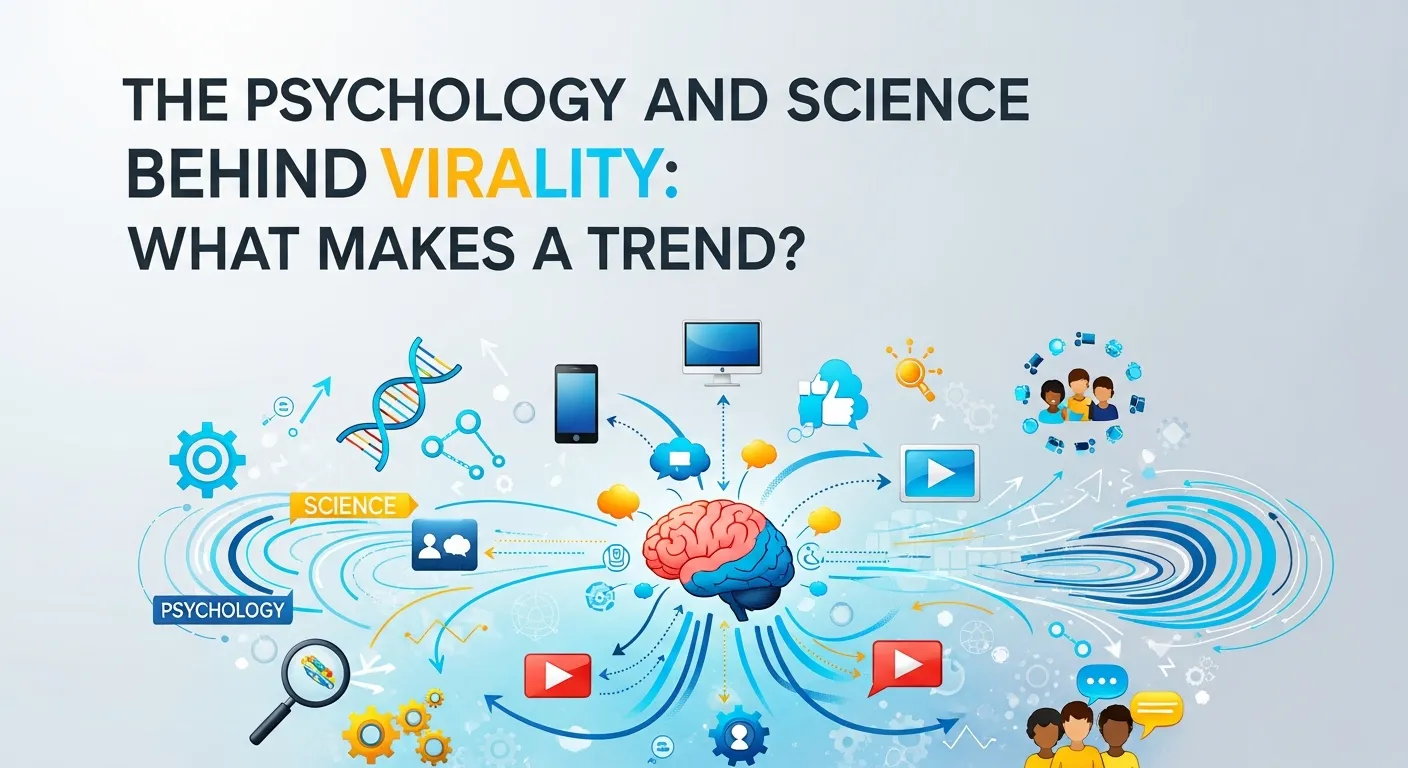
Understanding what makes social media viral trends explode begins with human psychology. While platform algorithms play a significant role in amplifying content, they are ultimately responding to human behavior. Virality is not a random accident; it’s the result of content successfully tapping into fundamental psychological triggers that compel people to engage and share. The psychology behind viral content is a complex interplay of emotion, social validation, and cognitive ease.
Emotion as the Engine of Sharing
Content that evokes strong, high-arousal emotions is far more likely to be shared. Research has consistently shown that feelings like awe, humor, amusement, joy, and even anger are powerful motivators for sharing. Low-arousal emotions like sadness are less likely to drive shares. This principle is the cornerstone of the psychology of trend marketing.
- Awe and Wonder: Content that is breathtaking, inspiring, or mind-blowing makes people feel part of something larger than themselves. Sharing it is a way to share that feeling. This is why videos of natural wonders or incredible human feats often become social media viral trends.
- Humor and Amusement: Laughter is a social bonding experience. When something makes us laugh, our natural instinct is to share it with others to spread the joy. This is why memes and funny videos are such a dominant part of the landscape of social media viral trends.
- Anger and Anxiety: While negative, these high-arousal emotions also drive sharing. People share content that outrages them to validate their feelings, warn others, or rally support for a cause. This is often seen in the spread of viral news and is a key component of the dark side of viral marketing.
- Joy and Empathy: Heartwarming stories of kindness, success, or connection create positive feelings that people want to pass on. These stories satisfy our need for positive social interaction.
The principle is simple: the stronger the emotional peak, the higher the likelihood of a share. This is a core concept in emotional marketing, and it is the bedrock of viral content. Brands that can master this emotional connection in their brand storytelling are more likely to create their own social media viral trends.
The Power of Social Currency
People are inherently driven to manage how others perceive them. Sharing content is a form of self-presentation. According to a landmark study by Jonah Berger, author of Contagious, social currency is one of the key reasons people share. We share things that make us look good. This concept is fundamental to any personal brand strategy.
- Appearing “In the Know”: Sharing timely social media viral trends signals that you are current, culturally aware, and connected. It’s a way of demonstrating cultural fluency and avoiding the marketing FOMO (Fear of Missing Out).
- Looking Smart or Funny: Sharing insightful articles, witty memes, or clever commentary enhances one’s perceived intelligence or humor. It’s a way to project a desired personality trait.
- Expressing Identity: The content we share becomes an extension of our personal brand strategy. It communicates our values, interests, and affiliations to our social network, helping to shape our digital reputation management.
Brands can leverage this by creating content that provides users with social currency. Exclusive information, inside jokes, or content that makes users feel smart for sharing can all contribute to virality. A successful brand marketing strategy will often incorporate this principle to encourage organic sharing.
Simplicity and Replicability
For a trend to become truly participatory, it must be easy to replicate. The lower the barrier to entry, the more people can join in, creating a snowball effect. This is the logic behind many of the most successful social media viral trends.
- Dance Challenges: Simple, repetitive choreography allows users of all skill levels to participate. The easier the dance, the wider the potential participation pool.
- Meme Templates: A fixed format with a customizable punchline makes it easy for anyone to create their own version. This turns consumers into creators.
- Duets and Stitches on TikTok: These platform features are designed for easy replication and reaction, fueling countless social media viral trends. They are built for participation.
The easier it is for a user to put their own spin on a trend, the more likely it is to achieve massive scale. This principle is vital for any brand marketing campaign aiming for user-generated content. Simplicity is a key element in how to make your product go viral.
Community, Connection, and Belonging
Humans have a fundamental need to belong. Social media viral trends often create a temporary, large-scale sense of community. Participating in a challenge, using a specific hashtag, or joining a conversation makes users feel like they are part of something bigger.
This taps into the “social proof” phenomenon: when we see many others doing something, we are more inclined to do it ourselves. This is why trends accelerate so quickly once they reach a certain threshold of visibility. Brands that can foster a sense of community around their content—through challenges or shared experiences—are well-positioned for viral success. Building brand authority is often about creating a community that trusts and engages with you.
The Role of Timing and Cultural Relevance (Zeitgeist)
Content doesn’t exist in a vacuum. Its potential for virality is heavily influenced by the cultural context in which it appears. A post that aligns with a current event, a popular movie, a seasonal holiday, or a widely felt societal mood has a much greater chance of taking off. This is the essence of real-time trend marketing.
This is why “newsjacking”—the practice of leveraging breaking news for marketing—can be so effective, though it requires a deft touch and careful brand safety in digital marketing considerations. A misstep can quickly lead to a brand crisis management situation. Aligning with the zeitgeist is a powerful way to make your content feel urgent and necessary, which is a key driver of social media viral trends.
Triggers and Mental Availability
Viral ideas often have “triggers”—cues in the everyday environment that make people think of them. Berger’s research points to the “Friday” song by Rebecca Black as an example; the song’s popularity spiked every Friday. The day itself became a trigger for the content.
For brands, this means creating content that can be linked to common events, objects, or routines. If your product can be associated with a daily activity (like a morning coffee), it has a built-in trigger that can keep it top-of-mind. This is a subtle but powerful element of viral marketing strategies.
The Algorithmic Amplifier
While psychology drives the initial shares, platform algorithms are the engine of massive reach. Algorithms on platforms like TikTok, Instagram, and YouTube are designed to identify content that is gaining traction and push it to a wider audience. They are programmed to find and promote emerging social media viral trends.
They monitor signals like:
- Engagement Velocity: How quickly a post accumulates likes, comments, shares, and saves. Rapid engagement is a strong signal of viral potential.
- Watch Time and Completion Rate: How long users watch a video. A high completion rate signals compelling content that holds attention.
- Share-to-Like Ratio: A high number of shares relative to likes can indicate that content is particularly resonant and worth spreading.
Essentially, algorithms are designed to detect what humans find most engaging and then show it to more people. They don’t create social media viral trends, but they provide the fuel that allows them to spread globally at an unprecedented speed. Understanding these mechanics is crucial for any digital marketing expert role. A good social media management strategy must account for how these algorithms function.
The Anatomy of Social Media Viral Trends: A Lifecycle
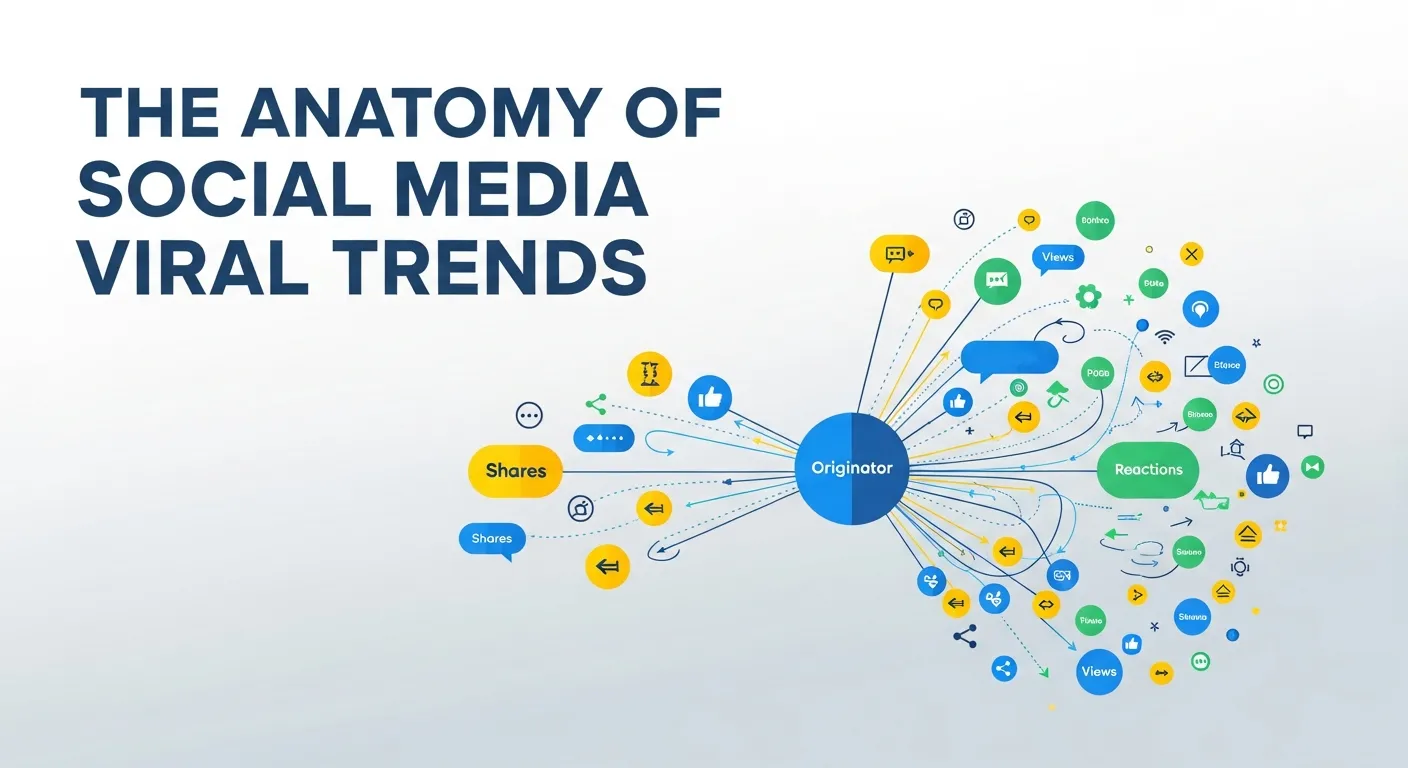
Social media viral trends are not static; they follow a predictable, albeit rapid, lifecycle. Understanding these stages allows marketers, creators, and brands to identify opportunities, time their participation effectively, and maximize impact. From a single spark to widespread saturation, this lifecycle is a roadmap for navigating the fast-paced world of digital culture. This framework is a core part of a modern brand strategy guide.
Stage 1: The Spark (Origination)
Every trend begins with a single piece of content from a single creator. This is the “patient zero” of the trend, the initial point from which one of the many social media viral trends will grow.
- The Creator: Contrary to popular belief, the originator is often not a mega-celebrity or a large brand. More frequently, it’s an everyday user who posts something authentic, relatable, or unexpectedly brilliant. Authenticity is often the key ingredient; the content feels spontaneous rather than a calculated part of a brand marketing strategy.
- The Content: The initial post has the raw DNA of virality—it’s emotionally resonant, simple, and has a novel hook. It could be a unique dance, a hilarious observation, a clever soundbite, or a heartwarming moment. This is the genesis of a viral social media campaign.
- Initial Audience: The content is initially seen by the creator’s immediate followers. This small, often niche audience provides the first round of engagement that signals to the algorithm that something special is happening.
Stage 2: The Ignition (Acceleration)
This is where the trend starts to catch fire. Early adopters and niche communities begin to engage with the content, moving it beyond the creator’s initial circle. The spark becomes a flame.
- Early Adopters: These are trend-savvy users who are quick to spot emerging patterns. They share, remix, and replicate the original content, adding their own creative spin. Their participation acts as social proof, encouraging others to join in.
- Algorithmic Detection: As engagement velocity increases, platform algorithms recognize the content’s potential. They begin pushing it to a broader audience through “For You” pages, “Explore” tabs, and suggested content feeds. This is the critical tipping point for many social media viral trends.
- Hashtag Formation: A common hashtag may emerge organically or be promoted by the creator, helping to aggregate all related content and make the trend easier to track and join. This gives the nascent trend a name and a home.
Stage 3: The Peak (Peak Virality)
At this stage, the trend has achieved maximum visibility and has entered the mainstream cultural consciousness. It’s no longer a niche phenomenon; it’s everywhere. This is the height of the trend’s power and influence.
- Mass Participation: Millions of users are now creating their own versions of the trend. The original sound, format, or challenge is inescapable on social media feeds. This is where the most significant growth in brand awareness can occur for participating brands.
- Influencer and Celebrity Involvement: Major influencers, celebrities, and public figures join in. Their participation provides a massive boost in reach and legitimizes the trend, turning it into a global event. Influencer marketing services often play a key role here.
- Media Coverage: Mainstream media outlets and culture blogs begin to report on the trend, analyzing its origins and impact. It may become a piece of viral news itself. This crossover to traditional media solidifies its status as a major cultural moment.
- Brand Participation: Brands that are agile and culturally attuned will enter at this stage. A well-executed brand post can achieve enormous reach, making this a key moment for consumer brand marketing. This is a core part of many digital marketing success stories.
Stage 4: The Saturation (Decline)
Like all things, even the biggest social media viral trends eventually fade. The saturation stage is characterized by overexposure and declining engagement.
- Overexposure: The trend becomes so ubiquitous that it starts to feel stale or overdone. Users begin to experience “trend fatigue.” The novelty that drove its initial ascent is gone.
- Diminishing Returns: As more people (and brands) jump on the bandwagon, the novelty wears off, and individual posts generate less engagement. The trend may even become the subject of parody or criticism, a sign that its cultural cachet is waning.
- The Next New Thing: User attention is finite. As one trend wanes, the audience’s focus naturally shifts to the next emerging trend, and the cycle begins anew. The ecosystem of social media viral trends is self-renewing.
Stage 5: The Legacy (Memorabilia)
While the active trend may be over, it often leaves a lasting impact on digital culture. The most significant social media viral trends become part of our collective digital history.
- Cultural Reference: The trend becomes a cultural touchstone, referenced in future memes, conversations, and even traditional media. It’s now part of the internet’s collective memory.
- Platform Integration: Some trend formats may become permanent features on a platform. For example, a popular video style might be integrated as a new editing tool or effect.
- Long-Term Impact: The trend may have launched a creator’s career, propelled a song to the top of the charts, or permanently shifted brand perception in marketing for a company that participated effectively. These are the kinds of outcomes documented in rebranding case studies or studies of brand equity in marketing.
For brands, the sweet spot for participation is typically between the late Acceleration stage and the early Peak stage. Entering too early is risky, as the trend may not take off. Entering too late can make a brand look out of touch. Successful brand adaptation strategies require constant monitoring and agile execution, which is a key focus for any brand strategy consulting guide.
Categories of Social Media Viral Trends
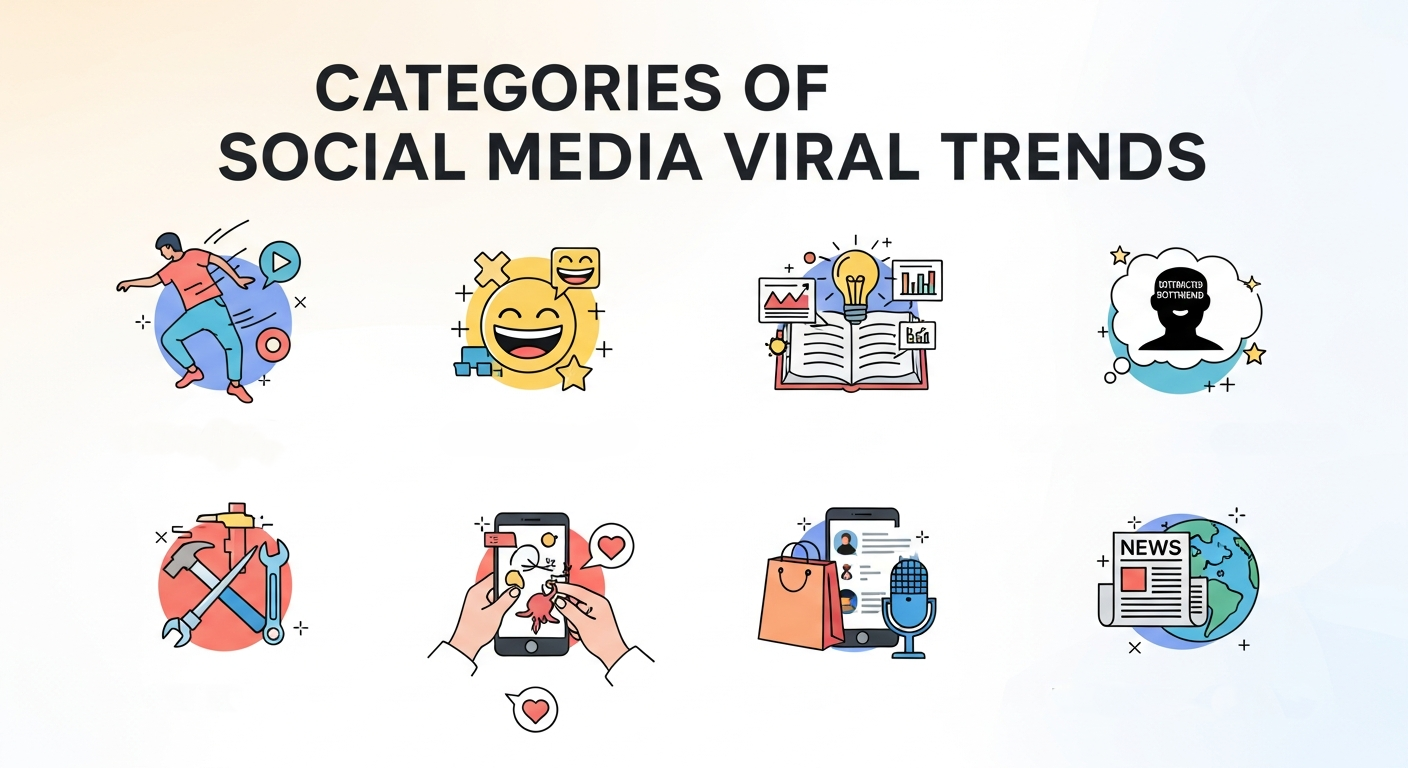
Social media viral trends are not a monolith. They come in diverse forms, each with unique characteristics that influence how they engage audiences and spread across platforms. Understanding these categories is essential for developing a versatile and effective brand marketing strategy. By identifying the type of trend, brands can better decide if and how to participate, moving from a reactive to a proactive stance. This knowledge is crucial for anyone aspiring to trend marketing mastery.
1. Viral Videos: The Cornerstone of Virality
The social media viral video is arguably the most powerful and common form of viral content. Its combination of audio and visual elements creates a highly immersive and emotionally engaging experience that is perfectly suited for today’s mobile-first audience.
- Characteristics: These videos often feature humor, drama, unexpected twists, exceptional talent, or heartwarming moments. Their power lies in their ability to tell a story or evoke a feeling in a very short amount of time (often under 60 seconds). This brevity is key to their success in the attention economy.
- Why They Spread: Platforms like TikTok and Instagram Reels have algorithms that prioritize video content with high watch time and engagement velocity. The autoplay feature ensures immediate exposure, capturing attention before a user can scroll away. This algorithmic preference makes video a primary vehicle for social media viral trends.
- Brand Application: Brands can create their own short-form videos or use features like TikTok’s Stitch and Duet to react to existing viral videos. This is a primary tactic for building brand awareness and showcasing a brand’s personality in marketing.
2. Challenges and Participation Trends
These trends are built on the principle of active participation. They provide a clear prompt or action for users to replicate, turning passive viewers into active creators. This participatory nature is what gives many social media viral trends their immense scale.
- Examples: Dance challenges (e.g., the “Renegade”), lip-sync challenges, fitness challenges (e.g., the “plank challenge”), and hashtag movements (e.g., the #IceBucketChallenge, a classic example of viral content strategies for non-profits and NGOs).
- Why They Spread: The barrier to entry is often low, and they tap into the psychological need for community and belonging. Each new video created reinforces the trend and acts as an invitation for others to join. This is a perfect example of a brand strategy framework that leverages user-generated content (UGC).
- Brand Application: Brands can create their own branded challenges, offering incentives for participation. This is a powerful B2B digital marketing strategy as well, encouraging professionals to share their expertise or participate in industry-specific challenges.
3. Meme Formats: The Language of the Internet
Memes are the quintessential form of remix culture. They are typically humorous and rely on a shared cultural context for their meaning. They are a flexible and highly effective format for social media viral trends.
- Characteristics: A meme format usually consists of a recognizable image, GIF, or phrase that can be adapted to countless situations. Examples include the “Distracted Boyfriend” or “Woman Yelling at a Cat” formats.
- Why They Spread: Memes are incredibly simple to understand and share. They distill complex ideas or relatable frustrations into a single, digestible image. Their adaptability allows them to stay relevant by evolving with current events, a hallmark of enduring social media viral trends.
- Brand Application: Brands can use popular meme formats to create timely and humorous content. However, this requires a deep understanding of internet culture to avoid appearing inauthentic. It’s a delicate balance that can either enhance or damage brand perception in marketing. A poorly executed meme can be detrimental to a brand’s digital reputation management.
4. Viral News and Commentary
Breaking news stories, especially those that are controversial, shocking, or emotionally charged, can quickly become social media viral trends. The trend is not the news itself, but the wave of conversation, commentary, and debate that follows.
- How It Spreads: Users share articles, quote-tweet with their opinions, or create video responses (stitches, duets) to express their views. Platforms like X (formerly Twitter) are epicenters for this type of viral spread.
- Brand Application: This is a high-risk, high-reward area. Brands must be extremely cautious. Commenting on sensitive news can lead to a brand crisis management situation if not handled carefully. However, taking a stand on an issue that aligns with a brand’s core values can build strong brand equity in marketing. This requires a solid ethical branding framework.
5. Audio Trends: The Unseen Driver
On platforms like TikTok and Instagram Reels, audio is a primary driver of trends. A catchy song clip, a funny soundbite, or a piece of dialogue can become the foundation for millions of videos, creating powerful social media viral trends.
- Characteristics: The audio provides a template for creativity. Users create content that complements, reinterprets, or lip-syncs to the sound. The song or sound itself can go viral, rocketing up music charts or becoming a cultural meme.
- Why They Spread: The audio is easily discoverable and reusable. When a user hears a sound they like, they can tap a button to see all other videos using it and create their own. This feature is built for virality.
- Brand Application: Using trending audio is one of the easiest ways for a brand to participate in social media viral trends. It instantly makes content feel more relevant and increases its chances of being discovered. This can even be a component of a sonic branding strategy.
6. Filter and AR Trends
Interactive filters and augmented reality (AR) effects provide a playful and visually engaging way for users to create content. These can quickly become social media viral trends based on novelty and fun.
- Examples: Filters that predict your future, morph your face, or place 3D objects in your environment.
- Why They Spread: They are inherently interactive and fun. The novelty factor encourages users to try the filter and share the results.
- Brand Application: Brands can create their own branded AR filters, which serve as a form of interactive advertising. This is a creative way to promote a product or event and encourage UGC, making it a valuable tool in consumer brand marketing. A successful filter can be one of the best digital marketing success stories.
Trend Category Strategy Table
|
Trend Category |
Key Driver |
Brand Opportunity |
Risk Level |
|---|---|---|---|
|
Viral Videos |
Emotional Storytelling |
Create original, engaging short-form content. |
Medium |
|
Challenges |
Participation & Community |
Launch a branded hashtag challenge to drive UGC. |
Low-Medium |
|
Memes |
Humor & Relatability |
Adapt popular meme formats to brand messaging. |
High |
|
Viral News |
Opinion & Debate |
Align with relevant, non-controversial news. |
Very High |
|
Audio Trends |
Replicability & Mood |
Use trending sounds to increase content relevance. |
Low |
|
AR Filters |
Novelty & Interactivity |
Create a branded filter for users to share. |
Medium |
By understanding these different categories of social media viral trends, brands can move from being passive observers to active participants, strategically choosing where and how to engage for maximum impact on their brand positioning.
The Viral Marketing Funnel: Turning Trends into Growth

While participating in social media viral trends can generate massive, short-term attention, the true goal for any business is to convert that fleeting visibility into tangible, long-term value. This is where the viral marketing funnel comes into play. It’s a strategic model that guides how brands can transform the energy of a trend into brand awareness, audience engagement, lead generation, and ultimately, customer loyalty and advocacy. This model is a cornerstone of any effective brand marketing plan and helps to build a viral marketing funnel that drives results.
Top of Funnel (ToFu): Awareness and Discovery
At the top of the funnel, the primary objective is to capture attention and maximize reach. This stage is all about leveraging the explosive power of social media viral trends to introduce your brand to a vast, new audience that may have never heard of you before.
- Goal: Broad visibility and brand awareness.
- Tactics:
-
- Early Participation: Monitor trends daily and be one of the first in your industry to participate. Speed is a competitive advantage. Utilize brand monitoring services to stay ahead.
- Trend-Jacking: Create content that directly incorporates a trending format, sound, or challenge. The content should be adapted to fit your brand voice but clearly tied to the ongoing viral conversation.
- Reactive Content: Produce content that reacts to a viral video or event (e.g., using TikTok’s Stitch or Duet features). This shows your brand is paying attention.
- Meme Marketing: Share timely, relevant memes that align with your brand’s personality. This can be a powerful way to engage in the culture of social media viral trends.
- KPIs: Impressions, reach, video views, profile visits. Tools like Google Analytics can help track traffic from social channels.
- Example: A skincare brand notices a viral trend where users are showing their “glass skin” routines. The brand quickly creates a high-quality TikTok video using the trending audio, showcasing how their product helps achieve that look. The video gets picked up by the algorithm, generating millions of views and driving a spike in brand awareness. This is a prime example of successful viral marketing on TikTok.
Middle of Funnel (MoFu): Engagement and Consideration
Once you have a user’s attention, the next step is to pull them deeper into your brand’s ecosystem. The middle of the funnel is focused on fostering interaction, building a relationship, and encouraging the audience to consider your brand more seriously. This is where you convert passive viewers of social media viral trends into an engaged community.
- Goal: Deeper engagement, community building, and lead nurturing.
- Tactics:
-
- Interactive Content: Move beyond passive viewing with polls, quizzes, Q&A sessions, and “ask me anything” (AMA) posts related to the trend.
- Branded Challenges: Launch a branded hashtag challenge that encourages users to create their own content featuring your product or brand. This is a powerful way to generate UGC and foster community.
- Educational Content: Create content that provides value related to the trend. For example, if a “healthy recipe” trend is going viral, a kitchenware brand could share tips on the best tools to use. This helps in building brand authority.
- Lead Magnets: Offer a valuable resource (e.g., an e-book, a webinar, a discount code) in exchange for an email address. For example, a link in your bio could lead to a sign-up for creative webinar ideas related to your industry. This integrates your inbound marketing efforts.
- KPIs: Likes, comments, shares, saves, UGC submissions, email sign-ups, website clicks.
- Example: Following their viral video, the skincare brand launches a #GlowUpChallenge, asking users to share their own transformation stories using the product. They feature the best submissions on their page, driving a surge in community engagement and UGC. Their bio now links to a webinar guide on achieving perfect skin.
Bottom of Funnel (BoFu): Conversion and Advocacy
The bottom of the funnel is where you convert engaged followers into customers and, ideally, into loyal brand advocates. The trust and relationship built in the previous stages are now leveraged to drive a specific action. This is where social media viral trends translate to revenue.
- Goal: Sales, conversions, and brand advocacy.
- Tactics:
-
- Viral Product Promotions: If a specific product was featured in the viral content, run a limited-time offer or create a special bundle. Use scarcity and urgency to drive sales. Craft irresistible webinar offers if you used a webinar as a lead magnet.
- User-Generated Proof: Showcase UGC from the MoFu stage as social proof on your product pages and in your ads. A customer’s video is often more persuasive than a brand’s.
- Retargeting Campaigns: Use outbound email marketing or paid social ads to retarget users who engaged with your viral content but didn’t convert.
- Referral Programs: Encourage new customers to share the brand with their friends in exchange for a reward. This ignites a new, smaller-scale viral loop. This is a classic referral marketing tactic.
- KPIs: Conversion rate, sales, customer lifetime value (CLV), referral rate.
- Example: The skincare brand creates a “Viral Glow Kit” featuring the products from their trending video. They run targeted ads to users who engaged with their challenge and offer a 15% discount for 48 hours. Sales skyrocket, and satisfied customers begin organically recommending the product to others, turning a fleeting trend into sustainable growth. This is a textbook example of a successful webinar sales funnel applied to social media.
By strategically moving audiences through this funnel, brands can ensure that the energy from social media viral trends doesn’t just dissipate. It becomes a powerful engine for building a resilient and profitable brand, showcasing the game-changing advantages of viral marketing.
How Brands Can Leverage Social Media Viral Trends Today

Incorporating social media viral trends into a marketing strategy is no longer a niche tactic for edgy startups; it’s a mainstream approach for achieving exponential reach, fostering authentic audience connections, and boosting the bottom line. However, success requires more than just jumping on every new dance craze. It demands a strategic, agile, and authentic approach. Here’s a guide for brands looking to effectively harness the power of virality and master the art of the viral content marketing strategy.
1. Establish a Robust Monitoring System
Trends move at the speed of culture. A trend that’s peaking today could be obsolete by next week. Acting early is critical for capitalizing on social media viral trends.
- What to Do: Designate a person or team to actively monitor key platforms daily. This isn’t passive scrolling; it’s active analysis. This team should be immersed in the culture of the platforms they monitor.
- Where to Look:
-
- TikTok: The “For You” page is the epicenter of trend formation. Pay attention to recurring sounds, formats, and challenges.
- Instagram: The Reels tab and Explore page are crucial for spotting video trends. Monitor popular audio and effects.
- X (Twitter): The “Trending” tab shows what conversations are dominating in real-time. This is key for spotting viral news and commentary-based social media viral trends.
- Reddit: Niche communities (subreddits) are often the breeding ground for memes and ideas that later go mainstream.
- YouTube: The “Trending” page, especially for Shorts, highlights what’s capturing broad audience attention.
2. Adapt, Don’t Just Copy
The biggest mistake brands make is blindly replicating a trend without considering their own identity. This often comes across as inauthentic or “cringey,” damaging the brand perception in marketing.
- The Goal: Find the intersection between the trend and your brand voice. Ask: “How can we participate in this conversation in a way that is true to who we are?” A successful adaptation feels natural, not forced.
- Brand Voice Strategy: A financial services firm shouldn’t be doing the same goofy dance as a fast-food chain. The firm could, however, use the trending audio as background for a video explaining a complex financial concept in a simple way. The key is adaptation, which is central to a strong brand voice strategy. This is a key part of navigating social media viral trends successfully.
3. Prioritize Authenticity and Humanization
Audiences, especially Gen Z, are highly attuned to overly produced or corporate content. They crave authenticity. The most successful brand engagements with social media viral trends often feel human.
- Actionable Tip: Don’t be afraid to be a little unpolished. A video shot on a smartphone with an employee genuinely having fun can often outperform a high-budget commercial. Show the people behind the brand. This human-centric approach is key to building brand resilience strategies.
- Example: The Duolingo TikTok account is famous for its unhinged, humorous content featuring its mascot, Duo the Owl. It feels less like a corporate account and more like a native creator, which is why it resonates so deeply and has become a master of leveraging social media viral trends.
4. Actively Encourage User-Generated Content (UGC)
Viral marketing is participatory by nature. The most successful brand-led social media viral trends are those that empower the audience to become creators.
- How to Do It:
-
- Launch a Branded Challenge: Create a clear, fun prompt with a unique hashtag.
- Offer Incentives: Reward participation with prizes, discounts, or features on your official channel.
- Feature Your Community: Regularly showcase the best UGC on your social media profiles. This not only provides you with free content but also encourages more people to participate. This approach is fundamental to building brand consistency and community.
5. Collaborate with the Right Influencers
Influencers are trend amplifiers. Partnering with them can give your content the initial velocity it needs to go viral and become one of the next big social media viral trends.
- Strategy: Don’t just look at follower counts. Partner with influencers whose audience and brand persona align with yours. Micro-influencers often have higher engagement rates and a more dedicated following. A tool like Ahrefs can help analyze an influencer’s domain authority and reach if they have a blog.
- Best Practice: Give influencers creative freedom. They know their audience best. A script that’s too rigid will come across as a forced advertisement. Effective influencer marketing services focus on authentic partnerships.
6. Weave Trends into Your Brand Storytelling
A trend is a format; a story is what connects. The most memorable viral brand moments use one of the current social media viral trends as a vehicle to tell a compelling story.
- Approach: Instead of just doing the trend, use the trend to say something. Connect it to your brand’s purpose, a customer success story, or a behind-the-scenes look at your company. This is the essence of effective brand storytelling.
- Example: Ocean Spray’s famous viral moment with Nathan Apodaca wasn’t planned, but they capitalized on it brilliantly by gifting him a new truck. They inserted their brand into his authentic, feel-good story, creating a massive wave of positive brand perception in marketing. This showed incredible agility in responding to one of the biggest social media viral trends of its time.
7. Leverage the Power of Trending Audio
Using trending sounds is one of the simplest and most effective ways to increase the discoverability of your content, especially on TikTok and Instagram Reels. It’s a low-effort, high-impact way to engage with social media viral trends.
- How it Works: The algorithms often push content that uses popular audio. It instantly makes your video feel current and relevant.
- Actionable Tip: When you’re scrolling and hear the same sound multiple times, that’s your cue. Save the audio and brainstorm how your brand can create a video around it.
8. Be Prepared for Failure (and Success)
Virality is not a guaranteed science. Not every attempt to create or participate in social media viral trends will be a home run.
- Mindset: Adopt a “test and learn” approach. Create content consistently, analyze what works and what doesn’t, and refine your strategy.
- Crisis Management: On the flip side, be prepared for a post to go viral. Have a plan for how to handle a massive influx of comments and attention. This includes having a brand crisis management plan in case the attention turns negative. Effective reputation management is key.
By integrating these practices, brands can move from being passive observers of social media viral trends to becoming active participants in digital culture, driving both brand love and business results.
The Future of Social Media Viral Trends

The landscape of social media viral trends is in a constant state of flux, shaped by technological advancements, evolving user behaviors, and the ever-changing algorithms of social platforms. Looking ahead, several key shifts are poised to redefine what goes viral and how brands can participate. Understanding these future currents is essential for developing a forward-thinking brand strategy road map and staying ahead in the world of next-gen trend marketing strategies.
1. The Rise of AI-Generated Content and Creativity
Artificial intelligence is no longer a futuristic concept; it’s a present-day tool that is democratizing creativity and will soon become a major engine of social media viral trends. This is a key component of an AI-driven trend marketing approach.
- Impact on Creation: AI tools that generate images (e.g., Midjourney), videos, and text are making it easier for anyone to produce high-quality, imaginative content. This will lead to an explosion of new visual styles and meme formats.
- AI-Driven Trends: We will see social media viral trends centered entirely on AI capabilities. Think AI-powered filters that create hyper-realistic avatars, AI voice changers that spark new audio trends, or trends where users prompt an AI to generate humorous or bizarre scenarios. AI-driven trend forecasting will become a standard practice.
- Brand Implications: Brands will need to embrace AI as a creative partner. Automated branding tools will help generate ideas and content at scale, but the challenge will be maintaining authenticity and a human touch. The brands that succeed will use AI to enhance, not replace, human creativity. This is the new frontier of trend marketing AI data strategy.
2. Hyper-Personalization and Niche Trend Ecosystems
The era of a single trend dominating the entire internet is giving way to a more fragmented landscape. Algorithms are becoming so sophisticated that they are creating hyper-personalized feeds tailored to individual interests and micro-communities. This leads to the rise of micro-trend marketing.
- From Mass to Niche: Instead of one global dance trend, we will see multiple social media viral trends emerging simultaneously within specific communities (e.g., #BookTok, #CleanTok, #FinTok). These trends will be deeply relevant to their niche but may not always cross over into the mainstream.
- The “For You” Universe: Each user’s “For You” page is becoming a unique universe of content. This means virality will become more relative; a video can be “viral” within a specific niche of 500,000 users without ever being seen by the general population.
- Brand Implications: Brand positioning will require a more targeted approach. Brands will need to identify and engage with the specific niche communities that are most relevant to their products. Family branding in marketing, for instance, could focus on parenting-related micro-trends rather than trying to capture the attention of the entire internet.
3. Immersive Experiences with AR and VR
As technology matures, social media viral trends will move beyond the 2D screen and into immersive, three-dimensional experiences. Augmented Reality (AR) and Virtual Reality (VR) will unlock new forms of participation.
- Interactive AR Filters: AR filters will become more sophisticated, moving beyond simple face masks to full-blown interactive games and experiences that overlay the real world. Brands can create “try-on” filters for products like makeup or clothing, turning product discovery into a viral activity.
- VR-Based Social Spaces: Socializing in VR environments will spawn its own set of trends, from virtual fashion shows to collaborative art projects. Brands could host immersive events or create branded spaces within these metaverses.
- Brand Implications: The focus will shift from content consumption to interactive experience. Sensory branding will become more important as brands explore how to engage users through sight, sound, and even virtual touch. This is the next frontier for luxury brand marketing strategy.
4. The Creator Economy Matures
The power dynamic will continue to shift towards individual creators. These creators are the engines of culture and the originators of most social media viral trends.
- Creators as Brands: Successful creators are building sophisticated media businesses with diverse revenue streams. Their influence will only grow, making them essential partners for any brand looking to tap into viral culture.
- Long-Term Partnerships: Brands will move away from one-off transactional posts and towards long-term, authentic partnerships with creators who align with their values. This is key to building brand authority in a creator-led world.
- Brand Implications: Your brand marketing strategy must be creator-inclusive. Brands that empower creators and treat them as strategic partners, rather than just media channels, will win. This includes co-branding in marketing initiatives and deeper creative collaborations.
5. The Push for Authenticity and Ethical Branding
As the digital world becomes more saturated with content, users are developing a stronger filter for inauthenticity. There is a growing demand for transparency, purpose, and ethical behavior from both creators and brands when they engage with social media viral trends.
- The Backlash to “Cringe”: Brands that try too hard or hop on trends in a disingenuous way will be called out more swiftly. This can lead to negative brand perception in marketing.
- Purpose-Driven Virality: Social media viral trends related to social causes, sustainability, and ethical consumption will continue to gain traction.
Conclusion
Understanding the mechanics and psychology of social media viral trends is essential for brands aiming to thrive in today’s dynamic digital landscape. True viral success comes from tapping into emotional resonance, fostering genuine community, and creating content that people are eager to share and engage with. It’s not just about chasing every trend—it’s about strategically selecting those that align with your brand’s values and audience.
Adaptability is key. As trends evolve and new formats emerge, brands must stay agile and be ready to experiment, listen, and respond quickly. Proactive participation—grounded in authenticity—can turn fleeting moments into meaningful connections and sustained brand growth.
Now is the time to innovate your marketing strategies. Dive into the world of viral trends with creativity, openness, and purpose. By blending data-driven insights with a human touch, your brand can lead conversations, inspire loyalty, and achieve lasting impact in the fast-moving world of social media.
FAQs
1. What are social media viral trends?
Social media viral trends are content or patterns of content that spread rapidly across platforms, reaching a wide audience through shares, remixes, and reactions. They are defined by their speed, reach, and user participation.
2. What makes content go viral on social media?
Viral content typically has characteristics like massive shareability, high emotional resonance, effortless replicability, platform optimization, and cultural relevance.
3. What are the common formats of social media viral trends?
Common formats include memes, viral videos, hashtag challenges, dance trends, audio clips, user-generated content (UGC) formats, and augmented reality (AR) filters.
4. Why do people share viral content?
People share viral content to evoke emotions, gain social validation, express their identity, and appear culturally aware or “in the know.”
5. How do platform algorithms influence viral trends?
Algorithms amplify viral trends by promoting content with high engagement velocity, watch time, and share-to-like ratios, ensuring it reaches a broader audience.
6. What role does psychology play in viral trends?
Viral trends tap into psychological triggers like strong emotions (awe, humor, anger, joy), social currency, and the human need for community and belonging.
7. How can brands leverage social media viral trends?
Brands can participate in trends by creating relevant content, launching branded challenges, collaborating with influencers, and using trending audio or formats to engage audiences authentically.
8. What are the risks of participating in viral trends for brands?
Risks include appearing inauthentic, misaligning with brand values, or facing backlash for poorly executed or insensitive content.
9. What is the lifecycle of a social media viral trend?
Viral trends typically follow five stages: Spark (origination), Ignition (acceleration), Peak (maximum visibility), Saturation (decline), and Legacy (lasting cultural impact).
10. How can brands turn viral trends into long-term growth?
Brands can use a viral marketing funnel to convert attention into engagement, lead generation, and customer loyalty by strategically participating in trends and fostering community interaction.






Leave a Reply