

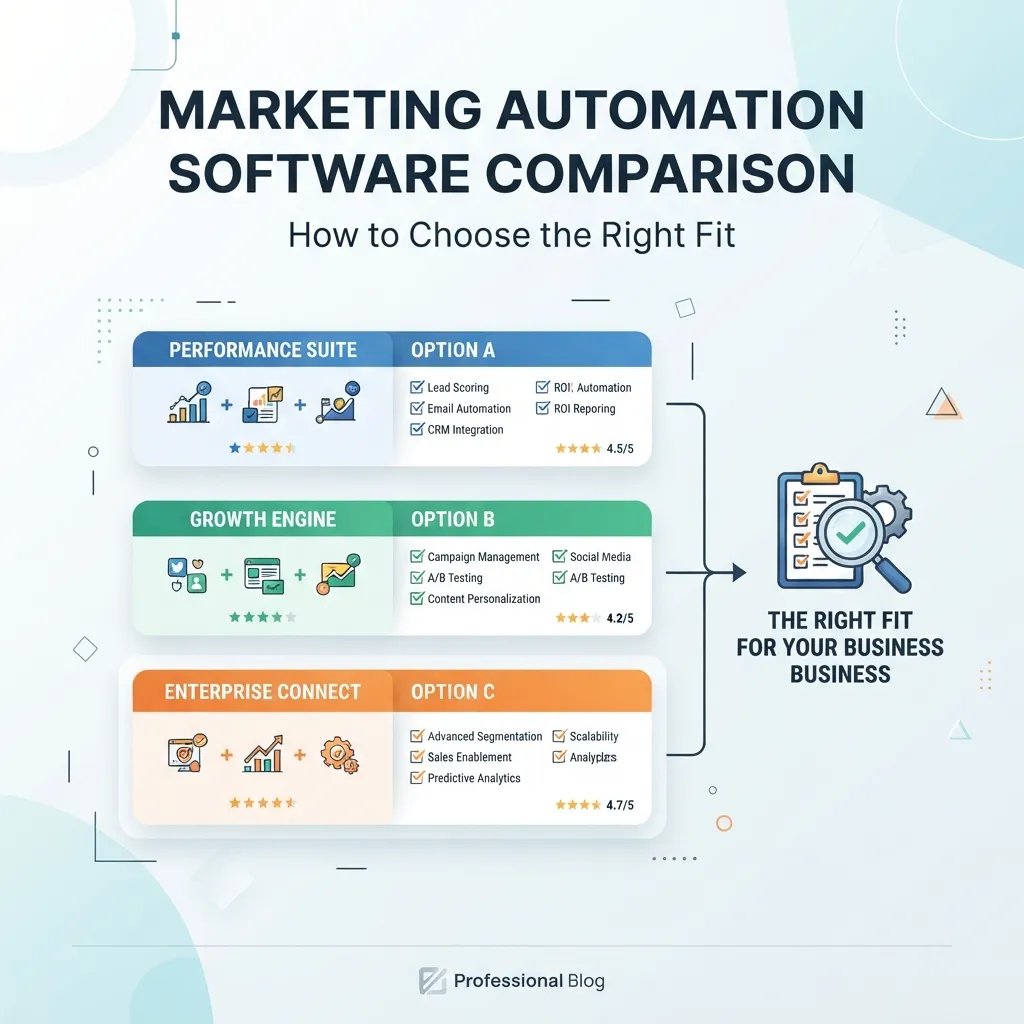
Comparing marketing automation software is harder than it should be, mostly because nearly every vendor’s website claims to offer the same broad set of features: email automation, workflows, CRM integration, analytics, and increasingly, AI. The real differences show up in the details — how flexible the workflow builder actually is, how deep the integrations really go, how pricing scales as contact volume grows, and how much support is available during setup. This guide provides a practical framework for comparing marketing automation software honestly, covering the categories of vendors on the market, the criteria that actually matter, common comparison mistakes, and a structured process for narrowing down options without getting lost in feature-list overwhelm.
Anyone who has tried to compare marketing automation software by reading vendor websites alone knows the problem: every platform appears to check every box. Email automation? Yes. Lead scoring? Yes. CRM integration? Yes. AI features? Also yes. This surface-level similarity makes it difficult to tell which platform will actually work well for a specific team, until real evaluation criteria are applied beneath the marketing copy. Even well-regarded resources, including this complete guide to the best marketing automation software, are most useful as a starting point for identifying candidates rather than a final answer, since the right choice still depends heavily on a team’s specific workflows and constraints.
A useful comparison goes beyond feature checklists and looks instead at depth, flexibility, and fit — how well a platform’s specific implementation of each feature matches a team’s actual workflows, technical comfort level, and growth trajectory. This guide walks through exactly how to run that kind of comparison, from understanding the broad categories of vendors on the market to building a structured evaluation process that holds up under real scrutiny.
Categories of Marketing Automation Software
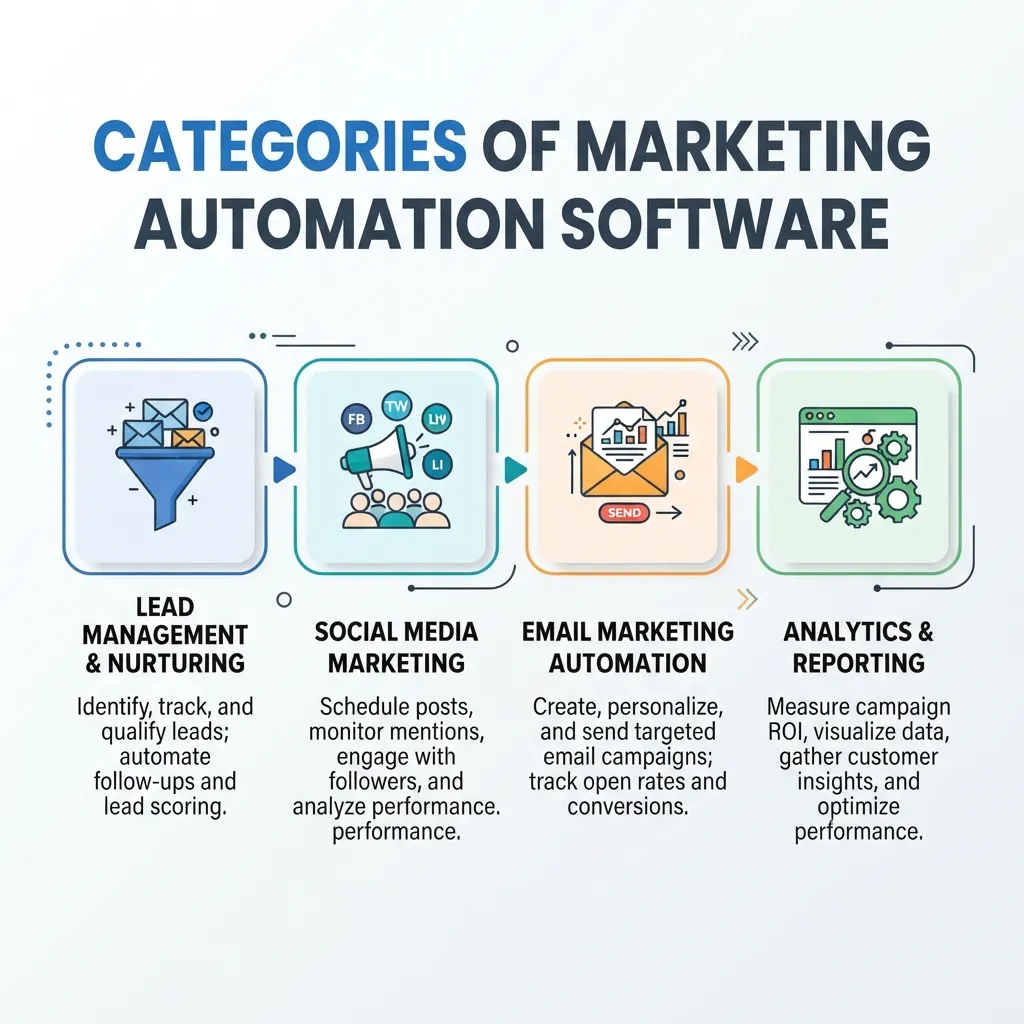
All-in-One Enterprise Platforms
These platforms bundle marketing automation with CRM, sales tools, and often customer service functionality into a single, comprehensive system. They tend to offer the deepest feature sets and strongest internal data consistency, at the cost of higher pricing and often a steeper learning curve. This category suits larger organizations with dedicated marketing operations staff who can fully utilize the platform’s breadth.
SMB-Focused Platforms
Built specifically for smaller teams and simpler use cases, these platforms prioritize ease of use and faster time-to-value over exhaustive feature depth. They generally cost less and require less onboarding effort, though they may eventually feel limiting as a company’s marketing operations grow more sophisticated.
Industry or Use-Case Specific Platforms
Some vendors focus specifically on a vertical — ecommerce, SaaS, real estate, nonprofits — building automation features tailored to the specific workflows and data structures common in that industry. These platforms can outperform generalist tools for their target use case, since features like abandoned cart recovery or donor stewardship are built in rather than approximated with generic workflow logic.
Email-First Platforms with Automation Layered On
A number of platforms started as email marketing tools and have since added workflow and automation capabilities on top. These often remain strongest at their original core function — email deliverability, design, and list management — while automation features may be less mature than platforms built around automation from the start.
Best-of-Breed Automation and Workflow Tools
Rather than combining marketing functions into one system, these tools specialize specifically in workflow logic and orchestration, often designed to integrate with a separate CRM or email tool rather than replace them. This category suits teams that already have strong point solutions in place and want a dedicated layer specifically for cross-tool automation.
Criteria That Actually Matter in a Comparison
Workflow Builder Flexibility
Not all visual workflow builders are equally capable. Some support only simple linear sequences, while others allow complex branching logic, multiple entry and exit conditions, and the ability to loop contacts back through earlier stages based on new behavior. Testing a platform’s workflow builder against a team’s most complex real-world use case, not just a simple welcome sequence, reveals this difference quickly.
Integration Depth, Not Just Integration Count
A long list of “supported integrations” on a vendor’s website often masks significant variation in how deep each connection actually goes. A CRM integration that only syncs contact names and email addresses is far less valuable than one that also passes purchase history, lead scores, and full activity timelines in both directions. This distinction is one of the most important, and most commonly overlooked, factors in a fair comparison of marketing automation platforms.
Pricing Structure and Scalability
Marketing automation software pricing typically scales with contact volume, feature tier, or both. Understanding not just current pricing but how costs will grow over the next one to two years, based on realistic list growth, prevents a platform that looks affordable today from becoming a budget problem down the line.
Reporting and Attribution Depth
Basic open and click tracking is standard across nearly every platform; the meaningful differences show up in multi-touch attribution, revenue reporting, and the ability to trace a closed deal back through specific automated touchpoints. Teams that need to justify marketing spend to leadership should weigh this criterion heavily.
Onboarding and Support Quality
A platform with strong theoretical capabilities delivers little value if a team struggles to implement it correctly. Structured onboarding, migration assistance, and responsive support during the critical first few months often matter more than an extra advanced feature that goes unused.
AI and Automation Intelligence
Increasingly, platforms differentiate through AI-powered features — predictive lead scoring, generative content suggestions, and automated send-time optimization. Evaluating how deeply these features are integrated into actual workflows, rather than treated as a bolted-on add-on, reveals which vendors are genuinely investing in this area versus those checking a marketing box.
A Structured Process for Comparing Marketing Automation Software
1. Define Must-Have Use Cases Before Reviewing Vendors
Listing the specific workflows a team needs to run — lead nurturing, onboarding, re-engagement, event promotion — before evaluating any vendor prevents feature lists from driving the decision instead of actual business needs. Documenting these use cases alongside a broader marketing automation strategy ensures the eventual software choice supports where the marketing function is actually headed, not just its current, narrower set of needs.
2. Request Trials or Sandbox Access, Not Just Demos
A guided vendor demo shows a platform at its best, in a carefully controlled scenario. Hands-on trial access, ideally using real (or realistic) data and workflows, reveals friction points a polished demo won’t surface.
3. Test the Specific Integrations That Matter Most
Rather than trusting a vendor’s list of supported integrations, testing the actual connection with a team’s existing CRM, ecommerce platform, or other core systems during the trial period avoids unpleasant surprises after signing a contract.
4. Involve the Team That Will Actually Use the Platform Daily
Decision-makers evaluating a platform on paper sometimes miss usability issues that become obvious to a marketer who will build workflows and campaigns in the tool every day. Including hands-on team members in the comparison process catches these issues before a purchase, not after.
5. Compare Total Cost of Ownership, Not Just List Price
Beyond subscription pricing, factor in implementation costs, training time, and the cost of any additional tools needed to fill gaps a platform doesn’t cover natively. A cheaper platform that requires several supplementary tools may end up costing more overall than a pricier, more complete solution.
Building a Fair Comparison Matrix
A structured comparison matrix, scoring each platform against the criteria above rather than relying on a simple checkmark for feature presence or absence, produces a far more useful comparison than a basic feature list. Assigning weighted importance to each criterion, based on a team’s specific priorities, also prevents an objectively feature-rich platform from winning a comparison simply because it has more items on a checklist, when a smaller subset of well-executed features might actually serve the team better. A simple spreadsheet with criteria as rows and candidate platforms as columns, scored on a consistent numeric scale, often works better than a more elaborate scoring system, since the goal is a clear-headed comparison rather than a perfectly precise mathematical model.
This kind of structured evaluation mirrors how buyers approach choosing the right platform in other marketing categories as well — the specific criteria differ by category, but the underlying discipline of comparing based on actual fit rather than surface-level feature parity applies broadly across marketing technology purchases.
Common Mistakes When Comparing Marketing Automation Software
- Comparing feature lists instead of feature depth. Two platforms can both claim “lead scoring” while one offers a simple point system and the other supports sophisticated, multi-factor behavioral models.
- Ignoring the learning curve. A powerful platform that the team never fully adopts delivers less real value than a simpler platform used consistently and well.
- Overweighting AI features without checking depth. Not all “AI-powered” claims reflect the same level of actual capability or integration into daily workflows.
- Underestimating migration effort. Moving contact data, workflows, and historical campaign performance from an existing platform is rarely as simple as vendors suggest during the sales process.
- Choosing based on brand recognition alone. A well-known platform isn’t automatically the best fit for every team’s specific size, budget, and use case.
Comparing Vendor Reputation and Third-Party Reviews
Independent reviews and comparison resources, similar to how curated tool and platform recommendations tend to carry more credibility than vendor marketing pages alone, are a useful supplementary input during a comparison process. Reading reviews specifically from companies of similar size and industry provides more relevant signal than reviews from a very different type of organization, since the features and limitations that matter most vary considerably by company profile.
How Tool Categories Fit Into a Broader Automation Strategy
Choosing a specific piece of software is only one part of a broader decision. Understanding the different features and types of marketing automation tools available before comparing specific vendors helps clarify whether a team actually needs an all-in-one platform or whether a combination of specialized tools would serve its workflows better, a decision that should generally come before comparing specific vendor options rather than after.
When to Reevaluate an Existing Platform
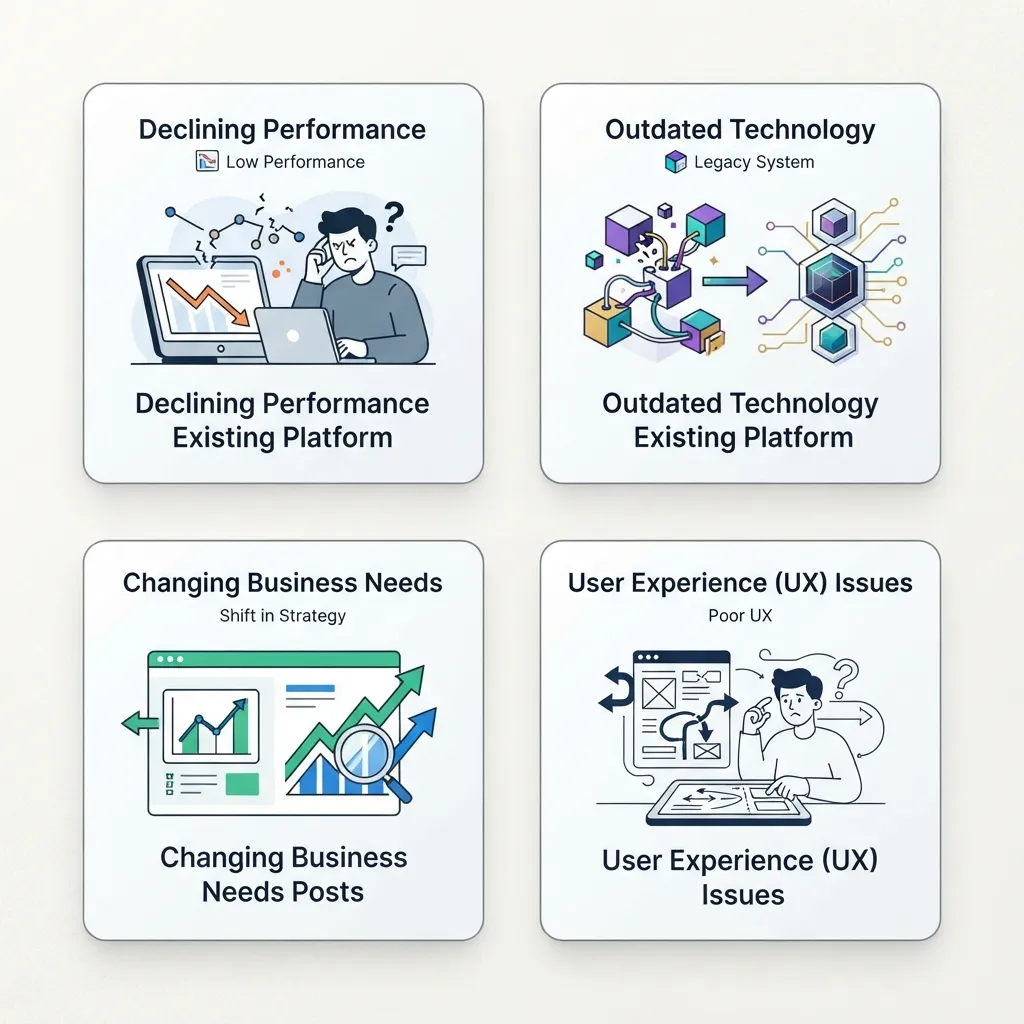
Comparison shouldn’t only happen before an initial purchase. Signs that it’s time to reevaluate an existing marketing automation platform include consistently working around missing features with manual processes, outgrowing pricing tiers faster than the platform’s value seems to grow, or watching competitors’ platforms add capabilities that would meaningfully improve current workflows. Switching platforms is rarely painless, so this reevaluation should weigh migration cost honestly against the expected benefit, rather than assuming a newer or more feature-rich option is automatically worth the disruption. Revisiting the same structured comparison process periodically, rather than assuming an initial choice remains the best fit indefinitely, keeps a company’s marketing technology aligned with its actual needs as those needs evolve.
Conclusion
A genuinely useful marketing automation software comparison goes well beyond matching feature checklists across vendor websites. It requires defining real use cases first, testing actual integration depth and workflow flexibility, involving the team that will use the platform daily, and weighing total cost of ownership rather than list price alone. Vendors will always present their platform in the most favorable light possible; a structured, criteria-based comparison process is what cuts through that marketing to find the platform that will genuinely support a team’s specific workflows, budget, and growth trajectory. Treating this comparison as a periodic discipline, rather than a one-time decision made once and never revisited, is ultimately what keeps a company’s marketing technology stack aligned with its actual needs over the long run.
Frequently Asked Questions
1. What’s the best way to compare marketing automation software?
The most reliable approach is defining specific use cases first, then testing platforms against those use cases through trials, rather than comparing feature checklists alone.
2. How important is pricing when comparing marketing automation platforms?
Pricing matters, but total cost of ownership — including implementation, training, and any supplementary tools needed — often matters more than list price alone.
3. Should I choose an all-in-one platform or several specialized tools?
It depends on team size and complexity; all-in-one platforms suit teams wanting a single system, while specialized tools can outperform in specific categories at the cost of more integration work.
4. How do I evaluate integration quality when comparing software?
Test the actual data sync with your existing systems during a trial period, since a “supported integration” can vary significantly in how much data it actually shares.
5. What role should AI features play in a comparison?
AI features are increasingly important, but evaluate how deeply they’re integrated into real workflows rather than assuming every “AI-powered” claim reflects similar capability.
6. Is a more expensive marketing automation platform always better?
No, a platform’s value depends on fit with a team’s specific workflows and technical comfort, not just its price point or feature count.
7. How long should a trial period be when comparing platforms?
Long enough to test real workflows and integrations with actual or realistic data, rather than relying solely on a guided vendor demo.
8. Who should be involved in comparing marketing automation software?
Both decision-makers and the team members who will use the platform daily should be involved, since usability issues often surface only during hands-on use.
9. How often should a company reevaluate its marketing automation platform?
Periodically, especially when workflows increasingly rely on manual workarounds or when pricing tiers are outgrown faster than the platform’s value seems to grow.
10. Are third-party reviews reliable when comparing marketing automation software?
They can be useful, particularly reviews from companies of similar size and industry, though they should supplement rather than replace hands-on evaluation.
11. What’s a common mistake in comparing marketing automation vendors?
Comparing surface-level feature lists instead of testing feature depth is one of the most common mistakes, since many platforms claim similar capabilities at very different levels of sophistication.
12. Does brand recognition matter when choosing marketing automation software?
Not as much as fit; a well-known platform isn’t automatically the best choice for every team’s specific size, budget, and workflow needs.






Leave a Reply