

A Social Media Listening Strategy helps businesses understand what customers are saying about their brand, products, competitors, and industry across digital platforms. By analyzing conversations, tracking brand mentions, measuring sentiment, and identifying customer needs, businesses can make smarter marketing decisions and build stronger relationships with their audiences. This guide explores social media listening tools, monitoring techniques, sentiment analysis, reputation management, customer feedback, audience insights, competitor research, and practical best practices to help businesses turn online conversations into meaningful growth opportunities.
Social media has become more than a place for people to share opinions, experiences, and recommendations. It is also a valuable source of information that businesses can use to understand their customers and improve their marketing efforts. People frequently discuss brands, compare products, ask questions, and share feedback on social networks, forums, review websites, and online communities. These conversations reveal what customers appreciate, what frustrates them, and what they expect from businesses.
Social Media Listening Tools
The right tools make it easier to discover conversations, organize information, and identify patterns across multiple platforms. Depending on your goals, useful tools may include social media management dashboards, brand mention trackers, review monitoring platforms, analytics solutions, and specialized sentiment analysis software.
A Social Media Listening Strategy should begin with selecting tools that match your business needs. Some platforms help track keywords, hashtags, competitor names, and brand mentions, while others offer audience demographics, sentiment classification, trend detection, and reporting features. Tools such as Brandwatch, Talkwalker, Sprout Social, and Hootsuite offer different listening or monitoring capabilities, although features and availability vary by plan.
Before investing in a platform, consider your budget, the networks you need to monitor, the languages your audience uses, and the reporting features your team requires. Start with a manageable set of keywords, including your brand name, product names, common misspellings, industry terms, and relevant competitor names. Review the results regularly to ensure the collected information is accurate and useful.
The goal is not simply to collect more data. It is to discover actionable insights that improve customer relationships, marketing performance, and business decisions.
Social Media Monitoring Strategy
An effective Social Media Listening Strategy requires a clear monitoring process. Without defined objectives, businesses can become overwhelmed by large volumes of comments, mentions, and conversations that do not support their priorities.
Start by identifying what you want to learn. You may want to measure brand awareness, understand customer complaints, evaluate a new product launch, discover industry trends, or compare your reputation with competitors. These objectives will determine which keywords you track, which platforms you prioritize, and how frequently you review the results.
Next, establish a consistent workflow for collecting and reviewing information. Marketing teams should know who is responsible for monitoring mentions, responding to customer concerns, escalating urgent complaints, and documenting recurring feedback. Response guidelines can also help ensure that communication remains professional and consistent across channels.
Businesses that connect listening insights with broader marketing systems can make their data more useful. For example, integrating customer information with marketing campaigns can improve personalization and follow-up communication. This is where marketing automation and CRM integration becomes relevant, helping teams connect customer interactions with organized records and more coordinated marketing activities.
A monitoring process should be reviewed regularly. As products, audiences, and marketing priorities change, businesses should update their keywords, objectives, and reporting methods to keep their listening efforts relevant.
Social Listening Best Practices
 Successful social listening depends on consistency, context, and a willingness to learn from customer conversations. Businesses should avoid treating every mention as equally important. A question about product availability, a detailed complaint, and a viral discussion about an industry trend may require completely different responses.
A practical Social Media Listening Strategy combines automated tracking with human judgment. Automated tools can identify keywords and possible sentiment, but people are better positioned to understand sarcasm, cultural references, humor, and complex customer experiences. Reviewing important conversations manually helps prevent misunderstandings and improves the quality of insights.
It is also important to monitor more than your official brand accounts. Customers may discuss your business in community groups, review platforms, industry forums, and conversations that do not directly tag your profile. Expanding your monitoring scope can reveal feedback that would otherwise remain unnoticed.
Another best practice is to document what you learn and turn it into action. If customers repeatedly mention confusing product instructions, share that insight with the product or support team. If audiences consistently respond positively to educational content, use that information to guide your content calendar.
Businesses should also respect privacy, follow platform policies, and collect only the information necessary for legitimate business purposes. Transparent practices and responsible data handling help maintain customer trust while supporting long-term listening efforts.
Social Media Sentiment Analysis
Sentiment analysis helps businesses understand whether online conversations express positive, negative, or neutral attitudes toward a brand, product, service, or campaign. Rather than counting mentions alone, it examines the tone and context of those conversations to provide a clearer picture of public perception.
A Social Media Listening Strategy can use sentiment analysis to identify changes in customer attitudes over time. For instance, a product launch may generate a large number of positive mentions initially, followed by negative discussions about delivery delays. Tracking sentiment alongside mention volume helps businesses recognize the problem and respond before dissatisfaction spreads.
However, automated sentiment analysis is not always accurate. Sarcasm, slang, mixed emotions, and context-dependent expressions can lead to incorrect classifications. A statement such as a sarcastic compliment may be interpreted as positive even when the customer is clearly dissatisfied.
For this reason, sentiment scores should be combined with manual reviews, customer feedback, and other performance indicators. Teams should also examine the reasons behind negative sentiment instead of focusing exclusively on the percentage of negative mentions.
Video performance data can provide additional context when evaluating campaigns. Businesses developing video content may benefit from understanding video marketing KPIs and metrics that actually matter, including engagement, watch time, conversions, and other indicators that help connect audience reactions with campaign outcomes.
Brand Reputation Management
Brand reputation is shaped by customer experiences, public discussions, product quality, service reliability, and the way a business responds to criticism. Social listening gives companies an opportunity to identify potential reputation issues before they become more difficult to manage.
A proactive Social Media Listening Strategy helps businesses recognize repeated complaints, misinformation, negative reviews, and sudden increases in brand mentions. These signals can indicate that customers are experiencing a problem or that a particular issue is attracting unusual attention.
When responding to criticism, businesses should acknowledge legitimate concerns, provide accurate information, and explain what steps they are taking to resolve the issue. Defensive responses or generic statements can make customers feel ignored. When a problem requires private account details, the conversation should move to an appropriate private support channel without dismissing the public concern.
Positive conversations also deserve attention. Thanking customers for thoughtful reviews, recognizing genuine recommendations, and engaging with loyal supporters can strengthen relationships. Companies can use these interactions to identify potential advocates who may be interested in sharing their experiences more widely.
For a deeper approach to turning satisfied customers into active supporters, businesses can explore this complete guide to building customer advocacy. Combining reputation management with customer advocacy helps create a more sustainable foundation for trust and loyalty.
Customer Feedback Analysis
 Customer feedback reveals how people experience a product or service in real situations. Social media conversations can expose recurring problems, feature requests, service delays, confusing instructions, and unmet expectations that traditional reports may not fully capture.
An effective Social Media Listening Strategy organizes this feedback into meaningful categories. Businesses might separate comments into product quality, pricing, usability, delivery, customer support, and feature requests. Grouping similar comments makes recurring patterns easier to identify and helps teams prioritize improvements.
For example, several customers may complain that an online checkout process is confusing. Individually, these comments might seem minor. Together, they could reveal a usability problem that causes abandoned purchases. Sharing this feedback with the development team can help the business improve the customer journey and reduce unnecessary friction.
For ecommerce companies, listening insights can be especially valuable when combined with a reliable digital shopping experience. Businesses reviewing their store infrastructure can learn more about ecommerce web development and building an online store. Improvements to navigation, product pages, checkout functionality, and mobile usability can address issues customers frequently discuss.
The process should not end with collecting feedback. Teams should assign responsibility for investigating recurring concerns, implementing appropriate changes, and evaluating whether customer sentiment improves afterward. Closing this feedback loop demonstrates that customer opinions contribute to real business decisions.
Social Media Engagement Strategy
Social listening and social media engagement work best when they support one another. Listening helps businesses discover what audiences care about, while engagement allows them to respond with useful information, relevant content, and meaningful conversations.
A Social Media Listening Strategy can reveal which topics generate genuine interest, what questions customers repeatedly ask, and which communication styles receive the strongest responses. These insights can inform content planning, community management, influencer collaboration, and customer support.
For example, if customers frequently ask how a product works, a business might create an instructional video or a detailed guide. If followers regularly discuss a shared industry challenge, the marketing team could publish an educational post that directly addresses it. Responding to relevant conversations can make a brand more helpful without turning every interaction into a sales pitch.
Engagement should also be measured by quality, not only quantity. A thoughtful response that resolves a customer’s concern may be more valuable than dozens of superficial interactions. Teams should track response times, meaningful conversations, recurring questions, and the outcomes of customer interactions.
Businesses promoting webinars or educational events can use social listening to discover the subjects their audiences want to learn about. These insights can help shape webinar marketing goals and strategy, including topic selection, promotional messaging, audience targeting, and post-event follow-up.
Audience Insights and Analytics
Audience insights help businesses understand the people participating in conversations about their brand and industry. These insights may include common interests, preferred content formats, recurring questions, purchasing concerns, and discussions around emerging needs.
A data-driven Social Media Listening Strategy uses these patterns to improve marketing decisions. Instead of assuming what customers want, teams can examine actual conversations to discover which topics matter most and how audience expectations change over time.
For example, a business might find that customers increasingly discuss sustainability, affordability, or convenience. These patterns can guide product messaging, content development, customer education, and campaign planning. Comparing conversations across platforms can also reveal differences in audience preferences and communication styles.
Analytics should connect listening activity with meaningful business outcomes wherever possible. Relevant measurements may include brand mention volume, share of voice, sentiment trends, recurring complaint categories, response times, referral traffic, and conversions associated with campaigns. No single metric provides a complete picture, so businesses should select indicators that align with their objectives.
Reports should explain what changed, why the change may matter, and what action the business should consider next. This makes analytics more useful to marketing leaders and other departments that need clear recommendations rather than large volumes of raw data.
Competitor Social Media Analysis
Monitoring competitors can help businesses understand their market position, discover content opportunities, and recognize changing customer expectations. By reviewing public discussions about competing brands, companies can identify what audiences appreciate, which complaints appear repeatedly, and how different businesses communicate their value.
A Social Media Listening Strategy for competitor analysis should examine more than follower counts or likes. Businesses can compare conversation volume, recurring customer concerns, audience questions, campaign themes, and the general tone of public discussions.
For example, if customers repeatedly complain about slow support from competing brands, a business with responsive customer service can highlight that advantage through clear messaging and reliable service. If a competitor receives strong engagement for educational content, the finding may suggest an opportunity to create more useful resources for a similar audience.
Competitor analysis should remain ethical and evidence-based. Businesses should focus on publicly available information, avoid intrusive data collection, and refrain from copying another brand’s messaging without considering their own audience and positioning.
The purpose is to identify opportunities for differentiation. Insights from competitor conversations can help companies improve products, refine marketing messages, strengthen customer service, and respond more effectively to the needs of their target market.
Social Listening for Businesses
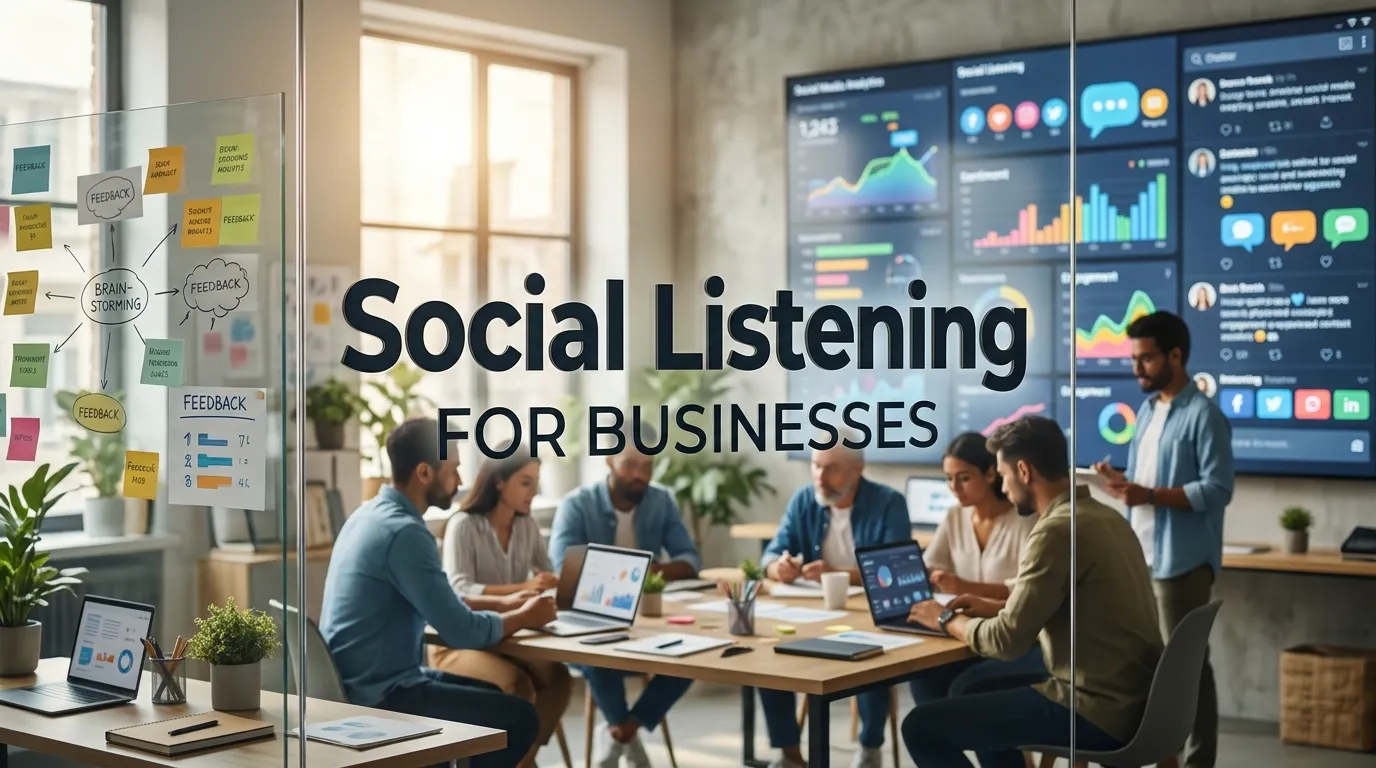 Social listening can benefit businesses of different sizes and across many industries. Small companies can use it to understand local customer preferences, while larger organizations can monitor multiple brands, markets, languages, and product categories. The specific tools may differ, but the underlying objective remains the same: understand conversations and use the findings to improve decisions.
A successful Social Media Listening Strategy should be integrated into everyday business operations rather than treated as an isolated marketing activity. Marketing teams can use insights to improve campaigns, customer service teams can identify common problems, product teams can prioritize improvements, and leadership teams can monitor shifts in customer perception.
Businesses should begin with realistic goals and a manageable monitoring process. Track a few important keywords, review conversations consistently, document recurring themes, and share relevant findings with the people responsible for taking action. As the process becomes more effective, expand monitoring to additional platforms and business objectives.
It is equally important to establish clear responsibilities and review performance periodically. Businesses should evaluate whether listening efforts are improving response quality, identifying problems earlier, informing product decisions, or supporting stronger customer relationships.
Ultimately, social listening creates value when insights lead to meaningful improvements. Companies that listen carefully, respond thoughtfully, and learn from customer conversations can build stronger relationships and make more informed marketing decisions.
Conclusion
A well-developed Social Media Listening Strategy helps businesses move beyond basic engagement metrics and understand the conversations shaping customer opinions. From selecting the right tools and analyzing sentiment to managing reputation, evaluating competitors, and improving customer experiences, social listening offers practical insights throughout the customer journey.
FAQ
1. What is a social media listening strategy?
A Social Media Listening Strategy is a structured approach to tracking and analyzing online conversations about a brand, its products, competitors, and industry. It helps businesses understand customer opinions, identify trends, and make informed decisions based on real conversations.
2. What is the difference between social media listening and monitoring?
Social media monitoring focuses on tracking mentions, comments, messages, and other interactions. Social listening analyzes those conversations to identify patterns, sentiment, customer needs, and broader market trends.
3. Which tools are best for social media listening?
Popular options include Brandwatch, Talkwalker, Sprout Social, and Hootsuite. The best choice depends on your budget, preferred platforms, reporting requirements, and the features available under each subscription plan.
4. Why is social media listening important for businesses?
It helps businesses understand customer expectations, identify complaints, improve products, measure public perception, discover industry trends, and respond to potential reputation issues before they grow.
5. How often should businesses monitor social media conversations?
Businesses should monitor important conversations regularly, with more frequent reviews during product launches, major campaigns, or reputation issues. Urgent customer complaints and potential crises may require immediate attention.
6. How does sentiment analysis support social listening?
Sentiment analysis categorizes conversations by their apparent emotional tone, helping businesses recognize positive feedback, dissatisfaction, and changes in public perception. Human review remains important because automated tools can misunderstand context and sarcasm.
7. Can small businesses benefit from social listening?
Yes. Small businesses can track brand mentions, customer reviews, local discussions, and competitor activity using affordable tools or platform-specific features. Even a simple, consistent process can reveal valuable customer insights.
8. How can social listening improve customer satisfaction?
It helps businesses identify recurring concerns, understand customer expectations, respond to complaints, and prioritize improvements. Acting on feedback can reduce frustration and demonstrate that customer opinions matter.
9. Which metrics should businesses track?
Useful metrics include brand mention volume, sentiment trends, share of voice, engagement quality, response time, recurring complaint categories, and campaign-related conversions. The most relevant measurements depend on the business objectives.
10. How can businesses measure the success of social listening?
Businesses can evaluate success by tracking improvements in customer response times, recurring complaint resolution, brand sentiment, customer satisfaction, campaign performance, and the number of actionable insights implemented. Regular reporting helps teams understand which activities produce meaningful results.






Leave a Reply