

A Social Media Listening Strategy helps businesses understand what customers say about their brand, products, competitors, and industry across social media platforms. By analyzing conversations, customer opinions, trending topics, and audience behavior, companies can improve marketing campaigns, strengthen customer relationships, and make informed business decisions. This guide explores social media listening tools, monitoring techniques, sentiment analysis, audience insights, and best practices to help businesses develop an effective strategy and achieve sustainable growth.
Social Media Listening Tools
Social media listening tools help businesses collect, organize, and analyze conversations from different online platforms. These tools can track brand mentions, industry keywords, hashtags, customer feedback, and competitor discussions. Depending on the platform, they may also offer sentiment analysis, reporting dashboards, and trend identification features.
Popular options include Brandwatch, Talkwalker, Sprout Social, and Mention. Each platform offers different capabilities, so businesses should compare features, pricing, supported channels, and reporting options before choosing a solution. Smaller companies may begin with native social media analytics and basic monitoring tools, while larger organizations may require advanced analytics and automated reporting.
Selecting the right tools is an important part of building a Social Media Listening Strategy. Businesses should identify their objectives first, such as improving customer service, measuring brand awareness, or researching competitors. Once these goals are clear, they can choose tools that provide relevant data and help teams turn information into practical actions.
Social Media Monitoring Strategy
A social media monitoring strategy establishes how a business tracks mentions, comments, messages, and conversations about its brand. It helps marketing teams respond to customer questions, identify complaints, and recognize opportunities to engage with their audience.
Effective monitoring begins with identifying relevant keywords, brand names, product names, campaign hashtags, and common variations or misspellings. Businesses should also monitor industry terms and competitor names to understand discussions beyond their own social profiles. Clear guidelines help teams decide which conversations require immediate responses and which can be reviewed during regular reporting.
A strong Social Media Listening Strategy combines monitoring with analysis. For example, a sudden increase in negative comments may indicate a product issue, a delivery problem, or a misunderstanding about a recent campaign. Recognizing the underlying cause enables a business to respond appropriately and prevent similar issues from affecting more customers.
Companies developing their broader marketing plans can also explore this social media marketing strategy guide to understand how listening can support their overall promotional activities.
Social Listening Best Practices
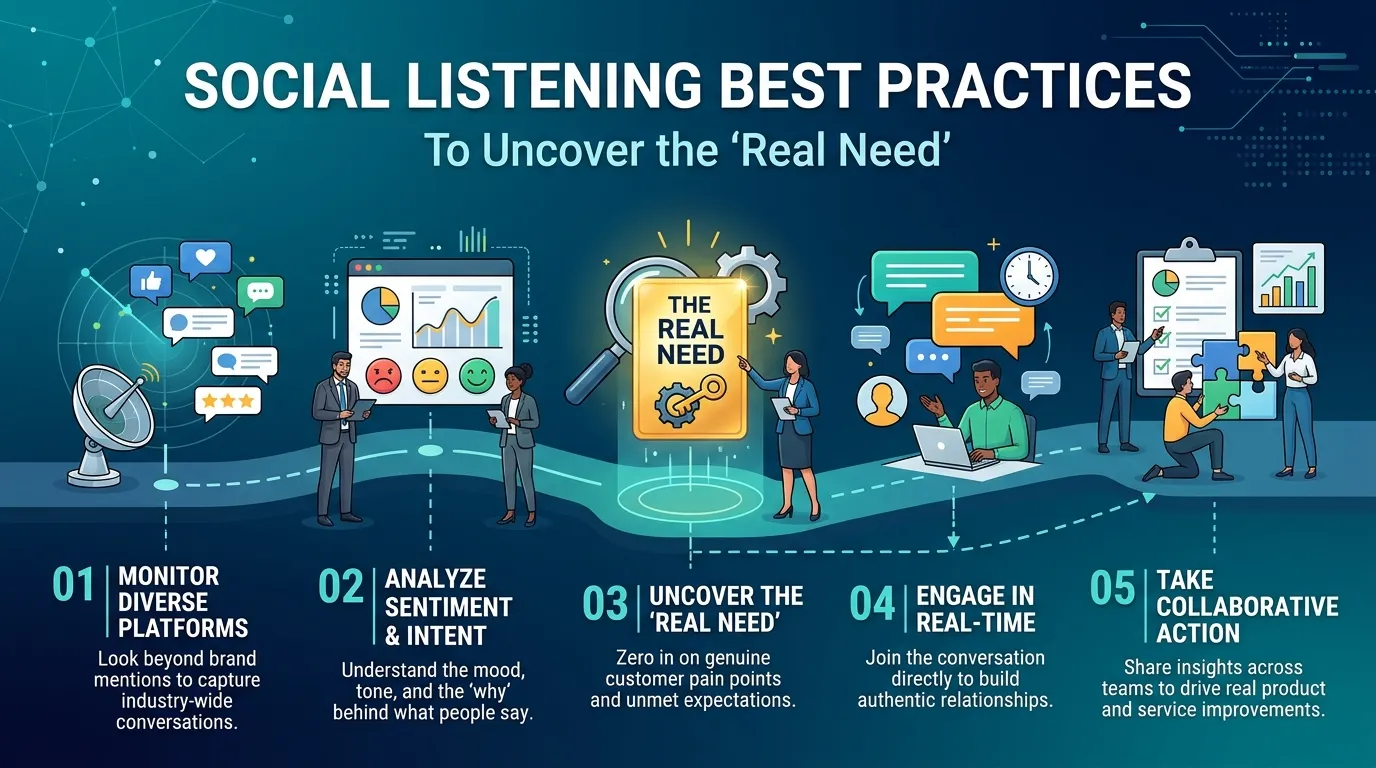 Successful social listening requires consistency, clear objectives, and responsible data management. Businesses should regularly review relevant conversations rather than collecting information only during product launches or marketing campaigns. Consistent analysis helps organizations identify changes in customer expectations and recognize developing problems before they become more serious.
Another important practice is to listen across multiple channels. Customers may discuss a company on Instagram, Facebook, TikTok, LinkedIn, forums, review websites, and other online communities. Focusing on a single platform can create an incomplete picture of brand perception.
An effective Social Media Listening Strategy should also prioritize context. A negative comment may represent an isolated experience, while repeated complaints about the same issue may indicate a larger problem. Teams should examine conversation patterns, audience characteristics, and relevant events before drawing conclusions.
Businesses should protect customer privacy, follow platform policies, and avoid collecting unnecessary personal information. They should also document important findings and share them with relevant departments so that insights lead to meaningful improvements rather than remaining unused in marketing reports.
Brand Sentiment Analysis
Brand sentiment analysis examines whether online conversations express positive, negative, or neutral opinions about a business. It helps organizations understand customer satisfaction, brand reputation, and public reactions to their products, services, and campaigns.
For example, positive discussions may indicate that customers appreciate product quality or customer support. Negative conversations may reveal delivery delays, pricing concerns, or disappointing experiences. Neutral mentions can provide useful information about product comparisons, general questions, and industry discussions.
A Social Media Listening Strategy can use automated sentiment analysis to process large volumes of conversations quickly. However, automated systems may misunderstand sarcasm, slang, humor, and cultural expressions. Businesses should therefore review important findings manually, especially when dealing with sensitive complaints or sudden changes in public opinion.
Sentiment analysis becomes more valuable when companies compare results over time. Tracking sentiment before and after a product launch, campaign, or service improvement can help determine whether customer perceptions are changing. Combining sentiment data with customer reviews, sales information, and support records provides a more complete understanding of brand performance.
Social Media Audience Insights
Audience insights help businesses understand who their customers are, what they care about, and how they communicate online. Social listening can reveal common questions, preferred content formats, purchasing concerns, and topics that generate meaningful engagement.
For instance, an online retailer may discover that customers frequently ask about product durability, delivery options, or return policies. These insights can guide content creation, improve product descriptions, and help customer service teams prepare more useful answers.
A data-driven Social Media Listening Strategy also helps marketers identify different audience segments. Some customers may prioritize affordability, while others value convenience, quality, sustainability, or customer support. Understanding these differences makes it easier to develop messages that address specific needs.
Businesses can use these findings alongside their e-commerce promotional efforts. This online store marketing guide offers a relevant resource for exploring ways to promote products and improve online store visibility. Combining audience insights with broader marketing activities can help businesses create more relevant customer experiences.
Social Listening for Businesses
Social listening benefits businesses of different sizes and across many industries. Small businesses can use it to understand local customer preferences, identify frequently asked questions, and discover opportunities to improve their services. Larger companies can analyze broader industry conversations, assess reputation risks, and evaluate customer responses across multiple markets.
A practical Social Media Listening Strategy should connect listening activities to specific business objectives. A customer service team may focus on identifying unresolved complaints, while a product development team may investigate recurring feature requests. Marketing teams may study campaign reactions, emerging topics, and competitor positioning.
Social listening can also support business growth by revealing unmet customer needs. When people repeatedly discuss a problem that existing products do not adequately solve, businesses may identify opportunities to develop new services or improve existing offerings.
Companies considering professional support can review this digital marketing company resource to explore how digital marketing services can support their wider promotional goals. However, the most effective results come when listening insights are connected to clear responsibilities, measurable objectives, and consistent action.
Customer Feedback Analysis
 Customer feedback analysis involves examining comments, reviews, messages, and online discussions to identify what customers appreciate and where improvements are needed. Unlike traditional surveys, social listening can uncover opinions that customers share naturally during everyday conversations.
Businesses should organize feedback into useful categories, such as product quality, customer service, pricing, delivery, usability, and overall satisfaction. Reviewing these categories regularly makes it easier to recognize repeated problems and prioritize improvements according to their frequency and business impact.
An effective Social Media Listening Strategy should also include a process for responding to important feedback. If customers repeatedly report confusing instructions, a company can update its product documentation. If delivery delays generate complaints, the business can investigate its logistics process and communicate more clearly with customers.
After implementing changes, organizations should continue monitoring conversations to understand whether customer experiences improve. This creates a continuous feedback cycle in which businesses listen, analyze, respond, and evaluate the results. Over time, this approach can strengthen customer trust and support better product and service decisions.
Social Media Engagement Strategy
A social media engagement strategy focuses on building meaningful interactions between a brand and its audience. Social listening supports this process by revealing which topics matter to customers, what questions they ask, and what type of content encourages discussion.
Rather than publishing content based only on assumptions, businesses can use listening insights to create relevant posts, answer common questions, and participate in conversations that align with their expertise. Timely responses to customer comments can also demonstrate that a company values feedback and takes concerns seriously.
A well-designed Social Media Listening Strategy helps businesses distinguish between superficial engagement and meaningful interaction. A post may receive many likes without generating valuable customer relationships, while a detailed discussion may reveal important product feedback or purchasing intent.
Listening can also help businesses identify emerging viral trends and decide whether participating is appropriate for their audience. Companies exploring trend-based content can consult this social media viral trends resource for additional ideas. Every trend should be evaluated for relevance, brand suitability, and potential risks before a company joins the conversation.
Competitor Social Media Analysis
Competitor analysis helps businesses understand how other brands communicate, engage audiences, and respond to market changes. By monitoring publicly available conversations about competitors, organizations can identify common customer expectations, industry weaknesses, and opportunities to differentiate their products or services.
Businesses may compare engagement patterns, customer complaints, recurring product requests, and audience reactions to promotional campaigns. For example, if customers frequently complain about limited support options offered by competing brands, a company may differentiate itself through faster responses and more accessible service.
A Social Media Listening Strategy should focus on learning from these patterns rather than simply copying competitors. Every business has different resources, customer expectations, and brand positioning. Competitor insights are most valuable when they inform original decisions that strengthen the company’s own value proposition.
Companies should also monitor changes in industry messaging and customer preferences. This can reveal opportunities for new campaigns, improved service delivery, or more effective communication. Competitor analysis should rely on publicly accessible information and respect platform rules, privacy requirements, and ethical research practices.
Social Media Listening Techniques
 Several techniques can make social listening more useful and efficient. Keyword tracking helps businesses discover conversations involving brand names, products, industry terms, and customer concerns. Hashtag analysis reveals discussions surrounding campaigns, events, and popular topics, while competitor monitoring helps identify changing market expectations.
Another valuable technique is trend analysis. By reviewing conversations over time, businesses can distinguish temporary spikes from sustained changes in customer interests. Influencer and community analysis can also reveal which voices contribute to discussions and how specific audiences respond to particular topics.
An advanced Social Media Listening Strategy combines these techniques with performance measurement. Businesses can monitor changes in sentiment, response times, recurring complaints, share of voice, and engagement quality. The most useful metrics depend on the original business objectives and should be selected accordingly.
Companies in industries that use multiple advertising channels can also examine how social conversations relate to other promotional activities. For example, this resource on the benefits of TV advertising provides relevant context for businesses considering traditional media alongside digital campaigns. Similarly, discussions about business opportunities can complement research into profitable online business ideas.
Ultimately, social listening techniques work best when they are combined into a consistent process. Businesses should collect relevant information, interpret the findings, assign responsibility for action, and review outcomes regularly. This turns online conversations into practical knowledge that supports better decisions.
Conclusion
A Social Media Listening Strategy enables businesses to understand customers, evaluate brand reputation, discover market opportunities, and improve their marketing decisions. By using appropriate tools, analyzing sentiment, monitoring competitors, and responding to feedback, organizations can build stronger relationships with their audiences.
The key is to move beyond collecting mentions and focus on understanding the meaning behind conversations. Businesses that listen consistently, respect customer privacy, and act on meaningful insights are better positioned to adapt to changing expectations and achieve sustainable growth.
FAQ
1. What is a social media listening strategy?
A social media listening strategy is a structured approach to collecting and analyzing online conversations about a brand, its competitors, customers, and industry. It helps businesses understand opinions, identify trends, and make informed decisions.
2. How is social media listening different from social media monitoring?
Social media monitoring primarily tracks mentions, comments, and messages so businesses can respond to conversations. Social listening goes further by analyzing patterns, customer sentiment, and underlying reasons behind those discussions.
3. Which social media listening tools are best for businesses?
Popular tools include Brandwatch, Talkwalker, Sprout Social, and Mention. The best choice depends on budget, platform coverage, reporting requirements, and the complexity of the business’s listening objectives.
4. Why is social listening important for marketing?
Social listening helps marketers understand audience preferences, measure reactions to campaigns, identify emerging trends, and create more relevant content. It can also reveal opportunities to improve customer relationships.
5. How does brand sentiment analysis work?
Brand sentiment analysis evaluates conversations to determine whether opinions are positive, negative, or neutral. Businesses can use automated tools and human review to understand customer perceptions and identify potential reputation issues.
6. Can small businesses benefit from social media listening?
Yes. Small businesses can use social listening to understand local audiences, respond to customer concerns, monitor competitors, and identify opportunities to improve products or services without necessarily investing in expensive software.
7. How often should businesses conduct social listening?
Social listening should be an ongoing activity. Businesses can review important mentions daily, monitor urgent issues in real time when possible, and conduct deeper analysis weekly or monthly, depending on their resources and objectives.
8. What metrics should businesses track?
Useful metrics include brand mention volume, sentiment trends, share of voice, response time, recurring customer concerns, and engagement quality. Businesses should select metrics that directly relate to their goals.
9. How can social listening improve customer satisfaction?
Social listening reveals customer complaints, questions, and suggestions. By responding promptly and addressing recurring issues, businesses can improve their products, services, communication, and overall customer experience.
10. What is the first step in creating a social media listening strategy?
Start by defining clear objectives, such as improving customer satisfaction, protecting brand reputation, or understanding competitors. Then identify relevant keywords, select suitable tools, establish a review process, and determine how insights will lead to action.






Leave a Reply