

This pillar guide brings together everything a marketing team needs to understand about social media listening and monitoring — the difference between the two, why they matter, how to build a strategy and choose the right tools, and how to apply listening data to brand reputation, customer insight, competitor analysis, and product research. Each section links to a focused deep-dive for readers who want to go further on a specific topic.
Every day, people talk about brands, products, and competitors across social platforms without ever tagging the company directly. A frustrated customer vents in a comment thread. A happy one posts an unprompted photo. A competitor’s product gets quietly compared to a brand’s own in a forum thread nobody on the marketing team will ever see — unless they’re actually listening.
Social media listening and monitoring are the disciplines built around catching exactly that kind of conversation, turning scattered mentions into usable signal. The two terms get used almost interchangeably in casual conversation, but they describe genuinely different activities that work best together. This guide walks through both, along with the strategy, tools, and specialized applications that turn raw social data into decisions a brand can actually act on.
What Is Social Media Listening?
Social media listening is the practice of tracking conversations across social platforms — mentions, keywords, hashtags, and broader topic discussions — to understand sentiment, themes, and emerging patterns, rather than just counting individual mentions. It goes beyond simply noticing when a brand is tagged; it captures the tone and context behind conversations, including ones where the brand is discussed but never directly mentioned by name or handle.
The distinction that matters most here is between reacting to individual posts and understanding the broader pattern those posts belong to. A single complaint is a customer service issue. A hundred similar complaints within a week, surfaced through listening, is a product or messaging problem that deserves strategic attention. Our detailed explainer on what social media listening actually is breaks down the mechanics of how this tracking works and how it differs from simple mention alerts.
Social Media Listening vs. Social Media Monitoring
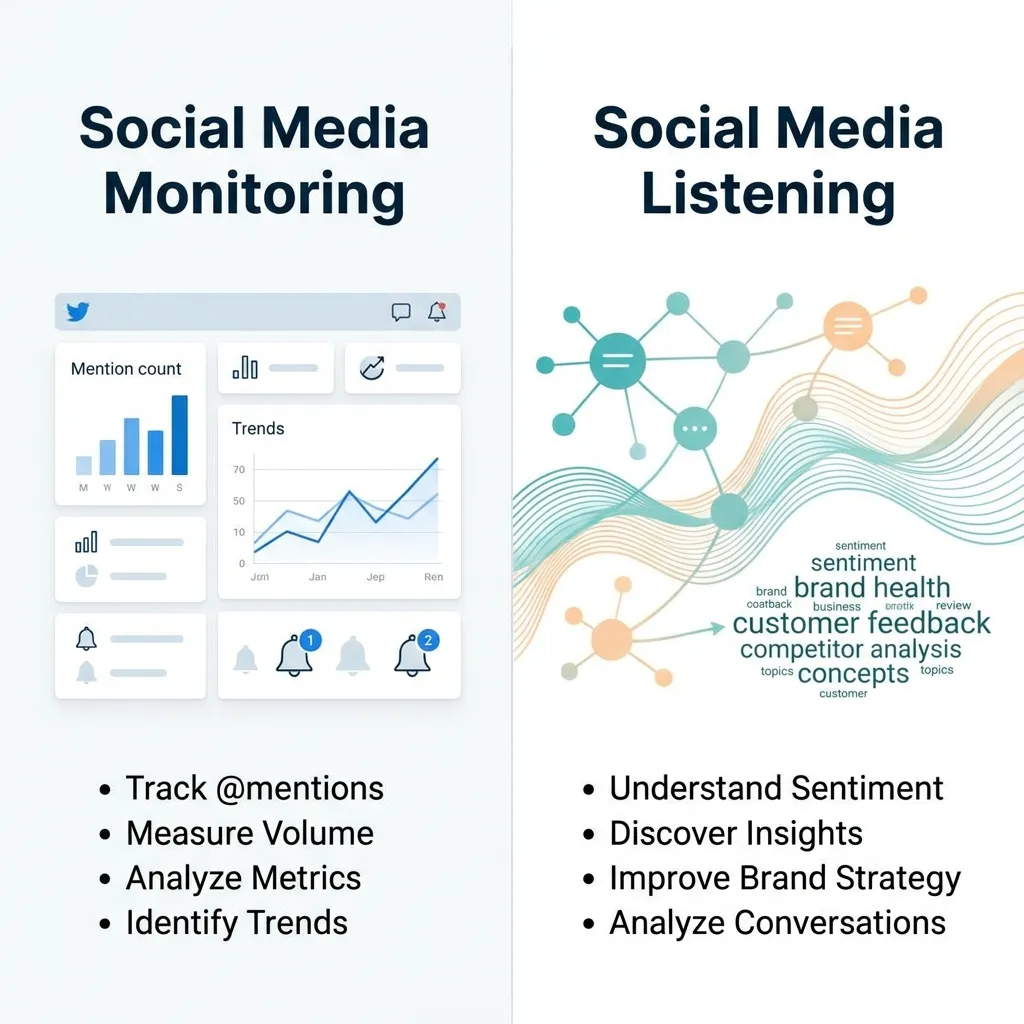
This distinction confuses more marketers than almost any other term pair in the discipline, and getting it right shapes how a team actually builds out its listening and monitoring program.
Social media monitoring is the narrower, more tactical activity: tracking specific, defined metrics and mentions — direct brand mentions, hashtags, customer service tickets flagged on social — and responding to them individually. It’s largely reactive and operational, often owned by a community management or customer support function.
Social media listening is the broader, more strategic activity: analyzing the themes, sentiment, and patterns across a much wider set of conversations, including ones that never directly mention the brand, to inform strategy rather than individual responses. It’s proactive and analytical, typically owned by marketing, insights, or product teams.
In practice, most mature programs need both — monitoring catches and resolves the individual moment, while listening reveals the pattern behind repeated moments. Our full comparison of social media monitoring covers where the operational and strategic responsibilities typically split within a marketing organization.
Benefits of Social Media Listening
The value of social media listening compounds across several distinct areas of a business, which is part of why it’s increasingly treated as a cross-functional capability rather than a marketing-only tool.
Faster issue detection. Problems surface on social media before they show up in formal support channels, giving teams a head start on addressing product or service issues before they escalate.
Sharper messaging. Understanding the actual language customers use to describe a product — not the language a brand assumes they use — makes marketing copy noticeably more resonant.
Competitive awareness. Listening surfaces how competitors are discussed, including complaints and praise a brand can use to sharpen its own positioning.
Crisis prevention. Catching a negative sentiment spike early, before it becomes a coordinated pile-on, gives a brand time to respond thoughtfully rather than defensively.
Product direction. Recurring feature requests or complaints, aggregated across thousands of organic conversations, often reveal product priorities that formal research misses. Our dedicated breakdown of social media listening benefits expands on each of these with examples of how different teams within an organization typically use the same underlying data differently.
Social Media Listening Strategy
A listening program without a defined strategy tends to generate interesting anecdotes but little actionable direction. Building a real strategy starts with a few deliberate decisions.
Define the questions first. Before choosing keywords or tools, a team should be clear on what decisions the listening data is meant to inform — brand health, competitive positioning, product feedback, or crisis readiness each require slightly different tracking setups.
Set up keyword and topic tracking deliberately. This includes brand names, common misspellings, product names, key competitor names, and industry or category terms broad enough to catch conversations where the brand isn’t mentioned directly but is relevant.
Establish a cadence for review. Real-time monitoring matters for urgent issues, but strategic listening insights usually emerge from weekly or monthly pattern review rather than a single day’s data.
Assign clear ownership. Listening data that nobody is responsible for actually reviewing and acting on tends to accumulate without ever influencing a decision. Our full walkthrough of social media listening strategy covers how to structure this process from initial setup through ongoing reporting.
Social Media Listening Best Practices
A handful of habits separate listening programs that consistently produce useful insight from ones that generate noise.
Track sentiment, not just volume. A spike in mentions can be good or bad — sentiment context is what turns a volume spike into an actual signal worth acting on.
Don’t ignore neutral and quiet signals. The loudest conversations aren’t always the most representative; quieter, consistent patterns often matter more than a single viral moment.
Segment by audience and channel. Conversation on a professional platform reads very differently from conversation on a more casual one, and treating all mentions identically flattens useful context.
Close the loop with other teams. Listening insight that stays inside marketing rarely reaches the product, support, or leadership teams who could act on it most directly.
Revisit tracked keywords regularly. Language shifts, new product names launch, and competitor sets change — a keyword list set up once and never revisited slowly becomes less accurate over time. Our detailed guide on social media listening best practices expands on each of these with concrete examples of what goes wrong when they’re skipped.
Social Media Monitoring Strategy
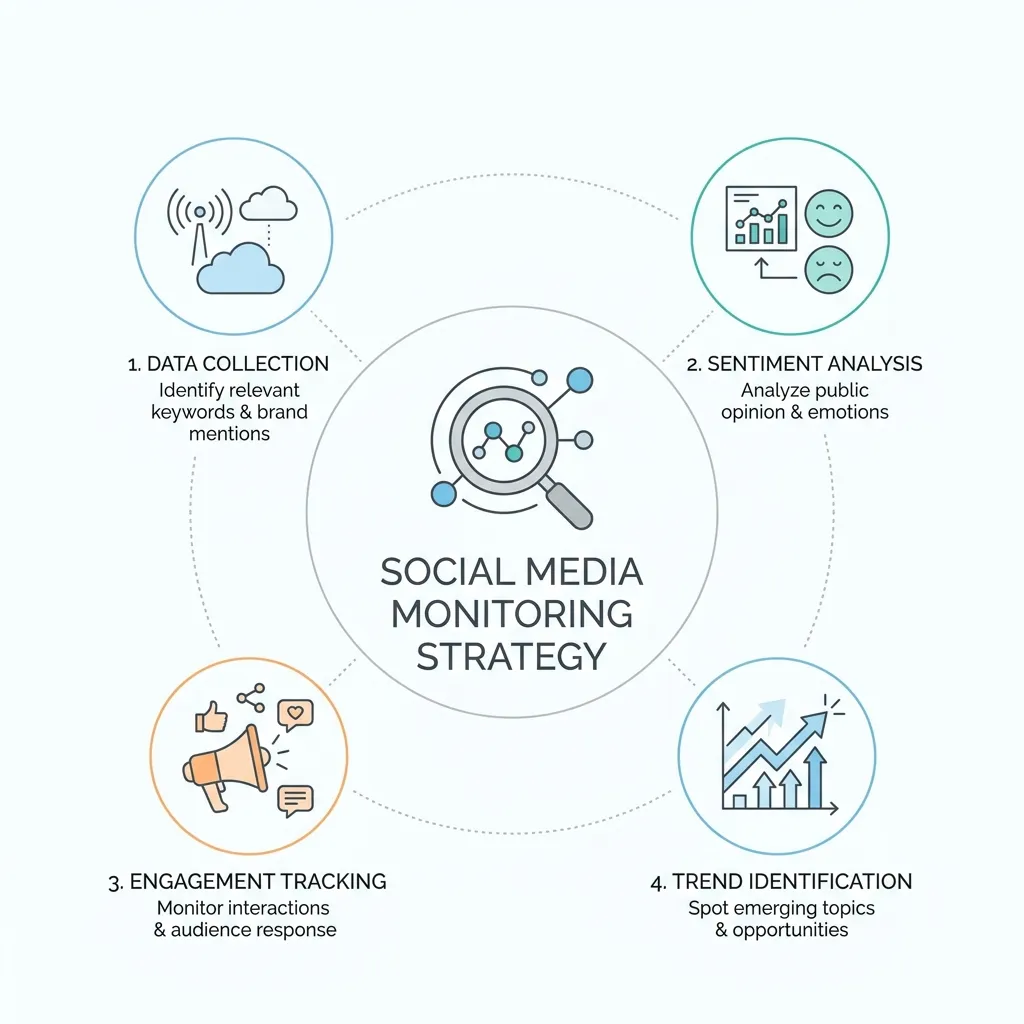
While listening strategy focuses on broad pattern discovery, monitoring strategy is built around consistent, reliable coverage of the specific mentions and channels that need a timely response.
A workable monitoring strategy typically defines response time targets by mention type — a direct complaint might need a response within an hour, while a neutral mention might not need one at all — along with clear escalation paths for anything touching legal, safety, or major reputational risk. It also requires deciding which channels get active human monitoring versus automated alerting only, since coverage expectations vary significantly by platform and audience size. Our dedicated guide on social media monitoring strategy walks through how to set these parameters realistically for a team’s actual staffing capacity.
Social Media Brand Monitoring
Brand monitoring specifically focuses on tracking how a brand’s name, products, and leadership are discussed, separate from broader category or competitor conversations. This narrower scope makes it well suited to ongoing reputation tracking and rapid response, since the volume is more manageable than full-category listening.
Effective brand monitoring tracks not just direct mentions but common variations — misspellings, abbreviations, nicknames a community has adopted — along with mentions of key spokespeople or executives whose public statements can directly affect brand perception. Our full guide on social media brand monitoring covers how to build tracking that catches these variations without generating so many false positives that the alerts get ignored.
Social Media Monitoring Tools & Platforms
Choosing the right tooling is one of the most consequential decisions in a listening and monitoring program, since the platform shapes what’s actually trackable and how much manual effort is required to extract insight.
Social Media Monitoring Tools
At the tactical end, monitoring tools focus on real-time alerts, mention tracking, and response workflows — typically integrating directly with a team’s existing social publishing and customer service tools. Our guide to social media monitoring tools breaks down what to look for depending on team size and response volume.
Social Listening Tools
Listening-focused tools go further, offering sentiment analysis, topic clustering, and historical trend data across much larger conversation volumes than a typical monitoring tool covers. Our overview of social listening tools covers the core feature set that separates a genuine listening platform from a basic mention tracker.
Best Social Listening Tools
Comparing specific platforms against each other — pricing, data coverage, ease of use, and integration depth — is where most teams actually make their purchasing decision. Our comparison of the best social listening tools on the market walks through how leading options stack up across these criteria for different team sizes and budgets.
Social Listening Platforms
Beyond individual tool comparisons, it’s worth understanding platform categories broadly — enterprise suites built for large organizations, mid-market tools built for growing teams, and lightweight options built for solo marketers or small businesses. Our guide to social listening platforms breaks down these categories and which type of organization each is actually built for.
Social Media Listening Software
Software selection also depends on deployment and integration needs — whether a tool needs to connect with an existing CRM, a support ticketing system, or a business intelligence dashboard. Our detailed look at social media listening software covers integration considerations that often get overlooked during an initial feature comparison.
Social Listening for Specialized Business Functions
Beyond general brand tracking, social listening data serves several distinct, high-value use cases once a team moves past basic monitoring.
Social Listening for Brand Reputation
Reputation-focused listening tracks sentiment trends over time rather than individual mentions, helping a brand spot a slow reputational decline — or improvement — long before it shows up in survey data or formal brand tracking studies. Our guide on social listening for brand reputation covers how to set up sentiment tracking that’s sensitive enough to catch meaningful shifts without overreacting to daily noise.
Social Listening for Customer Insights
Unprompted social conversation often reveals customer motivations and language more honestly than a formal survey does, since people aren’t filtering their words for a research context. Our resource on social listening for customer insights explains how to extract structured insight from inherently unstructured conversational data.
Social Listening for Competitor Analysis
Tracking how competitors are discussed — their launches, complaints against them, and comparisons customers make unprompted — provides a window into competitive positioning that’s harder to get through formal research alone, since it captures organic, unfiltered comparison rather than a survey respondent’s considered answer. Our guide on social listening for competitor analysis covers how to build competitor tracking that stays useful without becoming an overwhelming firehose of low-value data.
Social Listening for Product Research
Recurring feature requests, workaround discussions, and complaints aggregated across social conversation frequently surface product opportunities before they reach a formal product feedback channel. Our detailed piece on social listening for product research walks through how product teams specifically mine listening data for direction, separate from the marketing-focused use cases covered elsewhere in this guide.
How Listening and Monitoring Work Together
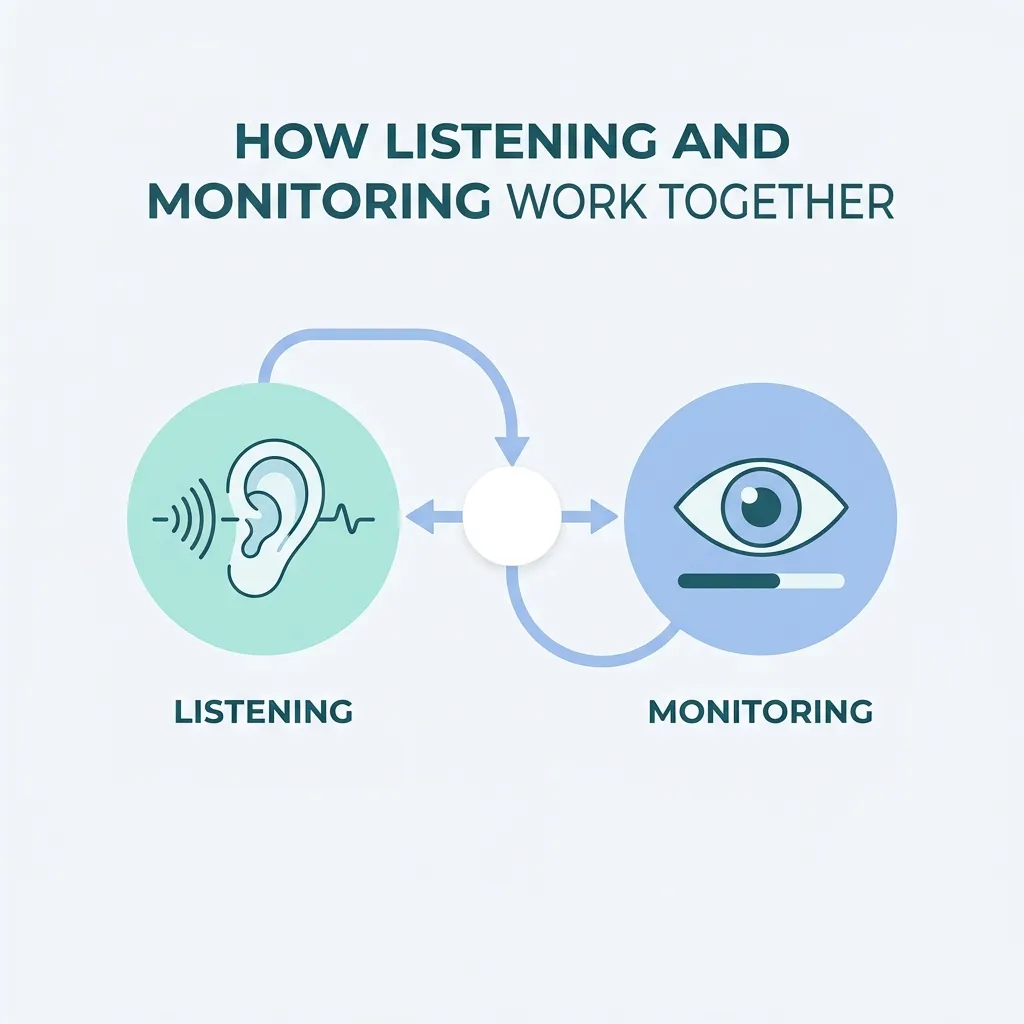
None of these sixteen concepts function in isolation. Monitoring catches the individual mention that needs an immediate response; listening reveals the pattern that mention belongs to. Strategy defines what to track and why; tools determine how efficiently that tracking actually happens. Brand monitoring keeps daily reputation risk in check, while the specialized applications — reputation trend analysis, customer insight, competitor analysis, and product research — turn accumulated listening data into decisions that reach well beyond the marketing or community team that originally set up the tracking.
A mature program treats social media listening and monitoring as connected disciplines rather than a single tool purchase. The tooling matters, but the strategy, ownership, and cross-functional habits built around that tooling are usually what determine whether a listening program produces real business value or just an interesting dashboard nobody checks after the first month.
There’s also a growing connection between social listening data and predictive analysis more broadly — using accumulated sentiment and conversation trends to anticipate shifts before they fully materialize rather than only reacting after they do. An outside resource on emotion analytics covers how this kind of sentiment-driven measurement is being applied across marketing more broadly, and a related piece on customer emotion mapping explains how teams translate raw sentiment signals — the same kind surfaced through social listening — into structured customer understanding that informs strategy beyond social media alone.
Getting this connected system working well typically takes longer than most teams expect. The tooling can be live within a day, but building the cross-functional habits — a product manager actually checking the listening dashboard before a roadmap meeting, a support lead flagging pattern shifts to marketing rather than just closing tickets — usually takes several months of consistent practice before it becomes routine rather than a novelty. Programs that survive past the initial setup phase tend to share one trait: someone with enough organizational standing has made reviewing and acting on listening data part of a recurring meeting, rather than leaving it as an optional dashboard anyone can check if they remember to.
Conclusion
Social media listening and monitoring aren’t interchangeable tasks — monitoring keeps a brand responsive in the moment, while listening reveals the broader patterns that shape strategy over time. Together, supported by the right tools and a clearly owned process, they turn an enormous, otherwise unmanageable stream of public conversation into something a brand can actually act on: faster issue resolution, sharper messaging, stronger competitive positioning, and product direction grounded in what customers are actually saying, not just what they say when asked directly. Each linked guide above goes deeper into its specific piece of this discipline — this page exists to show how all sixteen fit together into one coherent practice.
Frequently Asked Questions About Social Media Listening and Monitoring
1. What’s the Simplest Way to Explain the Difference Between Social Media Listening and Monitoring?
Monitoring tracks and responds to specific, defined mentions in real time, while listening analyzes broader patterns, sentiment, and themes across a wider range of conversations to inform marketing strategy.
2. Do Small Businesses Need Both Listening and Monitoring, or Just One?
Most small businesses can start with monitoring for timely responses and add social listening as conversation volume grows enough to reveal meaningful patterns rather than isolated comments.
3. How Is Sentiment Measured in Social Listening Tools?
Most platforms use natural language processing to classify mentions as positive, negative, or neutral. Accuracy can vary, so human review is often useful for sarcasm, context, and industry-specific language.
4. What’s the Difference Between a Monitoring Tool and a Listening Platform?
Monitoring tools primarily focus on real-time mention tracking and response workflows, while listening platforms typically add capabilities such as sentiment analysis, topic clustering, and historical trend analysis across broader conversations.
5. How Often Should a Brand Review Its Social Listening Data?
Urgent mentions may require real-time attention, but strategic insights usually come from reviewing broader patterns weekly or monthly rather than reacting to individual daily fluctuations.
6. Can Social Listening Replace Formal Customer Research?
Not entirely. Social listening provides unprompted customer insights that can complement formal research, but it does not offer the structured and representative sampling that surveys, interviews, and other research methods can provide.
7. What Industries Benefit Most From Social Listening?
Consumer-facing industries with high volumes of social conversations, including retail, hospitality, consumer technology, and entertainment, can benefit significantly. B2B brands can also use social listening for competitive and product insights.
8. How Does Competitor Analysis Work Through Social Listening?
Brands can track how competitors are discussed, including recurring praise, complaints, and comparisons. This provides insight into customer perceptions and competitive positioning from organic conversations.
9. What’s the Biggest Mistake Brands Make With Social Monitoring?
Treating every mention with the same level of urgency can overwhelm teams with low-value alerts. Brands should prioritize important issues while analyzing broader patterns for strategic insights.
10. Who Should Own Social Listening Within a Marketing Organization?
Ownership varies by company size, but social listening data can be more useful when shared across marketing, product, and customer support teams rather than being isolated within one department.
11. How Do Brands Use Listening Data for Product Research?
Brands can track recurring feature requests, workaround discussions, and customer complaints across organic conversations. These patterns can reveal potential product improvements and opportunities.
12. Is It Worth Investing in Enterprise-Grade Listening Platforms for a Growing Brand?
Not necessarily at first. Growing brands can begin with a tool that matches their current conversation volume and needs, then consider enterprise-level platforms when greater scale, complexity, and cross-team usage justify the investment.






Comments (1)
What Is Social Media Listening? A Complete Explainersays:
September 17, 2026 at 11:46 am[…] to what is social media listening in application, and this piece sits within our broader pillar guide to social media listening and monitoring, which connects this explainer to the full set of related strategy, tools, and specialized-use-case […]