

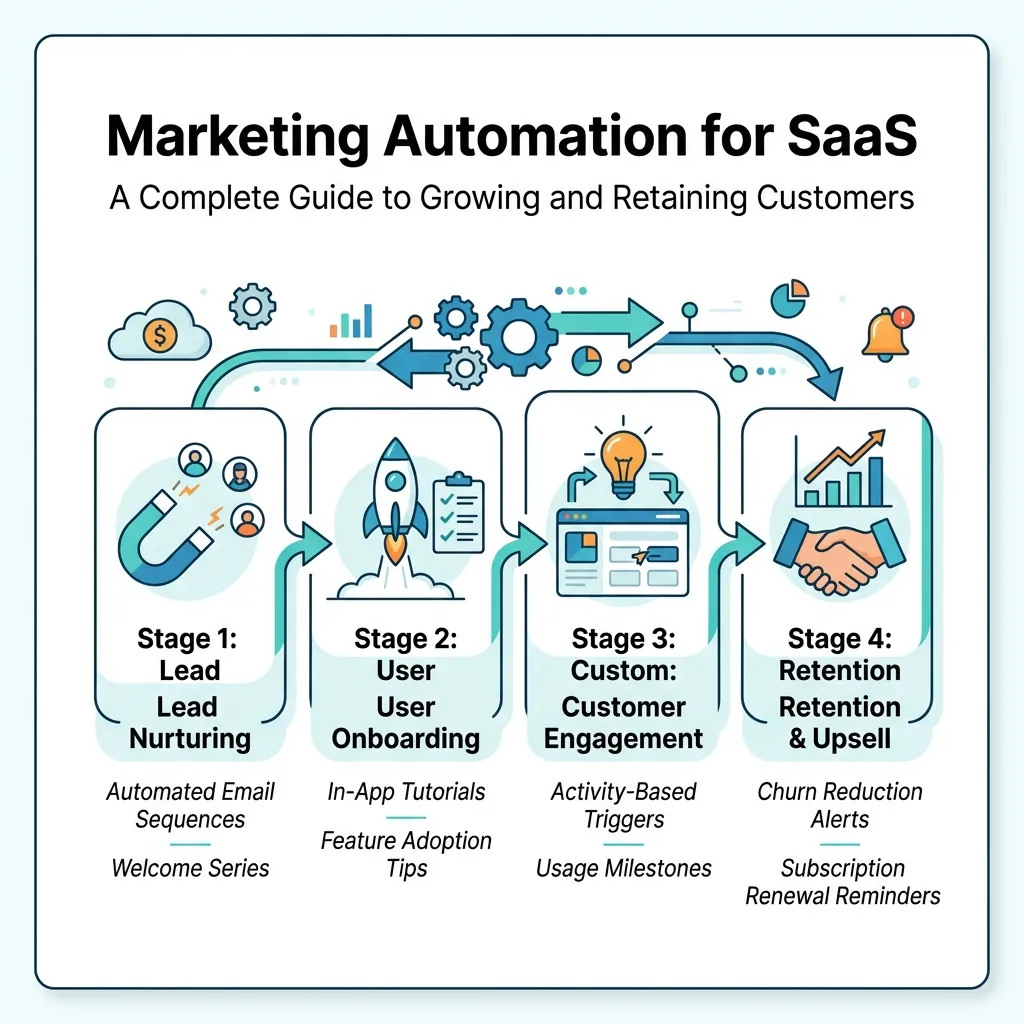
Marketing automation for SaaS helps software companies attract prospects, nurture leads, convert free users, and retain paying customers through automated, behavior-based campaigns. This guide explains how SaaS automation works, which workflows matter most, how to connect CRM and product data, and how to measure results without creating a poor customer experience.
SaaS companies operate differently from traditional businesses. Customers may discover a product through search engines, content, social media, or referrals before signing up for a free trial. They may then explore features, invite teammates, upgrade to a paid plan, and eventually become long-term subscribers.
Every stage requires a different type of communication. A new visitor needs education, a trial user needs activation guidance, a qualified prospect may need sales assistance, and an existing customer may need product education or retention support.
Managing every interaction manually becomes increasingly difficult as a SaaS business grows. This is where marketing automation for SaaS becomes valuable. Instead of sending the same message to everyone, SaaS companies can create automated journeys based on customer characteristics, lifecycle stages, and behavior.
What Is Marketing Automation for SaaS?
Marketing automation for SaaS is the use of software and automated workflows to manage repetitive marketing activities throughout the SaaS customer lifecycle.
These activities can include lead capture, email nurturing, free-trial onboarding, customer segmentation, product education, upgrade campaigns, re-engagement, and retention communication.
The objective is not simply to send more messages. The objective is to send more relevant messages at the right moment.
For example, imagine a visitor signs up for a free trial of a project management platform. A marketing automation workflow could:
- Send a welcome email immediately after signup.
- Explain how to complete account setup.
- Introduce the platform’s core feature.
- Encourage the user to create their first project.
- Send a helpful reminder if the user has not completed setup.
- Recommend a relevant tutorial based on product activity.
- Alert the sales team when the account demonstrates strong buying intent.
- Send an upgrade message when the user reaches a relevant usage limit.
This approach creates a more personalized experience than sending identical promotional emails to every subscriber.
Marketing automation is generally designed to automate marketing processes and customer communication, while CRM systems focus more heavily on organizing customer and sales information. The two technologies often work together. Marketing automation overview on Wikipedia
Why SaaS Businesses Need Marketing Automation
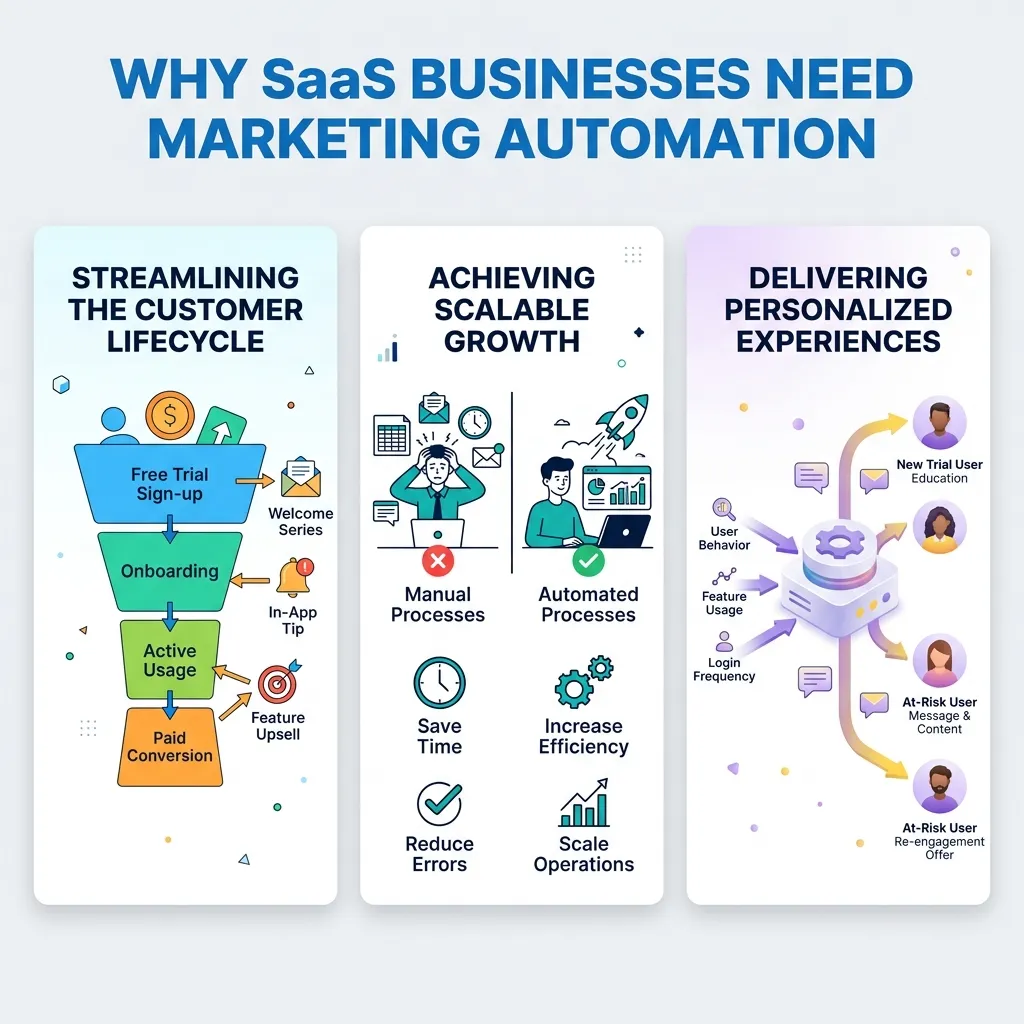
SaaS growth depends on much more than acquiring website visitors. Companies need to convert prospects, activate users, demonstrate product value, encourage adoption, and retain paying customers.
Marketing automation can connect these stages into a more organized customer journey.
1. SaaS Customer Journeys Are Complex
A SaaS customer may interact with a company through search, social media, blog content, webinars, product pages, pricing pages, free trials, sales calls, and customer support.
Each interaction can represent a different level of intent.
A person who downloads an introductory guide should not necessarily receive the same message as a trial user who has already invited several teammates.
Automation allows companies to create different journeys based on customer stage, behavior, and interests.
2. Free Trials Need Consistent Nurturing
Many SaaS companies use free trials or freemium models to reduce the barrier to adoption.
However, signing up does not mean a user immediately understands the product. Some users may never complete the initial setup or discover the feature that provides the greatest value.
Automated onboarding can guide users through these important steps without requiring a marketer to manually contact every account.
3. Retention Is Critical for SaaS Growth
SaaS businesses depend on recurring revenue. Acquiring customers is important, but keeping those customers active is equally important.
Automated retention campaigns can identify inactive users, introduce useful features, provide educational resources, and encourage customers to continue getting value from the product.
4. Automation Makes Scaling Easier
As the number of leads and customers increases, manually managing every communication becomes inefficient.
Automation handles repetitive activities while marketers spend more time on strategy, content, testing, and optimization.
How Marketing Automation for SaaS Works
A SaaS automation system usually combines customer information, behavioral data, triggers, workflows, and communication channels.
Step 1: Collect Customer and Product Data
Useful data can come from:
- Website forms
- Trial registrations
- Product usage
- Email engagement
- Content downloads
- Webinar registrations
- CRM records
- Subscription information
- Support interactions
- Account activity
The purpose is to collect data that helps the company make better decisions.
Step 2: Segment Users
Segmentation divides contacts or accounts into useful groups.
Common SaaS segments include:
- New leads
- Free-trial users
- Freemium users
- Product-qualified leads
- Paying customers
- High-value accounts
- Inactive users
- Cancelled customers
Companies can also segment users according to industry, company size, job role, plan type, location, or product usage.
Step 3: Define Triggers
Triggers determine when an automated workflow should begin.
Examples include:
- A user signs up.
- A prospect downloads content.
- A customer visits the pricing page.
- A user reaches a usage threshold.
- A customer stops using the product.
- A lead requests a demo.
- A subscription approaches renewal.
Step 4: Create Conditions and Actions
After a trigger occurs, conditions determine what happens next.
For example, a trial user who has completed onboarding may receive product education, while a trial user who has not logged in may receive a re-engagement message.
Actions can include sending emails, updating CRM fields, notifying sales representatives, assigning leads, or moving contacts into another workflow.
Step 5: Measure Results
Every workflow should have measurable objectives.
Depending on the campaign, businesses may track activation rate, conversion rate, engagement, retention, customer lifetime value, or revenue.
Essential SaaS Marketing Automation Workflows
A SaaS business does not need dozens of complicated workflows immediately. It is better to begin with the journeys that have the greatest effect on growth.
1. Lead Capture and Welcome Workflow
This workflow starts when someone submits a form, downloads a resource, subscribes to a newsletter, or otherwise becomes a known lead.
A basic sequence can include:
- Confirmation message
- Welcome email
- Educational content
- Relevant product information
- Clear next step
The goal is to establish trust and move the lead toward a meaningful action.
2. Free-Trial Onboarding Workflow
Trial onboarding is one of the most valuable automation opportunities for SaaS companies.
A possible sequence could look like this:
Day 0: Welcome message and setup instructions
Day 1: Core feature introduction
Day 3: Product tutorial
Day 5: Reminder to complete an important activation action
Day 7: Common problem-solving resources
Before trial expiry: Plan information and next steps
The timing should be adjusted according to the product’s typical user behavior.
3. Product Education Workflow
SaaS products often contain more features than users initially discover.
A product education workflow can introduce features gradually based on actual customer behavior.
For example, if a customer creates a project but does not use collaboration features, the system can later provide educational content about team collaboration.
4. Lead Nurturing Workflow
Not every lead is ready to purchase immediately.
Lead nurturing helps companies educate prospects over time.
A typical journey may look like:
Awareness → Educational content
Consideration → Use cases and comparisons
Evaluation → Case studies and product demonstrations
Decision → Pricing, demo, or sales consultation
For broader workflow planning, SaaS marketers can also review this related guide on marketing automation workflows.
5. Product-Qualified Lead Workflow
A product-qualified lead, or PQL, is a user whose product behavior indicates meaningful interest or potential buying intent.
Possible signals include:
- Inviting teammates
- Creating multiple projects
- Using advanced features
- Reaching a plan limit
- Repeatedly visiting pricing information
When these signals are combined with appropriate qualification criteria, automation can alert the sales team or trigger a more relevant communication.
However, product activity should not automatically be treated as purchase intent. Businesses should establish clear qualification rules.
6. Upgrade and Expansion Workflow
SaaS companies can use automation to identify customers who may benefit from a higher plan.
Useful triggers may include:
- Reaching usage limits
- Adding additional users
- Using features associated with higher plans
- Increasing account activity
- Viewing upgrade information
The communication should focus on the value of the upgrade rather than simply asking customers to pay more.
7. Customer Retention Workflow
Retention workflows help customers continue receiving value from the product.
They may include:
- Product tips
- Feature education
- Usage reminders
- Customer success communication
- Renewal preparation
- Re-engagement campaigns
The goal is to make the product more useful, not simply increase the number of emails sent.
8. Churn Prevention Workflow
Automation can identify potential churn signals before a customer cancels.
Possible warning signs include:
- Declining product usage
- Fewer logins
- Unresolved support issues
- Missed onboarding milestones
- Reduced engagement
- Failed payments
Depending on the situation, the system can provide educational content, offer assistance, or alert a customer success representative.
9. Renewal and Win-Back Workflow
Renewal workflows can remind customers about upcoming renewal dates and reinforce the value they receive from the product.
Win-back campaigns target customers who have cancelled or become inactive.
These campaigns should be personalized around the likely reason for disengagement instead of sending a generic discount to every former customer.
Marketing Automation for SaaS and CRM Integration
CRM integration is an important part of a scalable SaaS marketing system.
A CRM may contain:
- Contact information
- Company information
- Sales stage
- Account owner
- Deal value
- Communication history
- Customer status
Marketing automation can add behavioral information such as email engagement, website activity, and product usage.
For example, if a lead downloads an educational guide and later requests a demo, the sales representative can see those interactions and approach the conversation with greater context.
Clear lifecycle stages are also important. SaaS teams should define when a visitor becomes a lead, when a lead becomes qualified, and when a customer moves from acquisition into retention.
How to Build a SaaS Marketing Automation Strategy
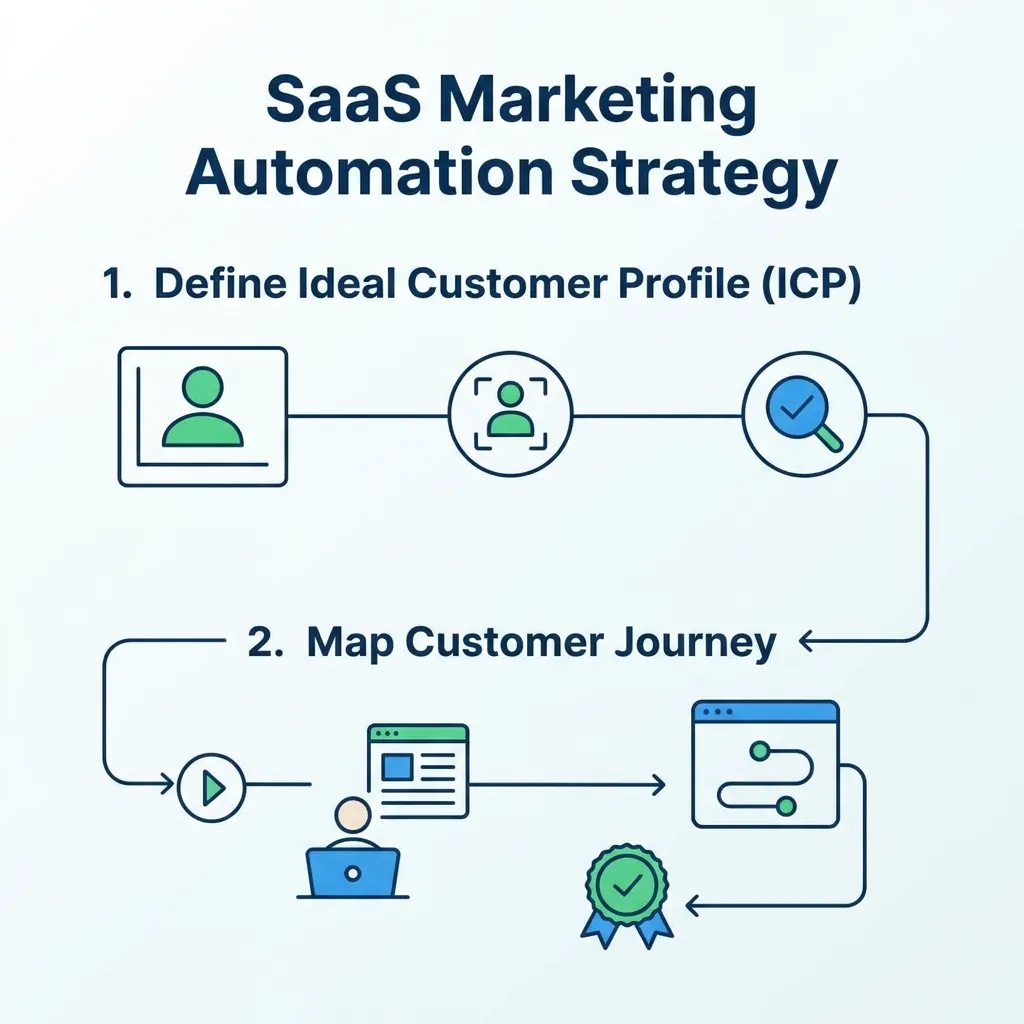
A strong strategy begins with business objectives instead of software features.
1. Define One Primary Goal
Possible goals include:
- Increasing trial activation
- Improving trial-to-paid conversion
- Reducing churn
- Increasing feature adoption
- Improving lead qualification
- Increasing expansion revenue
Starting with one or two priorities makes implementation easier.
2. Map the Customer Lifecycle
A simple SaaS lifecycle could be:
Visitor → Lead → Trial User → Activated User → Paying Customer → Retained Customer → Advocate
Your actual lifecycle may contain additional stages depending on your product and sales model.
3. Identify Important Customer Actions
Determine which actions show that a user is progressing.
Examples include:
- Completing setup
- Creating a first project
- Inviting teammates
- Connecting an integration
- Using a core feature
- Reaching a usage milestone
These actions can become workflow triggers.
4. Create Useful Content
Every automated workflow needs a reason for the customer to engage.
Content may include:
- Tutorials
- Product guides
- Case studies
- Educational articles
- FAQs
- Onboarding emails
- Feature explanations
The content should solve the customer’s current problem instead of constantly promoting the product.
5. Define Exit Conditions
Every workflow should have clear stopping rules.
For example, a trial onboarding campaign should stop when a user upgrades to a paid plan.
Without exit conditions, users may continue receiving messages that no longer apply to them.
6. Test the Workflow
Before launching, test different scenarios.
Check:
- Trigger conditions
- Audience segmentation
- Personalization
- Links
- Timing
- CRM updates
- Exit conditions
Testing prevents simple automation errors from becoming customer-experience problems.
7. Optimize Continuously
Automation should evolve based on real performance.
Review which messages help users progress and which messages create unnecessary friction.
Best Practices for Marketing Automation for SaaS
A strong SaaS automation system should prioritize relevance, timing, and customer experience.
Personalize Based on Behavior
Behavior-based personalization is usually more useful than simple personalization such as inserting a first name.
A message based on actual product usage can be much more relevant.
Avoid Over-Automation
Automation should not eliminate human interaction.
Sales representatives, customer success teams, and support specialists remain important when customers have complex questions or problems.
Keep Communication Useful
Every message should have a clear purpose.
If an email does not provide meaningful information, assistance, or a logical next step, it may not need to be sent.
Use Multiple Channels Carefully
Email is common in SaaS automation, but companies may also use in-app messages, notifications, and other communication channels.
The goal is consistency rather than overwhelming customers.
Respect Communication Preferences
Customers should have appropriate control over marketing communications.
Businesses should also follow applicable privacy and communication requirements when collecting and using customer data.
Align Marketing With Sales and Customer Success
Marketing automation should not operate independently from the rest of the customer lifecycle.
Marketing, sales, and customer success teams should understand which customer signals trigger communication and how those signals affect the customer experience.
For additional guidance on building a structured automation approach, see marketing automation strategy.
Common Marketing Automation Mistakes
Automating Without a Clear Objective
Adding automation simply because a platform offers a feature can create unnecessary complexity.
Every workflow should have a specific purpose.
Sending the Same Message to Everyone
A new lead, active trial user, and long-term customer have different needs.
Segmentation should reflect these differences.
Ignoring Product Usage
For SaaS companies, product behavior can provide valuable context.
A customer who has never used a key feature may need education, while a customer who is already highly active may need expansion opportunities.
Measuring Only Email Metrics
Open rates and click-through rates can provide useful information, but they should not be the only measures of success.
Connect campaigns to business outcomes such as activation, conversion, retention, and revenue.
Forgetting the Human Element
Automation should support relationships rather than replace them.
Customers should still have access to appropriate human assistance when needed.
How to Measure SaaS Marketing Automation Success
The metrics you choose should match the purpose of each workflow.
Lead Generation Metrics
- Qualified leads
- Cost per lead
- Lead conversion rate
- Form conversion rate
Trial and Activation Metrics
- Trial signup rate
- Activation rate
- Time to first value
- Trial-to-paid conversion rate
Engagement Metrics
- Email click-through rate
- Content engagement
- Feature adoption
- Workflow completion
Revenue Metrics
- Customer acquisition cost
- Customer lifetime value
- Expansion revenue
- Marketing-influenced revenue
Retention Metrics
- Customer churn
- Revenue churn
- Renewal rate
- Customer retention
The strongest measurement approach connects automation activity with actual customer and business outcomes.
Tools Commonly Used for SaaS Marketing Automation
Different SaaS businesses require different technology stacks.
Common categories include:
- Marketing automation platforms
- CRM systems
- Customer data platforms
- Product analytics tools
- Customer success platforms
- Email marketing platforms
When evaluating a platform, consider:
- Integration capabilities
- Segmentation
- Workflow flexibility
- Reporting
- Ease of use
- Scalability
- Data management
- Cost
The best platform is not necessarily the one with the largest number of features. It is the one that fits the company’s customer journey and operational requirements.
The Future of Marketing Automation for SaaS
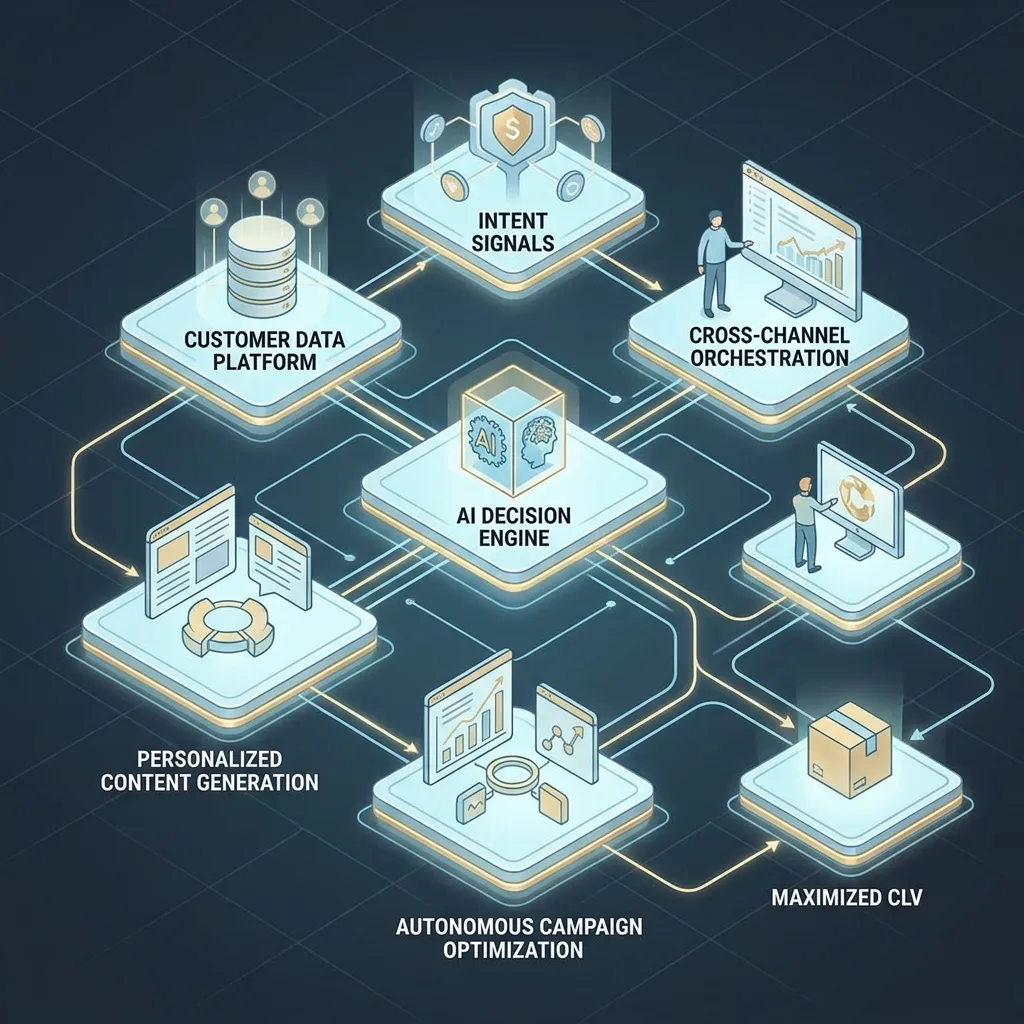
SaaS automation is becoming increasingly data-driven. Companies can use behavioral information to make customer journeys more relevant and responsive.
Artificial intelligence can also support tasks such as content personalization, audience analysis, campaign optimization, and predictive customer insights.
However, technology should not replace strategy.
The quality of the underlying customer data, segmentation, messaging, and workflow logic remains more important than simply adding more automation features.
A well-designed system combines automation with human judgment.
Conclusion
Marketing automation for SaaS helps software companies create scalable, personalized customer journeys from the first interaction through acquisition, activation, retention, and expansion.
The most effective approach is not to automate everything at once. Start with high-impact workflows such as lead nurturing, free-trial onboarding, product education, and customer retention. Then connect those workflows with CRM and product data so communication becomes more relevant.
Successful SaaS automation depends on three things: understanding the customer journey, delivering useful communication, and measuring meaningful business outcomes.
When these elements work together, automation can reduce repetitive work while helping customers discover value faster and remain engaged for longer.
Frequently Asked Questions (FAQs)
1. What is marketing automation for SaaS?
Marketing automation for SaaS is the use of software to automate marketing activities throughout the SaaS customer lifecycle, including lead nurturing, trial onboarding, product education, conversion, and retention.
2. Why is marketing automation important for SaaS companies?
It helps SaaS businesses manage customer journeys at scale, improve communication, support product adoption, and reduce repetitive manual marketing work.
3. What are the most important SaaS marketing automation workflows?
Common workflows include lead capture, welcome campaigns, free-trial onboarding, product education, lead nurturing, upgrade campaigns, retention, churn prevention, and renewal campaigns.
4. How does marketing automation help SaaS free trials?
It can guide users through onboarding, introduce important features, encourage activation, provide educational resources, and send relevant reminders before the trial ends.
5. What is a product-qualified lead?
A product-qualified lead is a user whose product activity indicates meaningful interest in a paid solution. Signals may include strong feature usage, team invitations, or reaching usage limits.
6. How does CRM integration support SaaS marketing automation?
CRM integration connects marketing interactions with customer and sales information, allowing teams to understand customer activity and coordinate marketing and sales actions.
7. Can marketing automation reduce SaaS churn?
It can support retention by identifying disengagement signals, providing relevant education, and helping customers get more value from the product. However, automation alone cannot guarantee lower churn.
8. What data is needed for SaaS marketing automation?
Useful information can include signup details, product usage, email engagement, subscription information, customer lifecycle stage, and relevant support interactions.
9. How do I start marketing automation for my SaaS business?
Start with one clear business objective, map the customer lifecycle, identify important customer actions, and build a simple workflow around a specific customer need.
10. What metrics should SaaS companies track?
Important metrics include activation rate, trial-to-paid conversion, feature adoption, customer retention, churn, customer lifetime value, and revenue-related outcomes.
11. Is marketing automation useful for small SaaS companies?
Yes. Small SaaS businesses can benefit from automation by starting with simple, high-impact workflows and expanding them as their customer base grows.
12. What is the difference between SaaS marketing automation and CRM?
Marketing automation focuses primarily on automated marketing activities and customer communication, while CRM systems primarily organize customer, account, and sales information. They commonly work together.





Leave a Reply