


Marketing automation platforms handle the repetitive, time-sensitive work of modern marketing — sending the right email at the right moment, scoring leads based on behavior, and triggering follow-up actions without a person manually pressing send each time. As marketing teams are asked to do more with smaller headcounts, these platforms have shifted from a nice-to-have to a core part of the marketing stack. This guide covers what marketing automation platforms actually do, the key features that separate strong platforms from weak ones, how to evaluate and choose the right one for a given team size and budget, and the common implementation mistakes that quietly waste the investment even after the right platform has been selected. Along the way, it also covers how to measure whether a platform is actually paying for itself, and where the category is likely headed as AI becomes a standard part of nearly every vendor’s roadmap.
Every growing marketing team eventually hits the same wall: too many leads, too many touchpoints, and not enough hours to manage them manually. Marketing automation platforms exist to solve exactly that problem, turning multi-step processes — welcome sequences, lead scoring, re-engagement campaigns — into workflows that run continuously in the background, adjusting to each contact’s behavior without requiring a marketer to intervene at every step.
The market for marketing automation platforms has matured significantly, and the differences between vendors go well beyond surface-level email design tools. Understanding what actually separates a strong platform from a merely adequate one is essential before committing to a tool that a team may depend on for years.
What Are Marketing Automation Platforms?
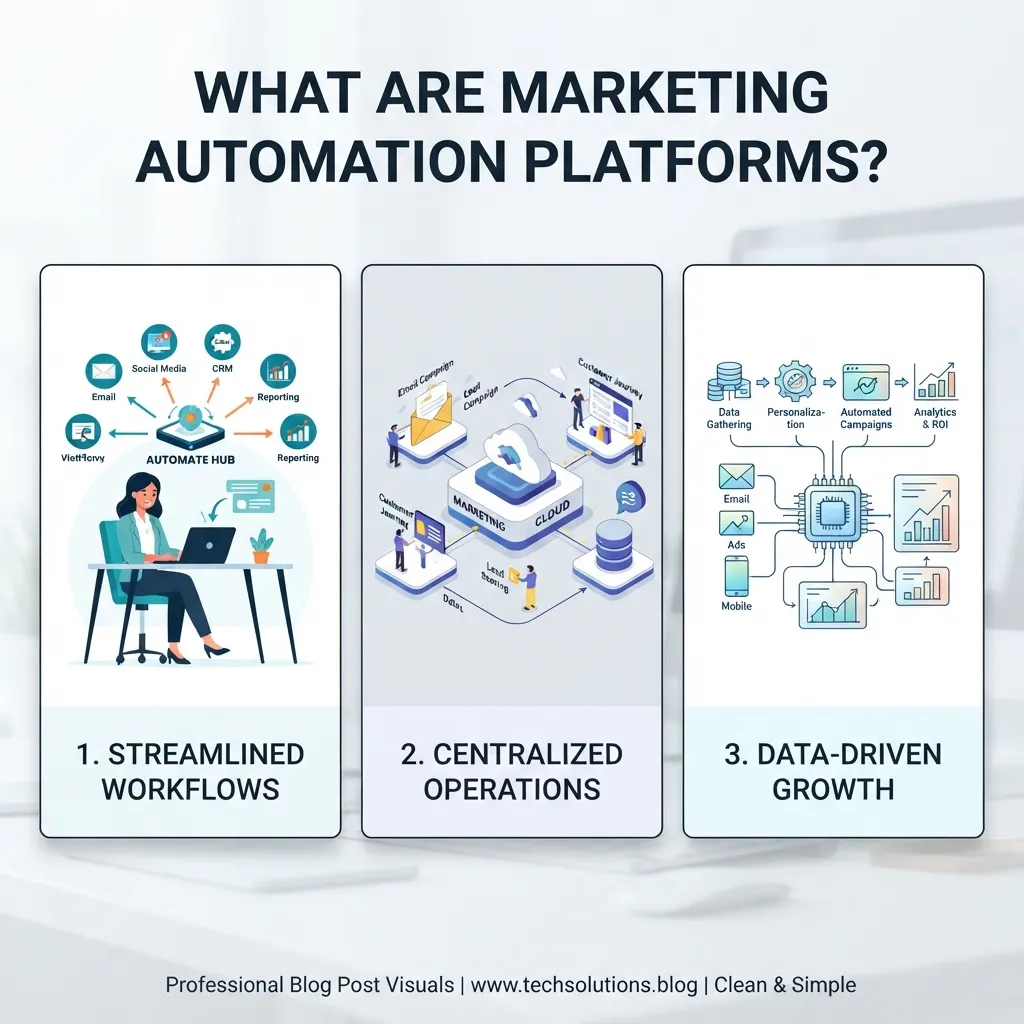
A marketing automation platform is software that manages and automates repetitive marketing tasks and multi-channel campaigns, typically triggered by a contact’s behavior, attributes, or lifecycle stage. Rather than sending a single email blast to an entire list, these platforms let marketers build conditional workflows: if a visitor downloads a specific resource, send a follow-up email three days later; if they don’t open it, send a different one a week after that. The underlying logic can branch as many times as needed, so a single workflow can eventually account for dozens of possible paths a contact might take based on how they engage at each step.
Most marketing automation platforms combine several core capabilities into a single system:
- Email marketing and drip campaigns, including behavior-triggered sequences rather than one-off sends.
- Lead scoring, which assigns numeric value to contacts based on engagement and fit, helping sales teams prioritize outreach.
- Workflow and journey building, usually through a visual, drag-and-drop interface for designing multi-step automations.
- CRM integration, syncing contact and activity data between marketing and sales systems.
- Analytics and reporting, tracking campaign performance, attribution, and pipeline contribution.
- Multi-channel orchestration, extending automation beyond email into SMS, push notifications, retargeting ads, and more.
Why Marketing Automation Platforms Matter
They Scale Personalization Without Scaling Headcount
Sending a genuinely personalized message to every lead manually simply isn’t feasible past a certain volume. Marketing automation platforms make it possible to deliver relevant, timely messaging to thousands of contacts simultaneously, each following a slightly different path based on their own behavior and interests.
They Shorten the Gap Between Interest and Follow-Up
A lead that fills out a form at 11 p.m. shouldn’t have to wait until the next business day for a response. Automated workflows can trigger an immediate follow-up, book a meeting, or route a hot lead to sales within minutes of a qualifying action, closing a gap that used to depend entirely on staff availability.
They Provide Visibility Into What’s Actually Working
Because every step of an automated journey is tracked, marketing automation platforms generate detailed data on which messages, timing, and channels actually move contacts forward. This kind of granular reporting is difficult to replicate with manual, ad hoc campaign execution.
They Connect Marketing and Sales Data
Tight CRM integration means sales teams see the same behavioral and engagement history that marketing does, reducing the friction and miscommunication that often occurs when the two systems operate independently.
Key Features to Evaluate in a Marketing Automation Platform
Ease of Workflow Building
A platform’s automation power means little if building a workflow requires a developer or a steep learning curve. Look for a visual builder that lets marketers construct, test, and adjust multi-step journeys without needing technical support for every change.
Lead Scoring and Segmentation Flexibility
Strong platforms allow scoring models based on a combination of demographic fit and behavioral engagement, along with flexible segmentation that can be adjusted as a business’s ideal customer profile evolves over time.
Native and Third-Party Integrations
A marketing automation platform rarely operates in isolation. Native integrations with a CRM, e-commerce platform, webinar tool, or advertising accounts reduce the need for custom development and keep data flowing consistently across the stack. Before committing to a platform, it’s worth confirming not just that an integration exists, but how deep it goes — a “connection” that only syncs contact names and email addresses provides far less value than one that also passes purchase history, engagement scores, and campaign attribution both ways.
Multi-Channel Capabilities
While email remains the backbone of most automation platforms, the strongest options extend workflows into SMS, in-app messaging, retargeting ads, and increasingly, direct mail — allowing a single journey to reach a contact wherever they’re most likely to engage. This kind of channel breadth also connects naturally with how SEO, PPC, and email marketing typically work together as part of a broader acquisition and nurture strategy, rather than automation existing as an isolated silo.
AI-Powered Optimization
Many modern platforms now use AI to optimize send times, subject lines, and content recommendations automatically, reducing the manual testing burden while often outperforming static, rules-based automation on engagement metrics.
Reporting and Attribution Depth
Basic open and click tracking is table stakes; the more valuable platforms provide multi-touch attribution, revenue reporting, and the ability to trace a closed deal back through the specific automated touchpoints that influenced it.
How to Choose the Right Marketing Automation Platform
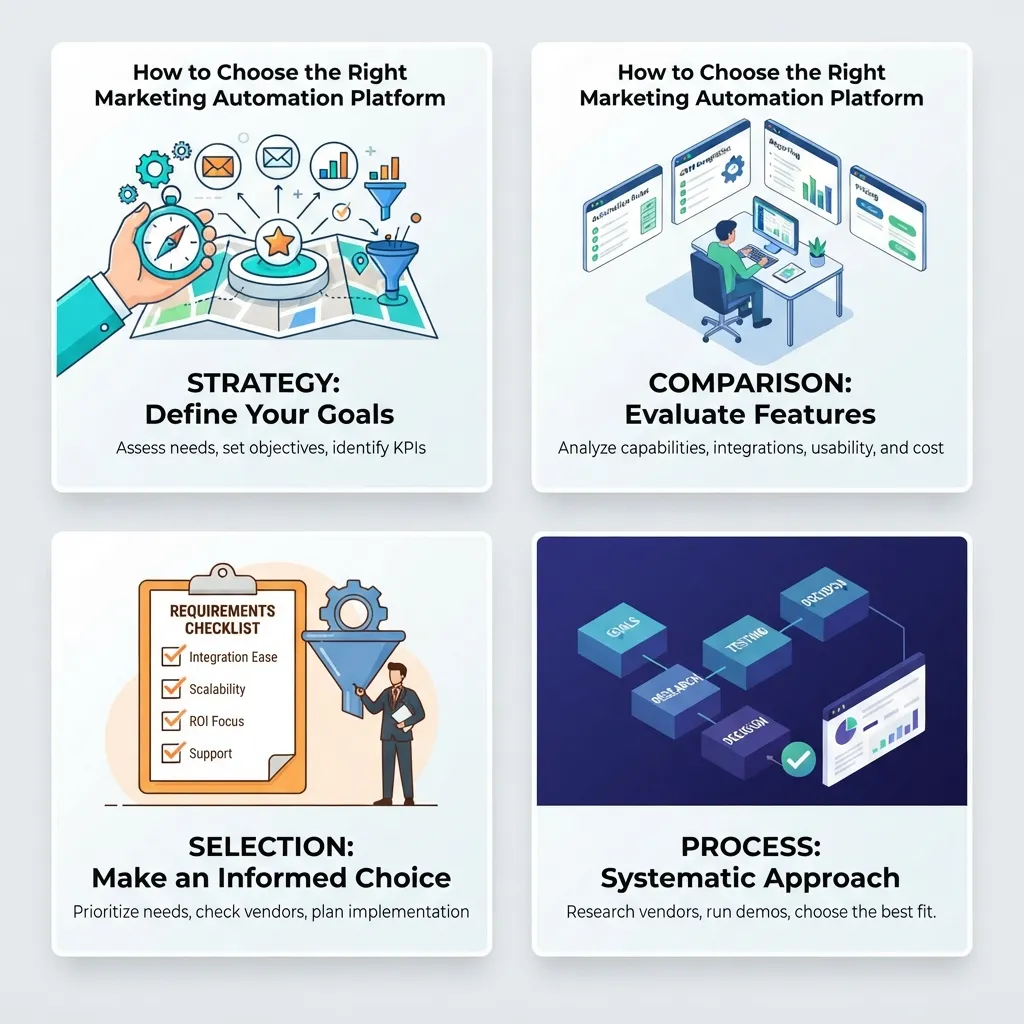
1. Start With Your Actual Use Cases, Not Feature Lists
It’s easy to be drawn in by a long feature list, but the right platform is the one that handles the specific workflows a team actually needs — whether that’s lead nurturing, customer onboarding, re-engagement, or event promotion — rather than the one with the most total capabilities on paper. Writing out the three or four workflows a team most urgently needs, before ever booking a vendor demo, makes it far easier to see past flashy but ultimately unused features during the evaluation process.
2. Match the Platform to Team Size and Technical Skill
A platform built for large enterprise marketing operations often introduces unnecessary complexity for a small team, while a lightweight tool may quickly become limiting as a company scales. Reviewing options built specifically with smaller teams and budgets in mind is worth doing before assuming a larger, more expensive platform is automatically the safer choice.
3. Test the Actual Integration With Existing Systems
A platform that claims to integrate with a CRM or e-commerce system doesn’t always do so cleanly in practice. Testing the real data sync — not just the marketing page’s list of “supported integrations” — during a trial period avoids unpleasant surprises after signing a contract.
4. Evaluate Total Cost, Not Just the Sticker Price
Many marketing automation platforms price based on contact volume or feature tiers, and costs can escalate quickly as a list grows. Factoring in likely growth over the next one to two years, not just current needs, prevents a platform choice that looks affordable today from becoming a budget problem later.
5. Prioritize Onboarding and Support Quality
Even a powerful platform delivers little value if a team struggles to implement it correctly. Vendors that offer structured onboarding, templates, and responsive support tend to see faster time-to-value than those that leave new customers to figure out the platform entirely on their own.
Best Practices for Getting Value From a Marketing Automation Platform
Following established marketing automation best practices makes a measurable difference in how quickly a platform starts delivering returns:
- Start with a small number of high-impact workflows rather than trying to automate everything at once.
- Keep data clean and consistent, since poor data quality undermines even the most sophisticated automation logic.
- Regularly audit and prune old workflows, since outdated automations can quietly send irrelevant messages long after their original purpose has changed.
- Align marketing and sales on lead scoring definitions, so a “qualified” lead means the same thing to both teams.
- Test before scaling, running new workflows on a smaller segment before rolling them out to the full contact database.
Common Mistakes When Implementing Marketing Automation
- Automating a broken process. Automation makes a good process more efficient, but it also makes a flawed process fail faster and at greater scale.
- Over-segmenting to the point of complexity. Too many narrow segments can make a system difficult to maintain and understand, even if each one seemed reasonable individually.
- Neglecting list hygiene. Sending automated campaigns to outdated, unengaged, or invalid contacts hurts deliverability and skews performance data.
- Treating automation as “set and forget.” Workflows need periodic review as products, offers, and customer behavior change over time.
- Underinvesting in training. A platform is only as effective as the team’s ability to use its more advanced features, not just the basics.
- Ignoring the human handoff. Even the best automated nurture sequence eventually needs a clean transition to a human salesperson or support agent; a clumsy handoff can undo much of the goodwill built during automated touchpoints.
Measuring Marketing Automation Platform ROI
A few metrics reveal whether a marketing automation platform is actually paying for itself, and tracking them consistently over time — rather than only at the moment of purchase — is what separates teams that keep improving their setup from those that quietly let it stagnate:
- Time saved on manual tasks. Comparing hours spent on manual campaign execution before and after implementation quantifies one of the most direct benefits.
- Lead-to-customer conversion rate. Improved nurturing and scoring should show up as a measurable lift in how many leads eventually convert.
- Sales cycle length. Faster follow-up and more consistent nurturing often shorten the time between initial interest and closed deal.
- Revenue attributed to automated workflows. Platforms with strong attribution reporting can tie specific automated sequences directly to closed revenue.
- Contact engagement over time. Rising or falling engagement trends within automated sequences indicate whether messaging and timing are still resonating with the audience.
The Future of Marketing Automation Platforms

AI is reshaping marketing automation platforms faster than almost any other part of the marketing stack. Predictive lead scoring, generative content suggestions, and automated campaign optimization are moving from premium add-ons to standard, expected features. As automation extends further into adjacent formats — for instance, automated webinar promotion and follow-up sequences — the line between separate marketing tools and a single, unified automation layer continues to blur. Platforms that can orchestrate consistent messaging across email, ads, events, and sales outreach from one central system are likely to pull further ahead of point solutions that only automate a single channel. Buyers evaluating platforms today should weigh not just current feature sets but each vendor’s roadmap and pace of AI investment, since the gap between platforms on this front is likely to widen considerably over the next few product cycles.
Conclusion
Choosing the right marketing automation platform isn’t about finding the tool with the longest feature list — it’s about matching real workflows, team size, and budget to a platform that can grow alongside the business. The strongest results come not just from picking the right software, but from disciplined implementation: clean data, focused workflows, and ongoing review rather than a “set it and forget it” mindset. Teams that treat the initial rollout as the finish line, rather than the starting point, tend to see returns plateau quickly, while those that keep refining workflows based on real performance data continue extracting more value from the same platform year after year. Done well, a marketing automation platform becomes less of a standalone tool and more of the connective layer that keeps marketing, sales, and customer communication working from the same playbook.
Frequently Asked Questions
1. What is a marketing automation platform?
A marketing automation platform is software that automates repetitive marketing tasks and multi-channel campaigns based on a contact’s behavior, attributes, or lifecycle stage.
2. How is marketing automation different from email marketing software?
Email marketing software typically sends standalone campaigns, while automation platforms build conditional, multi-step workflows triggered by specific actions or behaviors.
3. Do small businesses need a marketing automation platform?
Many small businesses benefit from lightweight tools designed for smaller teams, even if they don’t need the full feature set of enterprise-grade solutions.
4. What features matter most when choosing a platform?
Ease of workflow building, integration quality, lead scoring flexibility, multi-channel support, and reporting depth are among the most important features to evaluate.
5. How long does it take to see ROI?
Timelines vary, but teams that start with a small number of focused workflows may see measurable time savings and engagement improvements within the first few months.
6. Can these platforms integrate with a CRM?
Yes. Most modern platforms offer native or third-party CRM integrations, making integration capabilities an important factor during evaluation.
7. What’s the biggest mistake companies make with automation?
Automating a broken or poorly defined process is a common mistake because automation can scale inefficiency just as effectively as it scales well-designed processes.
8. Are AI features worth prioritizing?
AI-driven features, such as send-time optimization and content recommendations, can improve campaign efficiency and are worth evaluating alongside traditional automation capabilities.
9. How often should workflows be reviewed?
Workflows should be reviewed periodically because outdated automations can continue sending irrelevant messages long after their original purpose has changed.
10. What’s the difference between lead scoring and segmentation?
Lead scoring assigns a numeric value based on fit and engagement, while segmentation groups contacts according to shared characteristics for more targeted messaging.
11. Can automation platforms handle channels beyond email?
Yes. Many platforms support SMS, push notifications, retargeting ads, and even direct mail as part of a single automated workflow.
12. How do you measure the success of a marketing automation platform?
Time saved, lead-to-customer conversion rate, sales cycle length, and revenue attributed to automated workflows are among the most useful success metrics.






Leave a Reply