

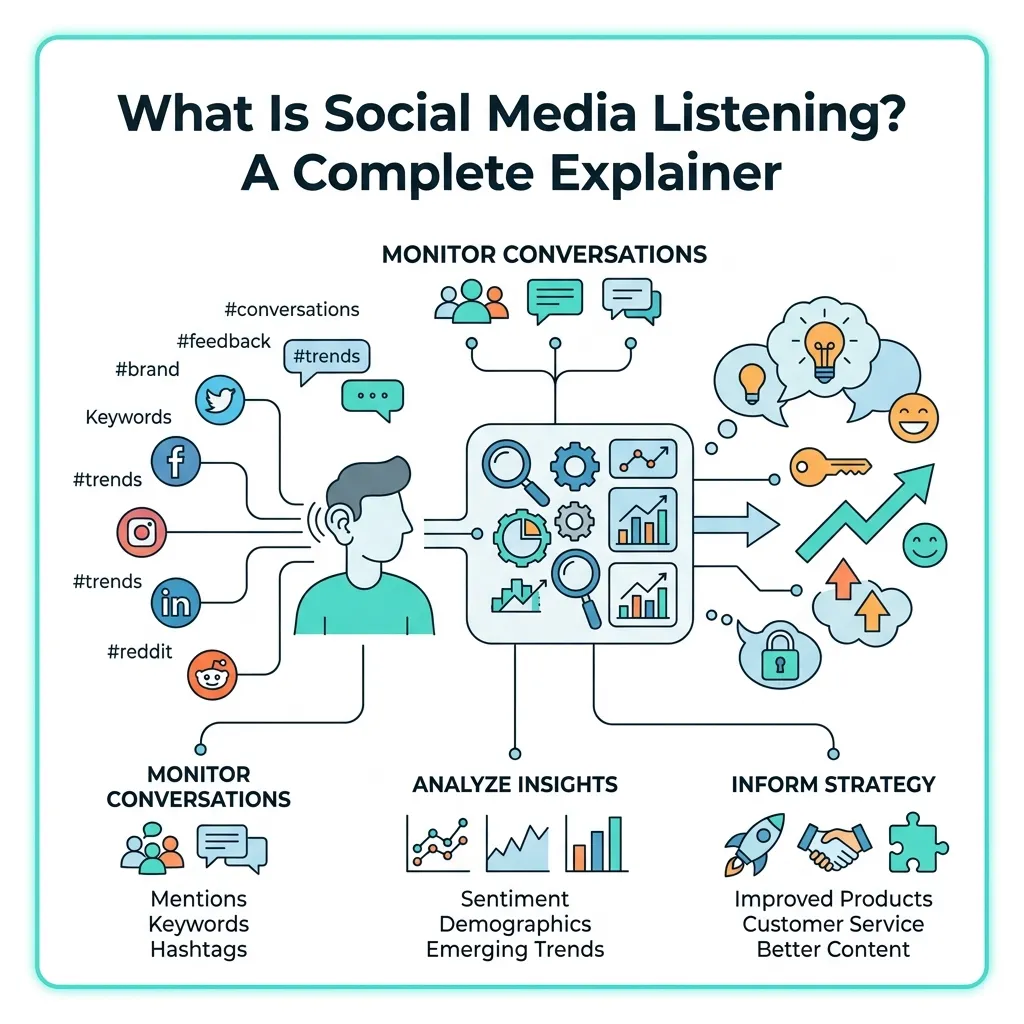
Social media listening is the practice of tracking and analyzing conversations across social platforms to understand sentiment, themes, and emerging patterns — not just counting individual mentions. This guide explains what social media listening actually involves, how it differs from monitoring, what data it captures, and how brands turn that data into real strategic decisions.
To understand what social media listening is, start here: somewhere right now, someone is probably talking about a brand without tagging it, mentioning it in a comparison thread, or venting about a product issue in a comment section nobody from that company will ever see manually. Multiply that across millions of daily posts, and it becomes clear why simply checking notifications isn’t enough to understand how a brand is actually perceived. That’s the gap social media listening is built to close.
This guide answers the core question directly: what is social media listening, really, beyond the marketing buzzword it’s often reduced to? It covers how the practice actually works, what makes it different from the more tactical activity of monitoring, what kind of data it captures, and how teams turn scattered conversation into decisions that actually shape strategy.
What Is Social Media Listening, Exactly?
Social media listening is the ongoing practice of tracking conversations across social platforms — mentions, keywords, hashtags, and broader topic discussions — in order to understand sentiment, recurring themes, and emerging patterns over time. It goes well beyond checking who tagged a brand; it captures conversations where a brand, product, or category is discussed without ever being directly mentioned by name or handle.
The core distinction that defines what is social media listening comes down to scope and purpose. Rather than tracking a narrow set of defined mentions for individual response, listening casts a wider net across relevant keywords and topics, then analyzes what’s found for patterns that inform decisions — not react to a single post. A useful way to think about it: monitoring answers “did someone mention us,” while listening answers “what are people actually saying, and what does it mean.”
How Social Media Listening Actually Works
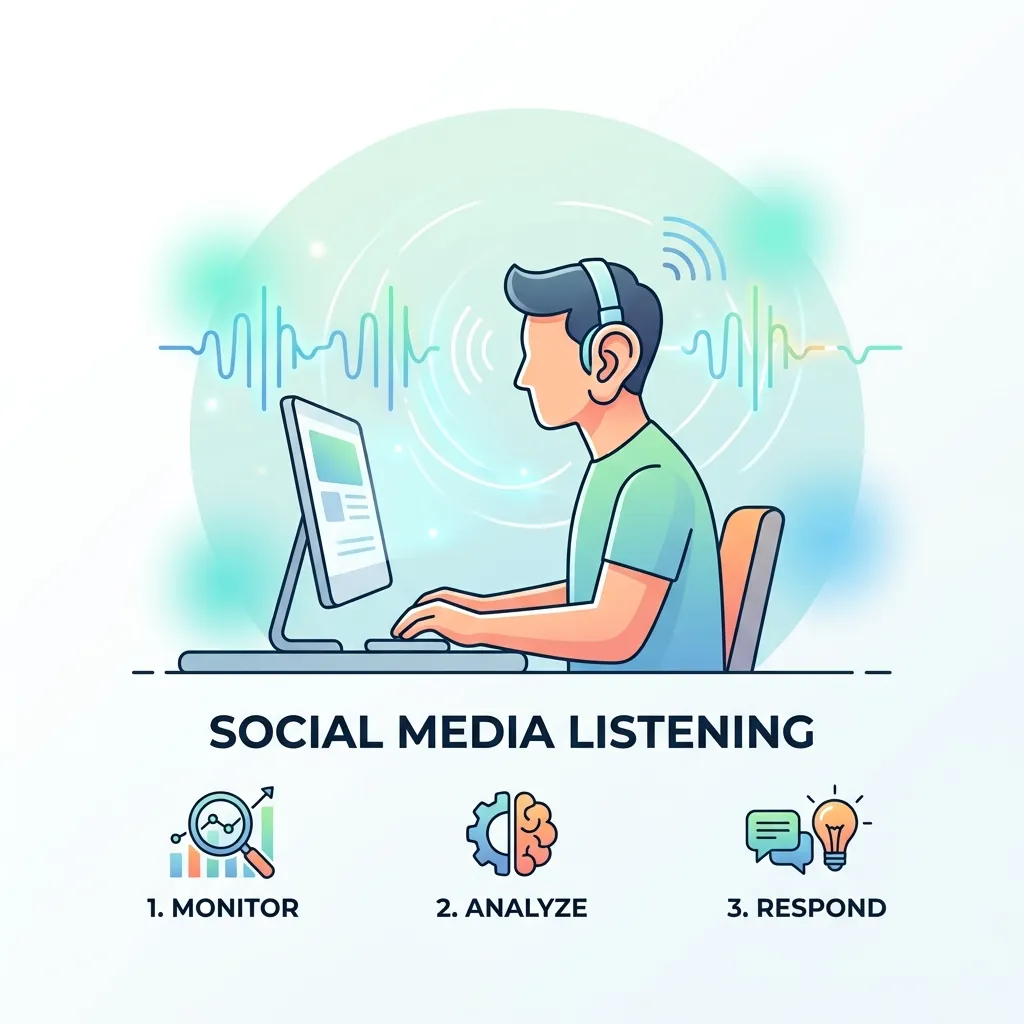
Understanding what social media listening involves in practice — and how it differs from just watching a notification feed — means understanding the pipeline behind it, which generally runs through a few consistent stages.
Data collection. Listening tools continuously pull data from social platforms, forums, review sites, and sometimes news coverage, based on tracked keywords, hashtags, and topics defined by the team using the tool.
Filtering and deduplication. Raw social data is noisy — duplicate posts, bot activity, and irrelevant matches (a brand name that’s also a common word, for instance) all need to be filtered out before the remaining data is useful.
Sentiment classification. Natural language processing models classify mentions as positive, negative, or neutral, giving a rough emotional read on each piece of conversation, though this classification isn’t perfect and benefits from human review, especially for sarcasm or niche industry language.
Theme and topic clustering. Beyond sentiment, listening tools group related conversations into themes — a spike in mentions about a specific feature, a recurring complaint pattern, a competitor comparison trend — that would be invisible looking at individual posts one at a time.
Reporting and interpretation. The final and most important stage is human interpretation. Raw sentiment scores and mention counts mean little without someone translating them into an actual recommendation or decision.
Social Media Listening vs. Monitoring: The Core Difference
This is the distinction most people ask about first when trying to understand what social media listening really is, since the two terms get used almost interchangeably in casual conversation despite describing different activities.
Monitoring is narrower and more tactical — tracking specific, defined mentions and hashtags, then responding to them individually. It’s largely reactive, often owned by a community management or customer support function, and measured by response time and resolution rate.
Listening is broader and more strategic — analyzing sentiment, themes, and patterns across a much wider set of conversation, including posts that never directly mention the brand. It’s proactive and analytical, typically owned by marketing, insights, or product teams, and measured by the quality of the strategic decisions it informs.
Most mature social programs run both simultaneously rather than choosing one over the other, since monitoring catches the individual moment that needs a response while listening reveals the pattern that moment belongs to.
What Kind of Data Does Social Media Listening Capture?
Understanding what social media listening captures helps clarify why it’s valuable beyond simple mention tracking. A well-configured listening program typically pulls in:
- Direct and indirect brand mentions, including common misspellings and abbreviations
- Product and feature-specific conversation, even when the brand itself isn’t named
- Competitor mentions and comparisons, including unprompted “versus” conversations
- Industry and category discussion, which reveals broader market sentiment a brand can position against
- Sentiment and emotional tone, distinguishing praise, complaints, and neutral commentary
- Emerging topics and trends, surfaced through volume spikes or newly recurring keywords before they become mainstream conversation
This breadth is what separates listening from a basic notification feed — it’s designed to surface conversation a team wouldn’t otherwise know existed, not just confirm conversation it already expected.
Why Understanding What Social Media Listening Does Matters for Strategy
Knowing the textbook definition of what is social media listening matters less than understanding what it actually enables in practice. A few concrete applications illustrate the value:
Early issue detection. Problems and complaints frequently surface on social media before they reach formal support channels, giving a brand a head start on addressing them before they escalate into a larger reputational issue.
More accurate messaging. Listening reveals the actual language customers use to describe a product, which is often noticeably different from the language a brand assumes they use internally.
Sharper competitive positioning. Understanding how competitors are discussed — including unprompted complaints and praise — provides positioning insight that’s difficult to obtain through formal research alone.
Grounded product decisions. Recurring feature requests and complaints, aggregated across thousands of organic conversations, frequently reveal product priorities that internal assumptions miss entirely.
Our companion guide on social media listening benefits expands on each of these applications with more detail on how different teams typically use the same underlying listening data for different purposes.
Common Misconceptions About What Social Media Listening Is
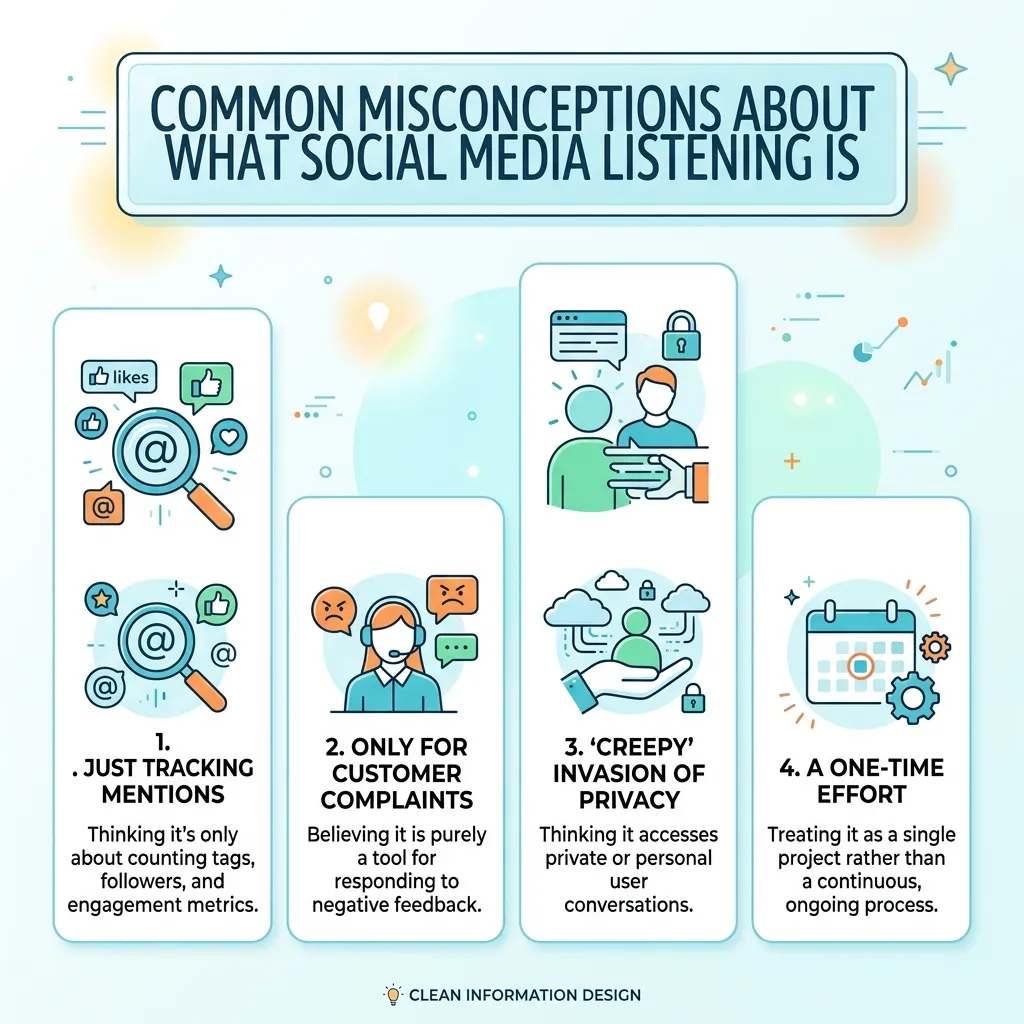
A few misunderstandings come up repeatedly when teams first try to answer what is social media listening for their own organization, and clearing them up early saves significant wasted effort.
“It’s the same as checking notifications.” Notifications only surface direct tags and mentions. Listening deliberately casts a much wider net, catching conversation about a brand, product, or category that never uses the brand’s actual handle or name.
“It’s only useful for large brands.” Conversation volume scales with audience size, but even small and mid-sized brands benefit from listening within their specific niche or local market, where the volume is naturally more manageable and the signal-to-noise ratio is often better than a large brand faces at scale.
“Sentiment scores tell the whole story.” Automated sentiment classification is a useful starting filter, not a final verdict. A post tagged “negative” by an algorithm might be sarcastic praise, and a post tagged “neutral” might contain a genuinely important complaint buried in measured language. Treating sentiment scores as a first pass rather than a conclusion avoids a lot of misread data.
“Once it’s set up, it runs itself.” Keyword lists, tracked topics, and competitor sets all need periodic review as language shifts and a business evolves. A listening setup configured once and never revisited slowly drifts out of alignment with what actually matters to track.
“It’s purely a marketing tool.” While marketing often owns the listening function, the most valuable insights frequently belong to product, support, or leadership teams who never see the raw data unless someone actively routes it to them.
Who Actually Uses Social Media Listening Data
Understanding what is social media listening also means understanding who benefits from it once the data exists, since the same underlying conversation data serves very different purposes depending on which team is looking at it.
Marketing teams use listening data to refine messaging, identify content opportunities, and track how campaigns land beyond simple engagement metrics. Product teams mine listening data for recurring feature requests and friction points that formal feedback channels miss. Customer support teams use it to spot emerging issues before ticket volume spikes. Executive and communications teams rely on listening for early warning on reputational risk, particularly around sensitive announcements or public statements. Competitive intelligence functions, where they exist, use listening to track how rivals are positioned and perceived without relying solely on official competitor communications.
This cross-functional value is exactly why listening data that stays siloed within a single team tends to underdeliver relative to its actual potential — the same dataset can inform decisions across an entire organization when it’s routed to the people who can act on it.
How to Tell If a Listening Program Is Actually Working
Because the value of social media listening shows up indirectly — in better messaging, earlier issue detection, sharper product decisions — it’s worth having a clear sense of what a functioning program looks like versus one that’s quietly stalled. A few signals are worth checking periodically.
A working program produces decisions, not just reports. If listening insights are being cited in actual planning conversations — a campaign brief referencing a sentiment trend, a product roadmap note referencing a recurring complaint — the program is doing its job. If the same dashboard gets generated every week but nobody can point to a decision it influenced recently, that’s a sign the insight isn’t reaching the people who need it, regardless of how sophisticated the underlying tool is.
A working program also evolves its tracked keywords and topics over time rather than running the exact same setup indefinitely. New product launches, shifting competitor sets, and evolving customer language all mean a listening configuration from a year ago is unlikely to still be fully accurate today. Periodically auditing what’s tracked, and why, keeps a program aligned with what actually matters to the business rather than what mattered when it was first configured.
Getting Started: What Social Media Listening Requires
Setting up a basic listening practice doesn’t require enterprise software from day one, though the requirements scale with a team’s ambitions.
Define the questions first. Before selecting keywords or tools, a team benefits from clarity on what decisions the data is meant to inform, since that shapes which conversations are actually worth tracking.
Choose keywords and topics deliberately. This includes brand names, common misspellings, product names, key competitor names, and category terms broad enough to catch relevant conversation the brand isn’t directly part of.
Pick a tool that matches actual scale. A small business tracking a few hundred mentions a month has very different tooling needs than an enterprise brand tracking hundreds of thousands. Our detailed guide to social listening tools breaks down what to look for at different scales.
Assign clear ownership. Listening data that nobody is responsible for reviewing tends to accumulate without ever informing a real decision, regardless of how sophisticated the underlying tool is.
For a fuller walkthrough of building this out as an ongoing program rather than a one-time setup, our guide on social media listening strategy covers cadence, escalation, and cross-team reporting in more depth. That’s the practical answer to what is social media listening in application, and this piece sits within our broader pillar guide to social media listening and monitoring, which connects this explainer to the full set of related strategy, tools, and specialized-use-case guides.
How This Connects to Broader Sentiment and Emotion Research

Social media listening doesn’t exist in isolation from the broader discipline of understanding how people feel about brands and products. An outside resource on emotion recognition in marketing covers the technical mechanics behind how sentiment and emotional tone get detected and classified in text and media more broadly, which underpins much of what listening tools do at the classification stage described earlier. A related piece on the psychology of advertising offers useful context on why the emotional tone captured through listening data matters so much for shaping messaging that actually resonates, rather than messaging that simply repeats brand talking points back at an audience that’s already tuned them out.
Conclusion
What is social media listening, at its core? It’s the practice of tracking and interpreting conversation across social platforms broadly enough to reveal patterns, sentiment, and emerging themes — not just confirming that someone mentioned a brand. Where monitoring keeps a brand responsive in the moment, listening builds the strategic picture that shapes messaging, product direction, and competitive positioning over time. Understanding the difference, and setting up tracking that captures the right breadth of conversation, is the foundation every other listening and monitoring practice builds on.
Frequently Asked Questions About Social Media Listening
1. What Is Social Media Listening in Simple Terms?
Social media listening is the practice of tracking and analyzing conversations across social platforms, including conversations that do not directly mention a brand. It helps businesses understand sentiment, themes, and patterns that can inform marketing and business strategy.
2. Is Social Media Listening the Same as Social Media Monitoring?
No. Social media monitoring is narrower and more reactive, focusing on specific mentions that may require an individual response. Social media listening is broader and more strategic, analyzing patterns across a wider range of conversations.
3. What Data Does Social Media Listening Actually Capture?
Social media listening can capture direct and indirect brand mentions, product and feature discussions, competitor comparisons, category conversations, sentiment, and emerging topic trends. The exact data available depends on the platforms and tools being used.
4. Do I Need Expensive Software to Start Social Media Listening?
Not necessarily. Basic social media listening can begin with simpler, lower-cost tools that match the volume and complexity of conversations a business needs to track. As the program becomes more sophisticated, businesses can scale to more advanced platforms.
5. How Accurate Is Sentiment Analysis in Listening Tools?
Sentiment analysis is useful but not perfect. Automated classification can handle straightforward language relatively well but may struggle with sarcasm, context, slang, and industry-specific terminology. Human review can therefore remain valuable when accuracy is important.
6. Who Typically Owns Social Media Listening Within a Company?
Ownership varies by organization. Marketing, customer insights, or product teams often manage strategic listening, while community management or customer support teams may handle day-to-day social media monitoring and responses.
7. Can Social Media Listening Detect Problems Before They Become a Crisis?
Yes, in many cases. Complaints, concerns, and emerging issues can appear on social media before they reach formal customer support channels. Monitoring these conversations can give teams an opportunity to investigate and respond before an issue grows.
8. How Is Social Media Listening Different From Customer Surveys?
Social media listening captures unprompted, organic conversations, while customer surveys collect responses to specific questions. Because they provide different types of information, the two approaches can complement each other rather than one completely replacing the other.
9. What’s the First Step in Setting Up a Social Listening Program?
The first step is to define the specific business questions the program needs to answer. These questions help determine which keywords, topics, competitors, audiences, and social platforms are worth tracking.
10. Can Social Media Listening Help With Competitor Research?
Yes. Tracking how competitors are discussed can reveal useful positioning insights, including recurring praise, complaints, product concerns, and customer expectations. This can complement information gathered through formal competitor research.
11. How Often Should Social Listening Data Be Reviewed?
The ideal frequency depends on the purpose. Urgent issues may require real-time attention, while strategic analysis is often more useful when patterns are reviewed weekly or monthly instead of reacting to individual daily fluctuations.
12. What’s the Most Common Mistake When Starting Social Media Listening?
One common mistake is setting up keyword tracking once and never reviewing it. Language, products, competitors, and customer discussions change over time, so listening queries should be regularly updated to maintain useful and accurate coverage.






Leave a Reply