

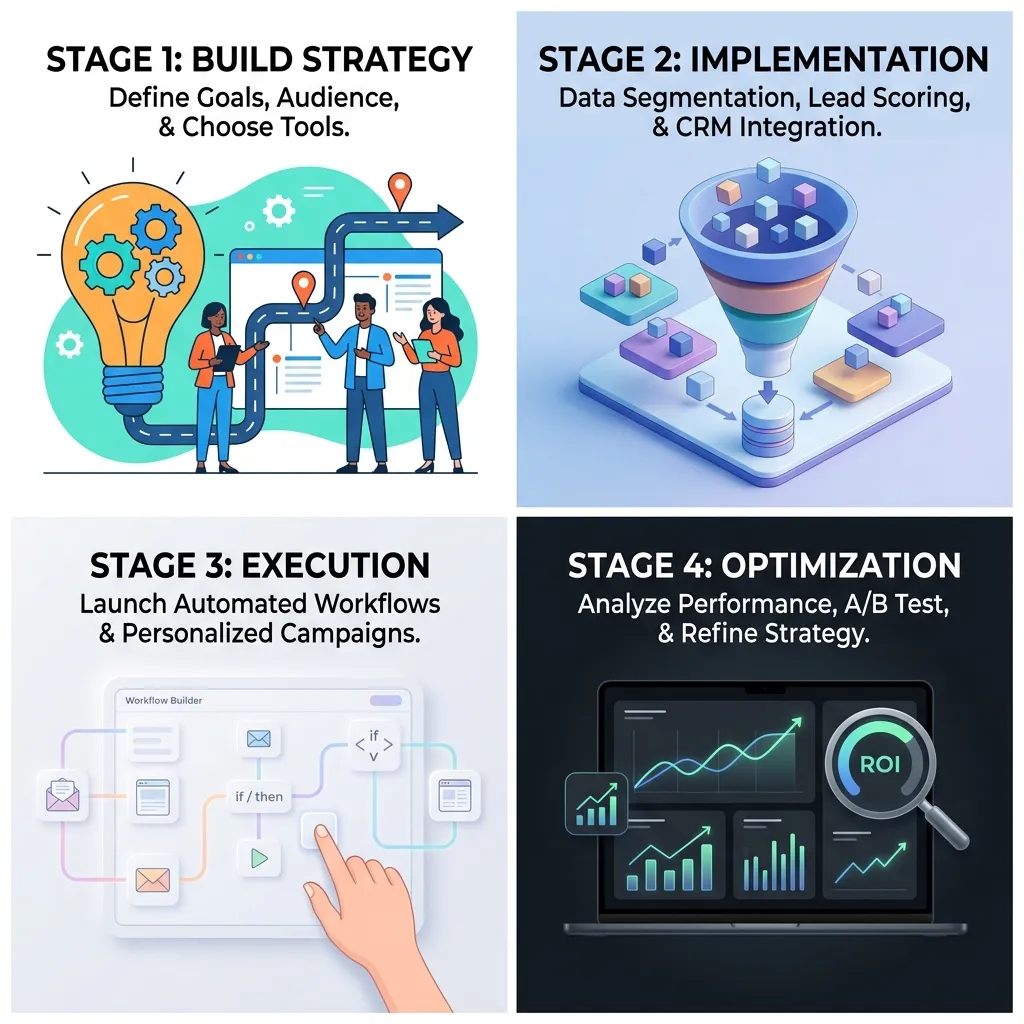
A marketing automation strategy is a structured plan for using automation technology to attract prospects, nurture leads, personalize customer communication, improve conversions, and retain customers. Instead of automating random marketing tasks, a strong strategy connects audience segmentation, customer journeys, workflows, content, CRM data, and performance measurement. This guide explains how to build a practical marketing automation strategy that supports sustainable business growth.
Marketing has become increasingly complex. Customers may discover a brand through search, interact with social media content, visit a website, download a resource, receive an email, compare products, and eventually make a purchase. Managing every interaction manually becomes difficult as an audience grows.
This is where a well-designed marketing automation strategy becomes valuable.
Marketing automation is not simply about scheduling emails or sending automatic messages. It is about creating a system that responds to customer behavior and delivers relevant communication at the appropriate stage of the buying journey.
For example, a new visitor might receive educational content after downloading a guide. If that person repeatedly visits product pages, the automation system can increase their lead score and trigger a more sales-focused sequence. After purchase, another workflow can support onboarding, collect feedback, and encourage repeat purchases.
The objective is to make marketing more timely, personalized, measurable, and scalable without removing the human element from customer relationships.
What Is a Marketing Automation Strategy?
A marketing automation strategy is a structured approach to planning, implementing, and optimizing automated marketing activities based on business objectives and customer behavior.
Instead of asking, “What can we automate?” marketers should ask:
“Which customer experience can automation improve?”
A strong strategy usually connects five major areas:
- Audience segmentation
- Customer journey mapping
- Automated workflows
- Personalized content
- Measurement and optimization
Automation should support the overall marketing strategy rather than operate as a separate technology project.
For businesses already developing an automation system, the existing Marketing Automation Complete Guide can provide broader background, while this guide focuses specifically on strategic planning and implementation.
Why Marketing Automation Strategy Matters
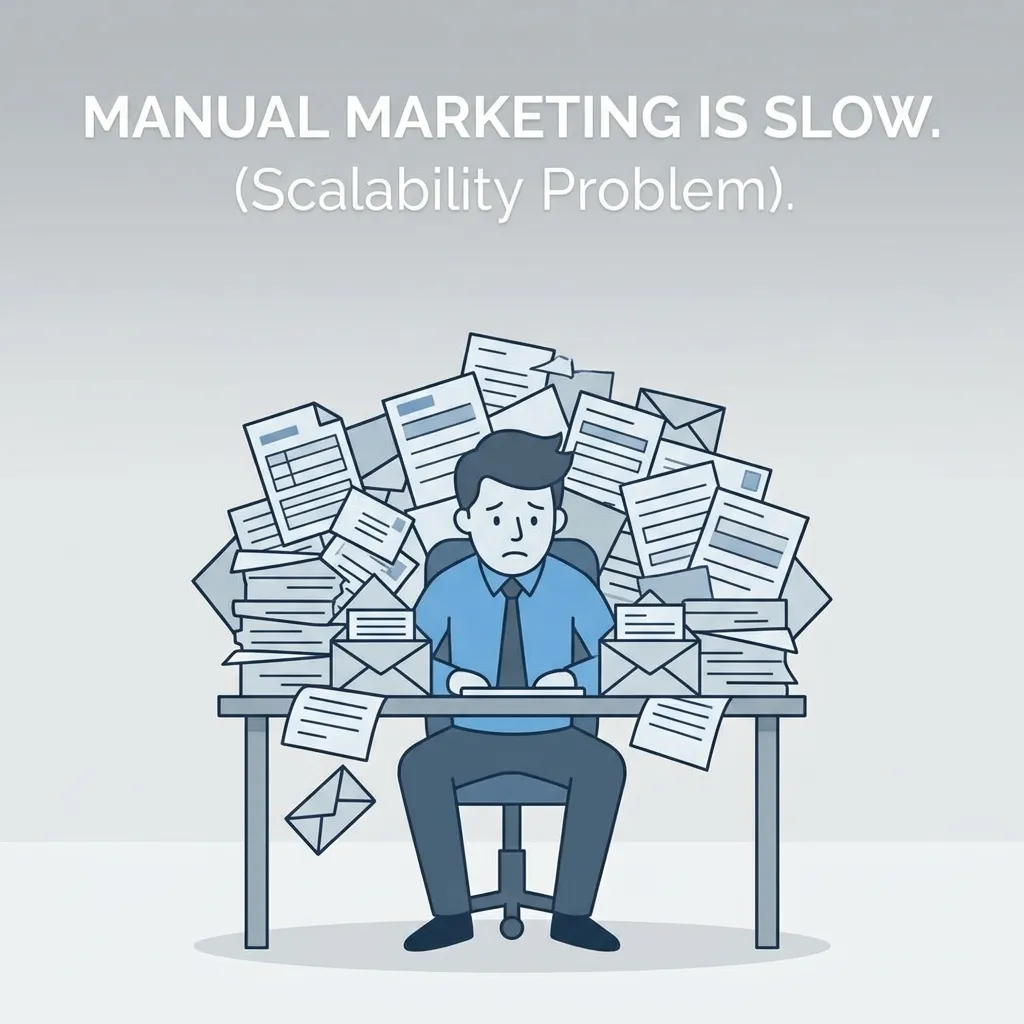
A marketing automation strategy helps businesses manage increasingly complex customer journeys without requiring marketers to manually manage every interaction.
1. Improves Marketing Efficiency
Repetitive activities such as welcome emails, lead follow-ups, reminders, segmentation, and reporting can consume significant amounts of time.
Automation allows marketers to create workflows once and let them operate continuously according to predefined rules.
This does not mean eliminating marketers. Instead, automation allows teams to spend more time on strategy, creative development, customer research, and optimization.
2. Creates More Consistent Customer Experiences
Without automation, communication can become inconsistent. One customer might receive several messages while another receives none.
Automation establishes predefined communication rules. When customers complete specific actions, they can receive appropriate follow-ups automatically.
Consistency becomes especially important when businesses have multiple campaigns, customer segments, and marketing channels.
3. Supports Personalization at Scale
Personalization becomes difficult when thousands of customers have different needs.
Automation makes it possible to segment audiences and create different communication paths.
A first-time visitor, returning customer, inactive subscriber, high-value customer, and sales-qualified lead should not necessarily receive the same message.
4. Improves Lead Nurturing
Not every prospect is ready to buy immediately.
Some need educational content, product comparisons, demonstrations, testimonials, or additional information before making a decision.
Automated nurturing workflows allow businesses to maintain communication until prospects show stronger purchase intent.
5. Makes Marketing More Measurable
A structured automation system can connect customer actions with marketing outcomes.
Businesses can analyze metrics such as engagement, conversion, lead progression, revenue contribution, and customer retention to understand which workflows are actually producing results.
Core Components of a Marketing Automation Strategy
A successful strategy requires more than an automation platform. The technology is only one part of the system.
Audience Segmentation
Segmentation determines who receives which message.
Businesses can segment audiences using information such as:
- Demographics
- Location
- Industry
- Customer status
- Purchase history
- Website behavior
- Email engagement
- Content interests
- Lead score
- Product usage
Behavioral segmentation is particularly useful because it reflects what people actually do rather than what they simply tell a business about themselves.
For example, someone who downloads a beginner’s guide may need educational content, while someone who visits a pricing page several times may be closer to conversion.
Customer Journey Mapping
Before creating workflows, map the customer journey.
A typical journey may include:
Awareness → Interest → Consideration → Conversion → Onboarding → Retention → Advocacy
Each stage requires different communication.
At the awareness stage, educational content may work best. During consideration, prospects may need comparisons, demonstrations, or case studies. After conversion, onboarding and customer support become more important.
Mapping this journey prevents marketers from creating disconnected automation campaigns.
Marketing Automation Workflows
Workflows are the operational foundation of automation.
A workflow defines:
- Trigger
- Audience
- Conditions
- Message
- Timing
- Next action
- Exit criteria
For example:
Trigger: User downloads an ebook
↓
Action: Send welcome email
↓
Wait: 2 days
↓
Condition: Did the user click?
↓
Yes: Send related case study
↓
No: Send educational article
↓
Engagement: Increase lead score
↓
High intent: Notify sales team
This type of logic turns customer behavior into meaningful marketing actions.
How to Build a Marketing Automation Strategy Step by Step
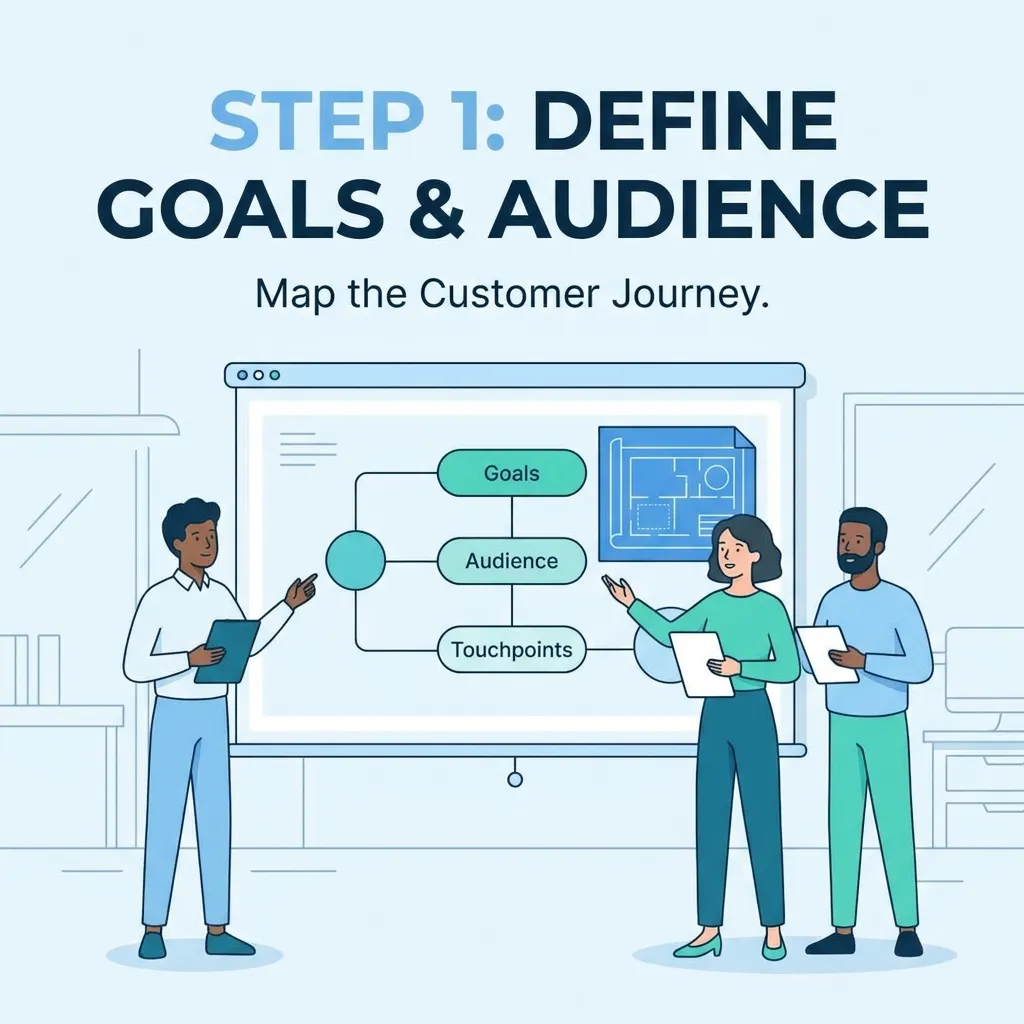
Step 1: Define Clear Business Goals
Start with business outcomes rather than software features.
Your objective might be to:
- Generate more qualified leads
- Increase conversion rates
- Reduce customer acquisition costs
- Improve retention
- Increase repeat purchases
- Shorten sales cycles
- Improve marketing efficiency
Every automation workflow should have a measurable purpose.
For example, “automate email marketing” is too broad. “Increase qualified demo bookings from nurtured leads” is much more strategic.
Step 2: Understand Your Target Audience
Automation becomes ineffective when the underlying audience research is weak.
Identify your ideal customers and understand their problems, motivations, objections, preferred channels, and buying behavior.
Develop useful customer segments rather than creating hundreds of tiny groups that are difficult to manage.
The goal is meaningful personalization, not unnecessary complexity.
Step 3: Audit Your Existing Marketing Process
Before automating anything, examine how marketing currently works.
Identify repetitive tasks, communication gaps, disconnected systems, manual handoffs, duplicate data, and areas where leads are being lost.
For example, if sales representatives manually follow up with every website inquiry, that process may contain opportunities for automated qualification and routing.
Step 4: Map the Customer Journey
Document the major customer touchpoints from first interaction through retention.
Ask:
- What happens when someone first discovers the brand?
- What happens after they subscribe?
- What content do prospects need before buying?
- When should sales become involved?
- What happens after purchase?
- How are inactive customers re-engaged?
The answers become the foundation for workflow development.
Step 5: Select the Right Automation Channels
Automation can support multiple channels, including email, SMS, social media, websites, paid advertising, push notifications, and CRM activities.
However, using every available channel is not necessarily a good strategy.
Choose channels based on customer behavior and business objectives.
For mobile-focused campaigns, marketing automation can also support real-time campaign management, push notifications, personalization, and engagement tracking. A useful cross-site resource is Marketing Automation Mobile Apps.
Step 6: Create Trigger-Based Workflows
Triggers determine when automation begins.
Common triggers include:
- Form submission
- Newsletter signup
- Product purchase
- Cart abandonment
- Content download
- Webinar registration
- Email engagement
- Website behavior
- Trial expiration
- Inactivity
- Customer milestone
The best triggers are closely connected to customer intent.
Step 7: Develop Relevant Content
Automation cannot compensate for poor content.
Every workflow needs content that matches the user’s stage, needs, and behavior.
For example, a lead who downloads an introductory guide should not immediately receive an aggressive sales pitch.
A better sequence could introduce the problem, provide educational resources, explain possible solutions, demonstrate value, and then present an appropriate offer.
Step 8: Connect CRM and Marketing Data
Your automation platform should work with the rest of your marketing technology stack.
CRM integration can help marketing and sales teams maintain a shared understanding of leads and customers.
For larger organizations, clean data becomes particularly important. Inconsistent names, duplicate contacts, missing fields, or incorrect lifecycle stages can cause automation workflows to behave incorrectly.
Marketing and communications teams can also benefit from a broader data-driven communications strategy that connects automation, analytics, CRM data, and customer journeys.
Step 9: Define Lead Scoring Rules
Lead scoring helps businesses identify prospects who demonstrate stronger buying intent.
A scoring system might assign points for:
- Opening an email
- Clicking a campaign
- Downloading high-value content
- Visiting pricing pages
- Requesting a demo
- Attending a webinar
- Returning to the website
Negative scoring can also be useful when leads become inactive or unsubscribe from communication.
The goal is not to create a complicated mathematical system. The goal is to provide a useful signal that helps determine what should happen next.
Essential Marketing Automation Workflows
Not every business needs dozens of workflows. A smaller number of well-designed journeys can often produce better results.
Welcome Workflow
A welcome sequence introduces new subscribers or leads to the brand.
The first message should confirm the relationship and deliver the expected value. Follow-up messages can introduce helpful resources, products, services, or educational content.
Lead Nurturing Workflow
Lead nurturing keeps prospects engaged until they are ready to take the next step.
Educational articles, case studies, webinars, product information, and customer stories can be used throughout the sequence.
Abandoned Cart Workflow
For ecommerce businesses, cart abandonment automation can remind customers about products they considered but did not purchase.
The timing and message should feel helpful rather than intrusive.
Re-Engagement Workflow
Inactive subscribers should not remain in every campaign indefinitely.
A re-engagement workflow can identify inactive contacts, offer useful content or incentives, and eventually remove contacts who consistently show no interest.
This improves database quality and reduces unnecessary communication.
Post-Purchase Workflow
Automation should not stop after conversion.
Post-purchase workflows can support:
- Order communication
- Product education
- Onboarding
- Feedback collection
- Cross-selling
- Upselling
- Review requests
- Loyalty campaigns
This turns automation into a customer relationship system rather than merely a lead-generation mechanism.
Personalization in Marketing Automation
Personalization is one of the strongest advantages of automation, but effective personalization goes beyond inserting a customer’s name into an email.
A better approach uses behavioral and contextual information.
For example, an online retailer could recommend products based on browsing behavior, previous purchases, or category interests.
A B2B company could customize content based on industry, company size, job role, or funnel stage.
The principle is simple:
Use customer data to make communication more relevant, not merely more automated.
Dynamic content can also allow different segments to receive different messages within the same campaign.
Marketing Automation and Omnichannel Strategy
Customers rarely follow a single-channel journey.
Someone may discover a brand through search, interact with a social post, visit the website, subscribe to email, and later respond to an advertisement.
A strong automation strategy coordinates these interactions.
For example:
Search visit → Content download → Email nurture → Webinar → Lead scoring → Sales notification → Purchase → Onboarding
The channels remain different, but the underlying customer journey is connected.
This is why automation should be designed around customer journeys rather than individual campaigns.
How to Measure Marketing Automation Strategy Success
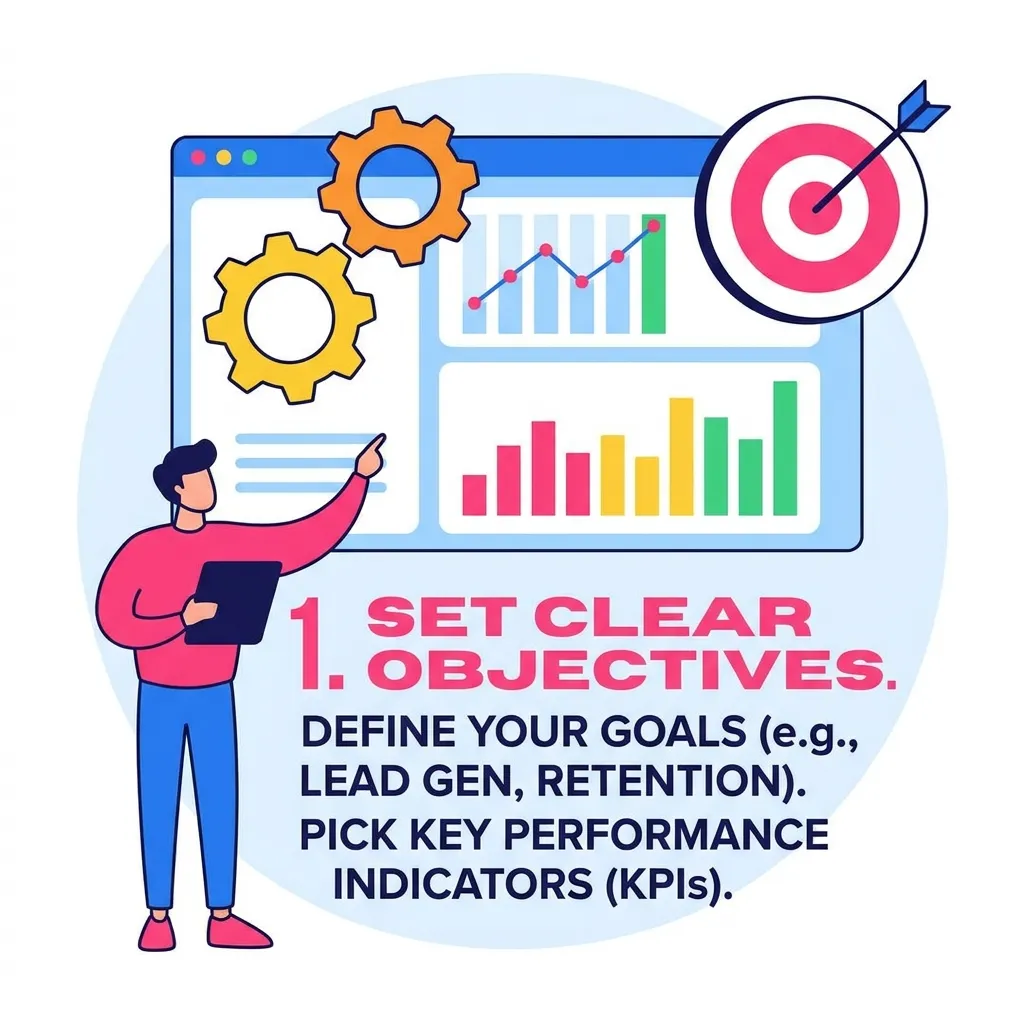
Automation should always be measured against business outcomes.
Engagement Metrics
Monitor:
- Email click-through rate
- Content engagement
- Website interactions
- Workflow completion
- Unsubscribe rate
These metrics indicate whether customers are responding to your communication.
Conversion Metrics
Track:
- Lead-to-customer conversion
- Demo bookings
- Form submissions
- Purchase rate
- Trial-to-paid conversion
These metrics are more closely connected to revenue.
Revenue Metrics
Advanced programs should measure:
- Revenue generated by campaigns
- Customer lifetime value
- Average order value
- Customer acquisition cost
- Return on marketing investment
Revenue attribution becomes especially useful when customers interact with multiple campaigns before purchasing.
Workflow Performance
Every automation should be reviewed individually.
A workflow may have excellent email engagement but produce very few qualified leads. Another may have modest click rates but generate significant revenue.
Therefore, avoid judging automation only by surface-level engagement metrics.
Common Marketing Automation Mistakes
Automating Too Much Too Quickly
Automation should follow a clear process.
If the underlying customer journey is confusing, automating it simply makes the confusion happen faster.
Sending Too Many Messages
More automation does not necessarily mean better marketing.
Excessive messages can create fatigue, increase unsubscribes, and damage customer trust.
Ignoring Data Quality
Poor data can produce poor personalization and incorrect workflow decisions.
Regularly review duplicate contacts, incomplete fields, outdated information, and incorrect segmentation.
Creating Complicated Workflows
A workflow with dozens of branches can become difficult to understand and maintain.
Start with simple logic and expand only when the additional complexity creates measurable value.
Forgetting the Human Element
Automation should support human relationships rather than replace them.
High-value leads, complex customer issues, and sensitive situations often require personal interaction.
How to Optimize a Marketing Automation Strategy
Optimization should be continuous.
Start by identifying the workflows responsible for the most important business outcomes.
Then test different elements such as:
- Subject lines
- Content
- Timing
- CTAs
- Offers
- Segmentation
- Workflow conditions
- Follow-up frequency
A/B testing can reveal which version performs better.
However, testing should have a clear hypothesis. Instead of randomly changing an email, determine what you expect to improve and measure the result.
Over time, underperforming workflows can be redesigned, successful workflows can be expanded, and unnecessary automation can be removed.
Marketing Automation Strategy for Different Business Models
B2B Businesses
B2B companies often have longer buying cycles.
Their strategy may focus on lead nurturing, content education, lead scoring, sales alerts, webinar follow-ups, and CRM integration.
Ecommerce Businesses
Ecommerce automation commonly focuses on product discovery, abandoned carts, post-purchase communication, cross-selling, upselling, and customer retention.
SaaS Businesses
SaaS companies can automate free-trial onboarding, product education, feature adoption, upgrade campaigns, renewal reminders, and inactive-user re-engagement.
Small Businesses
Small businesses should prioritize simple, high-impact workflows instead of attempting to automate every customer interaction.
A welcome sequence, lead nurture campaign, appointment reminder, and post-purchase workflow can provide a strong foundation.
For additional small-business automation considerations, see the existing Marketing Automation for Small Business resource.
The Future of Marketing Automation Strategy
Marketing automation is moving toward increasingly intelligent and adaptive systems.
AI can help marketers analyze customer behavior, identify patterns, generate content variations, predict likely actions, and improve personalization.
However, AI should support strategic decision-making rather than replace it.
The future of automation is likely to focus on connected customer journeys where CRM systems, analytics, content, advertising, websites, and automation platforms share information.
The winning strategy will not necessarily be the one with the most automation. It will be the one that creates the most useful customer experience with the least unnecessary friction.
Marketing Automation Strategy Checklist
Before launching your strategy, confirm that you have:
- Defined measurable business objectives
- Identified priority customer segments
- Mapped the customer journey
- Audited existing marketing processes
- Selected relevant automation channels
- Created trigger-based workflows
- Developed appropriate content
- Connected CRM and marketing data
- Established lead scoring rules where necessary
- Defined KPIs
- Tested workflows before launch
- Created a continuous optimization process
Conclusion
A successful marketing automation strategy is much more than a collection of automated emails. It is a coordinated system that connects customer data, segmentation, content, workflows, channels, sales processes, and measurement.
The most effective approach starts with customer needs and business goals. From there, marketers can map the customer journey, identify repetitive processes, build relevant workflows, personalize communication, and measure outcomes.
Start with a few high-impact workflows rather than trying to automate everything at once. Once the foundation is working, use data and customer feedback to expand and optimize the system.
When automation is strategic rather than purely technological, it can improve efficiency, strengthen customer relationships, increase conversions, and create a scalable marketing engine.
Frequently Asked Questions
1. What is a marketing automation strategy?
A marketing automation strategy is a structured plan for using automation technology to manage customer communication, lead nurturing, personalization, conversion, and retention based on defined business objectives.
2. Why is marketing automation strategy important?
It helps businesses scale marketing activities, maintain consistent communication, personalize customer experiences, improve lead nurturing, and measure marketing performance more effectively.
3. What are the main components of a marketing automation strategy?
The main components include audience segmentation, customer journey mapping, workflow design, personalized content, CRM integration, lead scoring, channel coordination, and performance measurement.
4. How do I create a marketing automation strategy?
Start by defining business goals, researching your audience, auditing current processes, mapping customer journeys, selecting relevant channels, building workflows, creating content, connecting data systems, and establishing KPIs.
5. What marketing tasks can be automated?
Common tasks include welcome emails, lead nurturing, customer onboarding, abandoned-cart reminders, appointment reminders, segmentation, lead scoring, re-engagement campaigns, reporting, and post-purchase communication.
6. Does marketing automation replace marketers?
No. Marketing automation handles repetitive and rule-based activities so marketers can focus more on strategy, creativity, analysis, customer research, and relationship building.
7. How does marketing automation improve personalization?
Automation uses customer information and behavior to determine which content, offer, message, or workflow a person should receive, allowing businesses to personalize communication at scale.
8. What is a marketing automation workflow?
A marketing automation workflow is a sequence of automated actions triggered by a customer event or condition. It can include messages, waiting periods, segmentation, scoring, notifications, and follow-up actions.
9. How does CRM integration support marketing automation?
CRM integration allows marketing automation systems to use customer and lead information for segmentation, personalization, lead scoring, sales handoffs, and performance reporting.
10. How can I measure marketing automation success?
Measure engagement, conversion, workflow performance, customer retention, revenue contribution, customer acquisition cost, and return on marketing investment. Choose metrics that match your business goals.
11. What are the biggest marketing automation mistakes?
Common mistakes include automating unclear processes, sending excessive messages, ignoring data quality, creating unnecessarily complicated workflows, using weak content, and removing human interaction from important customer relationships.
12. Is marketing automation suitable for small businesses?
Yes. Small businesses can benefit from automation by starting with a few high-value workflows such as lead nurturing, welcome sequences, appointment reminders, and post-purchase communication.





Comments (7)
Marketing Automation Best Practicessays:
September 12, 2026 at 12:12 pm[…] visited, products viewed, content downloaded — and tailors the message accordingly. Our guide on marketing automation strategy covers how to build this kind of behavior-based personalization directly into your workflow logic […]
Marketing Automation Campaigns: The Complete Guidesays:
September 13, 2026 at 9:57 am[…] a deeper foundation before building your first workflow, see our marketing automation strategy guide, or explore marketing automation best practices to refine campaigns you’ve already […]
AI Marketing Automation: The Complete Guidesays:
September 13, 2026 at 10:16 am[…] the foundational strategy that AI builds on top of, see our marketing automation strategy guide, or explore marketing automation best practices before layering in predictive […]
Marketing Automation and CRM Integration: The Complete Guidesays:
September 14, 2026 at 8:38 am[…] makes sense only when your data model has requirements neither native option supports. Our guide on building a marketing automation strategy covers how to evaluate this decision as part of a broader platform […]
Marketing Automation for SaaS: Complete Guidesays:
September 14, 2026 at 9:07 am[…] For additional guidance on building a structured automation approach, see marketing automation strategy. […]
Best Marketing Automation Software: The Complete Guidesays:
September 15, 2026 at 9:43 am[…] software second, since automating a poorly defined process just scales the confusion faster. Our guide to building a marketing automation strategy is a useful starting point before evaluating specific platforms, since the right tool becomes far […]
Marketing Automation Software Comparison: How to Choosesays:
September 16, 2026 at 11:15 am[…] the decision instead of actual business needs. Documenting these use cases alongside a broader marketing automation strategy ensures the eventual software choice supports where the marketing function is actually headed, not […]